



At the intersection of geopolitics and financial markets, the most intriguing paradox of the modern semiconductor sector is unfolding. The official policy of global superpowers has collided with the brutal reality of market demand, creating a tryst-like impasse between Washington, Beijing, and Nvidia. Instead of a complete decoupling of both economies, we are witnessing a hybrid model of interdependence, where official political narratives completely diverge from the actual needs of the economy and the defense sector.
A Game of Shadows: Official Blockade vs. Military Smuggling
On one hand, Beijing is forcing the development of domestic AI capabilities, ordering local businesses to independent themselves from Western tech and heavily backing domestic players like Huawei. On the other hand, reality ruthlessly exposes the massive technological gap that still separates China from the West. Recent media reports confirm that entities directly linked to the Chinese military and elite defense universities are actively seeking ways to acquire Nvidia chips through unofficial channels. This clearly demonstrates that for critical military applications and scientific data analysis, American silicon remains simply irreplaceable at this moment.
A Three-Way Market Impass
This deep divide creates a fundamental market tension, with each key player moving in completely opposite directions. US-based Nvidia aims to maintain access to one of the largest and most lucrative target markets in the world. Chinese buyers, regardless of political barriers and official decrees from their own government, desperately need American technology to avoid losing the AI arms race. Meanwhile, the US administration rigorously blocks the transfer of the latest silicon architectures, treating them as an absolute priority for national security.
The Global Supply Chain Knows No Borders
An additional piece of this complex puzzle comes from sobering assessments straight from within the semiconductor industry itself. The CEO of Arm Holdings pointed out that a total ban on AI technology exports to China might prove practically unfeasible for the US government. The global, highly fragmented trade structure, an extensive network of third-country intermediaries, and the growing capacity of Asian entities to bypass restrictions (e.g., via cloud leasing) render 100% control over the flow of advanced chips an illusion.
The Bull Case: Nvidia's Structural Advantage
For growth-oriented investors, the situation in China serves as ultimate proof of the massive, almost unreplicable economic moat surrounding Nvidia. Demand for Blackwell or H200 series architectures is fundamental and, at least for now, irreplaceable. Since the Chinese military prefers risking an international scandal to buy these products on the black market rather than utilizing readily available domestic alternatives, it sends a clear signal to NVDA shareholders that the company's leadership remains entirely unchallenged. If demand cannot fit into official distribution channels, the market finds a way regardless.
The Bear Case: Regulatory and Political Risks
However, more cautious investors must remember that this geopolitical gridlock generates massive long-term risks. Every subsequent report of Beijing bypassing sanctions will force Washington to introduce even harsher restrictions, penalize intermediaries, and tighten export blockades. Even though demand in China is immense, being officially cut off from legal revenue in this market forces Nvidia into a perpetual balancing act on the edge of compliance. Should the US-China conflict escalate further, it could trigger sudden and deep volatility in the company's stock price.
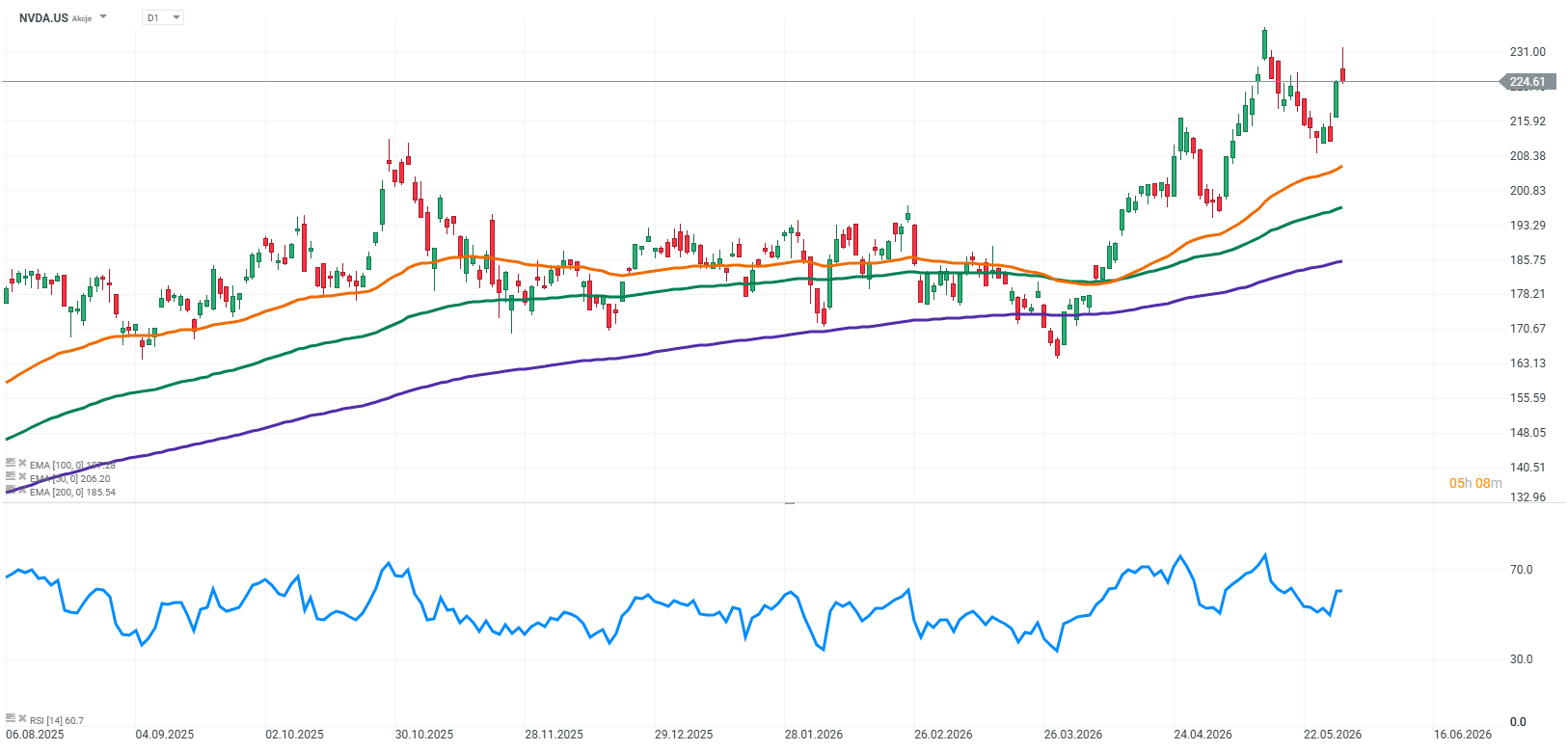
Source: xStation5



Market Wrap: A 4% surge in oil prices weighs on indices (08.10.2026)


🚩 Caterpillar shares extend decline, down 30% from record high


Webull shares down 20% amid fears over potential China ties



US Open: Wall Street in the Red 🚩 Nasdaq Falls 1% From Record Highs, Constellation Brands Back at March 2020 Level