


- The Bank of Canada raised its overnight rate by 25 bps to 2.50 percent.
- Policymakers acted to stop high energy prices from spreading to broader goods.
- USDCAD trades near 1.4040 following a correction to the 61.8 percent Fibonacci retracement.

- The Bank of Canada raised its overnight rate by 25 bps to 2.50 percent.
- Policymakers acted to stop high energy prices from spreading to broader goods.
- USDCAD trades near 1.4040 following a correction to the 61.8 percent Fibonacci retracement.
The Bank of Canada raised its overnight rate by 25 bp to 2.50% on Wednesday, its first hike in more than three years. The decision matched market expectations and the Bloomberg consensus. The bank said it acted to stop high energy prices from spreading to the prices of other goods and services. It also said further hikes “could” be needed, but that it will “proceed carefully” and decide “one meeting at a time”.
Key takeaways
- Rate hike: up to 2.50% from 2.25%, in line with market expectations
- Inflation forecast raised sharply: CPI is seen at 3.5% by end-2026 and 3.1% in 2027 (previously 2.0%), returning to the 2% target only by mid-2028.
- Growth upgraded: GDP is forecast at 1.0% in 2026 (previously 0.7%) and around 2% in 2027–2028, supported by business investment and PM Carney’s tax incentives.
- Oil: the bank expects energy prices to stay high through 2026 and sees “no clear path” to resolving the Middle East conflict. Brent is just below $115.
- Holding was considered: policymakers pointed to inflation concentrated in energy, remaining slack in the economy and US tariffs.
Commentary
This was a defensive hike against an energy shock rather than the start of a tightening cycle. The hike itself was hawkish, but the guidance was cautious, and Macklem admitted the bank discussed holding. The upgraded inflation forecasts explain why the bank moved. Even so, Canada has lost jobs for two straight months, housing is weak and tariffs remain a drag, which leaves limited room for further hikes. For the loonie, the Fed’s tone tonight may matter as much as the BoC decision itself.
USDCAD technical analysis
USDCAD trades near 1.4040 and reacted little to the decision. After the October high near 1.4300, the pair broke below its rising trendline and corrected to the 61.8% Fibonacci retracement near 1.3965, where buyers stepped in. It now holds just above the 50% retracement at about 1.4030.
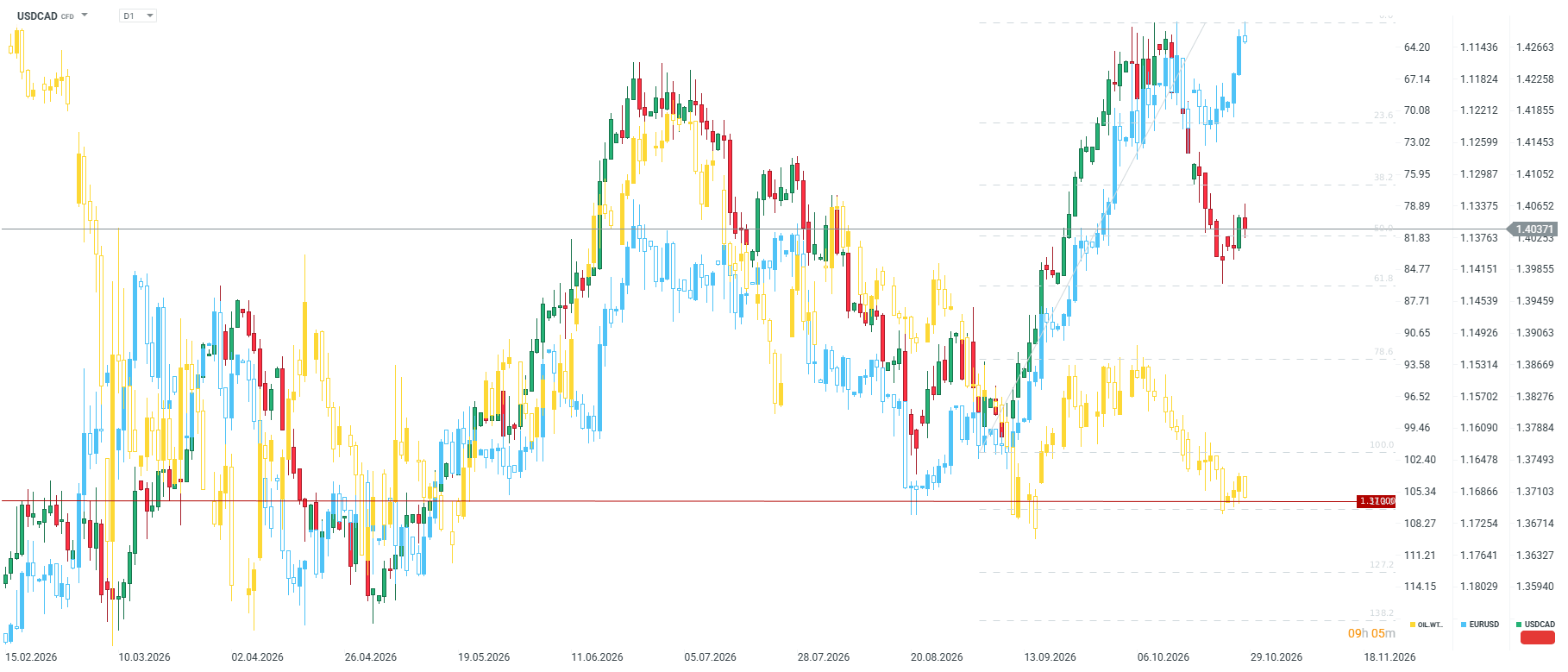
A break above 1.4100 would point to a return towards the October highs, especially if the Fed sounds hawkish. A close below 1.3965 would open the way to 1.3875. Oil and the Fed–BoC rate differential remain the key drivers.



Market Wrap: Renewed confidence in AI drives stock market recovery (27.10.2026)



📈Daily Summary: Falling Oil Prices and Anthropic Prospectus Drive Markets


Chart of the day: European gas ever closer to 100 EURMWh


Economic Calendar - German Ifo index, Middle East escalation, and Wall Street giants' earnings