

-
Hawkish but Outdated: March minutes revealed the Fed considered rate hikes due to high oil, but today's $90 crude and Iran truce make this scenario less likely.
-
Stagflation Trap: The Fed is paralyzed by "two-sided risk"—fearing entrenched inflation from energy shocks while warning that labor market fragility could cause a spike in unemployment.
-
Market "Fade": The Dollar and indices ignored the hawkish tone as investors dismissed old March data, focusing instead on whether the 14-day Persian Gulf ceasefire holds.

-
Hawkish but Outdated: March minutes revealed the Fed considered rate hikes due to high oil, but today's $90 crude and Iran truce make this scenario less likely.
-
Stagflation Trap: The Fed is paralyzed by "two-sided risk"—fearing entrenched inflation from energy shocks while warning that labor market fragility could cause a spike in unemployment.
-
Market "Fade": The Dollar and indices ignored the hawkish tone as investors dismissed old March data, focusing instead on whether the 14-day Persian Gulf ceasefire holds.
- The return of the hike specter: "Many" participants judged that persistently high oil prices could lead to an inflationary surge, which might later require rate hikes, while "some" proposed a "two-sided" description of future decisions that would officially include the possibility of tightening.
-
Asymmetric risks: A "vast majority" sees the risk of higher inflation while simultaneously identifying risks to employment, which theoretically could pave the way for a return to rate cuts in the future.
-
Labor market fragility: The Fed used remarkably direct language, warning that in a low-hiring environment, any further decline in labor demand could lead to a "sharp increase" in unemployment.
-
Middle East uncertainty: "Most" members felt it was too early to assess the conflict's impact on the U.S. economy, but they fear a protracted war could hit the labor market so hard that cuts might become necessary.
-
Forecasting errors: Fed staff assumed "only a small effect" from oil prices and stock market declines on the economy, which appears to be an overly optimistic forecast given March fuel prices.
-
Private Credit risks: The Fed noted an increase in redemption requests in credit funds and concerns about the software sector's exposure to AI-driven disruptions.
-
The Fed’s "crossfire" trap: Risks of increased inflation versus potential labor market weakness.
Today's Minutes are a record of discussions from a meeting that took place after the war in Iran had begun, but before the major escalation occurred, making the situation difficult to assess at the time. Nevertheless, the communication shifted to a more hawkish tone, and the minutes indicate an even more hawkish stance. Although mentions of hikes were included, it is worth noting that severe labor market problems could simultaneously lead to cuts. The Fed appears well-positioned, but the risk of stagflation is rising.
The Fed's key dilemma is a "two-sided trap":
-
On one hand, energy inflation (oil averaged around $100 in March) tempts hawks to hike rates to prevent an unanchoring of inflation expectations.
-
On the other hand, the labor market is becoming fragile. The Fed notes that job growth is concentrated in only a few sectors (e.g., healthcare), making the rest of the economy vulnerable to a sudden cooling.
What does this mean for markets in the context of today's truce? The Minutes show that the Fed is clearly concerned about inflation. However, today’s ceasefire (April 7) and the drop in oil to $90–$95 act as a "circuit breaker." If oil stays below $100, arguments for rate hikes will likely vanish quickly from the agenda, and the FOMC's focus will shift back to saving the weakening labor market.
The Minutes confirm that the Fed is currently "paralyzed." The market is pricing in less than a 50% chance of a cut, and given current uncertainty, there is a growing chance the Fed will decide that interest rates are already at the appropriate level.
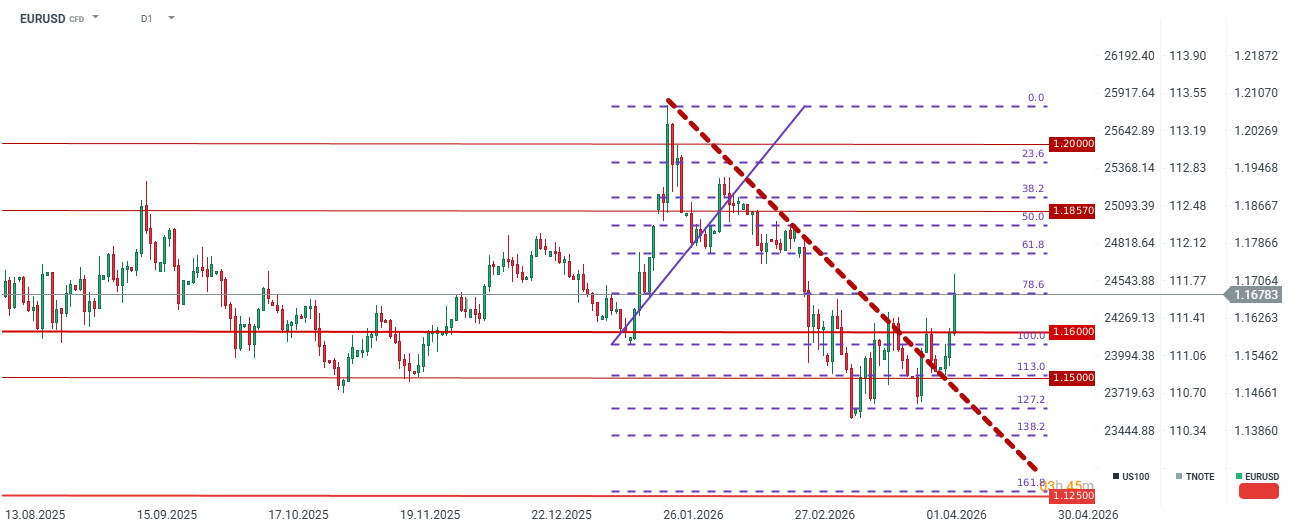
What is the final verdict? A hawkish tone in theory, but "outdated" in practice. Although the Minutes threaten hikes, today’s truce with Iran means markets will likely "fade" this signal, focusing instead on whether peace in the Persian Gulf survives the next two weeks. If the truce collapses, the hike scenario described in the Minutes will become the dominant market theme. In response, we are seeing essentially no major movement in EURUSD or U.S. indices.



Daily Summary: Rising inflation weighs on markets, semiconductors suffer most (14.10.2026)


US Open: CPI reading weighs on American indices (14.10.2026)
US inflation concerns rise

Economic Calendar - Start of Wall Street Earnings Season, Hawkish RBA, and Middle East Tensions (13.10.2026)