



The USDCAD exchange rate erases today's gains in response to Canada's trade retaliation. Just a day after the U.S. announced 50% tariffs, Canada announced a series of "dollar-for-dollar" duties, matching the scale of the burden to the "$20 billion bill" handed out by the U.S.
Why is Canada imposing retaliatory tariffs?
The decision came after negotiations with the U.S. regarding the USMCA North American trade agreement ended in failure. President Trump accused Canada of freeloading off the U.S. and "enjoying statehood privileges without wanting to join the U.S.," subsequently imposing 50% tariffs on goods worth a total of $20 billion on its neighbor.
Canadian Prime Minister Mark Carney warned that the attack would not go unanswered and the market did not have to wait long for concrete details. Canadian Finance Minister François-Philippe Champagne announced today a series of retaliatory tariffs ranging between 15% and 50% on a proportional $20 billion in U.S. goods.
Canada targets U.S. consumer goods
According to a Bloomberg report, the new tariffs will cover over 700 U.S. goods, chosen to allow for easy local substitutes without disrupting consumer habits. Among the products are seafood, kitchen appliances, air conditioning, and furniture. The highest rate of 50% will apply to industrial metals (steel and aluminum), dairy, cosmetics, and leisure goods (video game consoles, golf clubs, fishing rods).
Technical Analysis: USDCAD (D1)
The USDCAD exchange rate followed falling oil prices today (OIL, light blue, inverted), which further weakened the commodity-linked Canadian dollar. However, the trade retaliation reversed the situation in favor of CAD, partially balancing the potential for economic damage across both economies. The price turned back below the 23.6% Fibonacci retracement level, once again hugging the 10-day exponential moving average (EMA10; yellow). The RSI sits just above oversold territory, keeping the potential for CAD appreciation limited. A further drop in oil prices should be the primary driver of volatility for the pair now that the market has digested the return of the trade war between the neighbors. Last week's low near 1.3730 remains key support for the pair, while a continuation of gains will require a close above the EMA10.
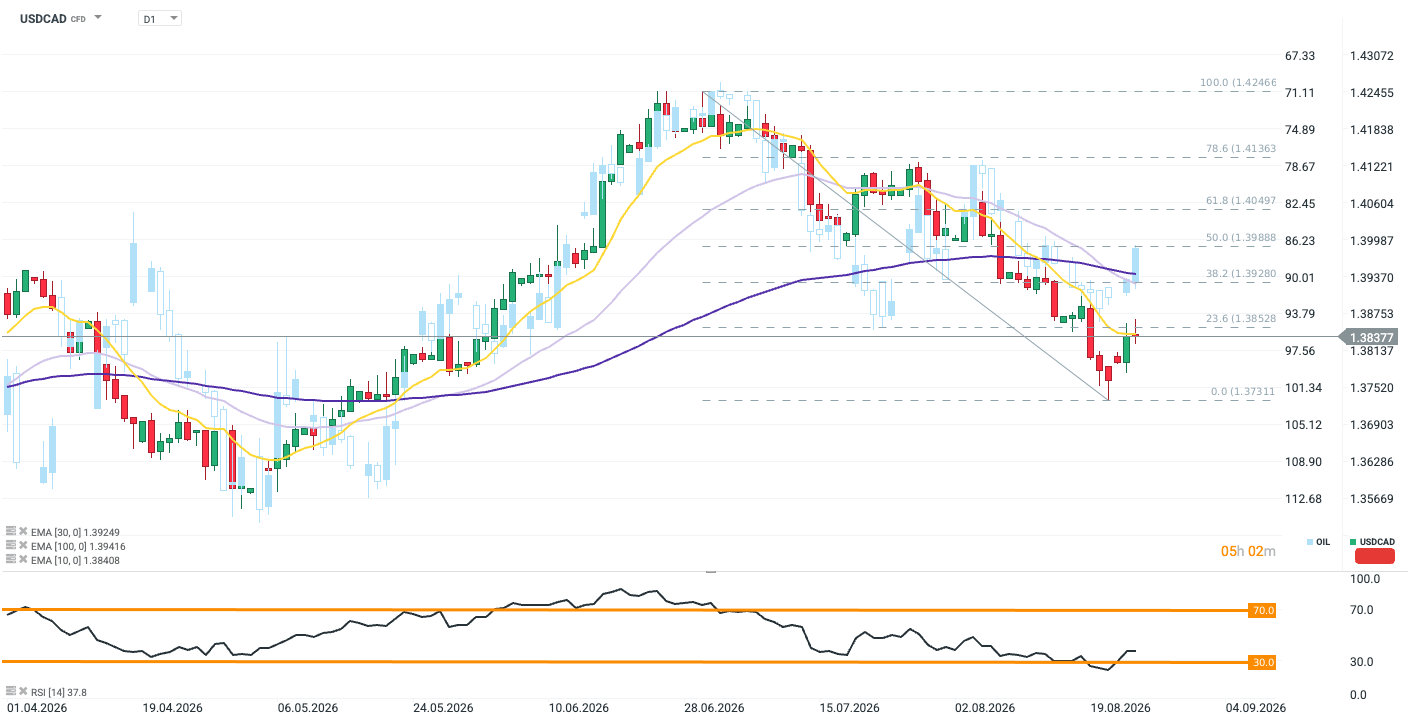
Source: xStation5



Gold Falls Below $4,000


Chart of the Day: USDJPY Caught in a Trap. Tokyo Intervention and a Hawkish BoJ Loom



Economic Calendar: Conference Board Consumer Confidence and US Data in focus

Morning Wrap: Wall Street Rises on Anthropic News, Asian Markets Surge