



Despite blockbuster Q2 earnings and upgraded full-year guidance from TSMC, Nasdaq futures are trading lower. A classic "sell the news" reaction to TSMC is being heavily compounded by a sudden, severe geopolitical escalation in the Persian Gulf. This double-whammy of valuation fatigue and a fresh energy supply shock is accelerating a "risk-off" rotation across global markets and the skepticism already visible in the AI related stocks.
Technical Analysis: US100 (H1)
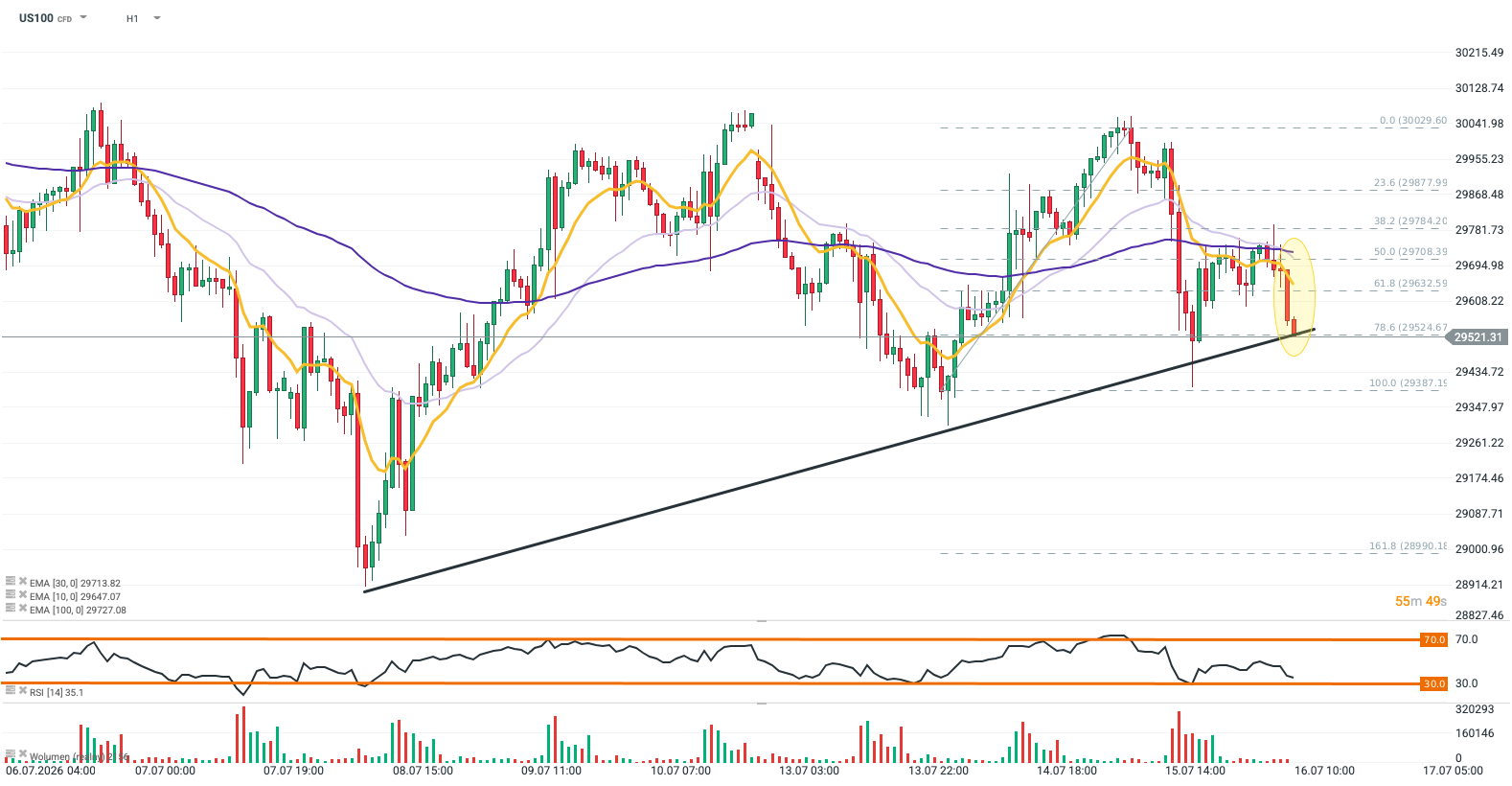
The post-earnings and geopolitical pullback has forced the US100 below its short- and medium-term Exponential Moving Averages (EMA 10 at 29,675.34, EMA 30 at 29,727.24, and EMA 100 at 29,731.29). The index has breached the 61.8% Fibonacci retracement level (29,632.59) and is fast approaching a crucial technical juncture: the upward-sloping trendline connecting the July swing lows, which aligns near the 78.6% Fibonacci level (29,524.67). The RSI (14) has declined to 37.6, showing dominant near-term selling pressure but indicating the market is nearing oversold territory. Bulls must defend this primary trendline support to prevent a deeper correction toward the 100.0% Fibonacci level at 29,387.19.
Source: xStation5
What’s driving Nasdaq futures (US100) today?
The morning's selling pressure reflects the fallout from TSMC's earnings, which failed to lift a semiconductor market already bogged down by negative sentiment (the Philly Semiconductor Index slid 2% yesterday). This market repositioning is accelerating as escalating conflict in the Middle East puts a spotlight on the fragile, supply-constrained nature of the global silicon supply chain.
TSMC's Blockbuster Q2 Numbers & Guidance:
-
Record Net Income: TSMC posted a record second-quarter net income of NT$706.56 billion (a 23.4% sequential increase), easily beating LSEG SmartEstimates of NT$632.64 billion and Bloomberg's consensus of NT$623.73 billion.
-
Revenue Growth: Q2 revenue surged 36% year-over-year to NT$1.27 trillion (approximately $39.45 billion), exceeding expectations.
-
Profitability Milestones: Operating efficiency remained stellar, with gross margins rising to 67.7% (against the 67.1% expected) and operating margins reaching 60.3% (against 58.6% expected).
-
Strong Q3 Guidance: The chipmaker expects Q3 sales between $44.6 billion and $45.8 billion, comfortably ahead of the $43.11 billion consensus. Q3 gross margins are projected between 65% and 67%.
-
Raised Full-Year Outlook: Underscoring massive forward demand, TSMC hiked its 2026 capital expenditure outlook to a range of $60 billion to $64 billion (up from $52 billion to $56 billion previously). It also upgraded its full-year USD revenue growth projection to slightly above 40%, up from its prior estimate of over 30%.
The Broader AI Narrative:
-
Real-World AI Hardware Demand: As the primary contract manufacturer for Nvidia, Apple, AMD, and Broadcom, TSMC's record-setting revenue serves as a highly accurate proxy showing that AI infrastructure investment is still operating at full throttle.
-
Persistent Supply Deficits: The structural deficit in cutting-edge silicon shows no signs of easing. CEO C.C. Wei recently warned that the company cannot build enough capacity to fulfill American customer demand for years, even as more US-based production comes online (including an estimated $265 billion investment in its Arizona campus). This supply shortage is corroborated by memory giant SK Hynix, which expects high-bandwidth memory (HBM) shortages to persist past 2030.
-
Overspending & Valuation Jitters: Despite exceptional fundamentals, the Nasdaq's immediate negative reaction highlights growing market skepticism. With hyperscalers like Meta and its rivals on track to spend over $725 billion on AI infrastructure this year alone, investors are increasingly concerned about whether these companies are overbuilding capacity relative to actual future revenue. Because a significant chunk of this spending is fueled by mounting corporate debt, tech stocks remain highly sensitive to valuation fatigue.
Geopolitical Escalation in the Persian Gulf:
-
Gulf Military Escalation: The US missile strike on the supertanker Belma and subsequent US-Iran airstrikes have effectively shut the critical Strait of Hormuz, stalling global tanker traffic and triggering a sharp spike in crude oil prices.
-
Risk-Off Asset Rotation: This severe energy shock and escalating geopolitical threat are driving a rapid market rotation, forcing capital out of high-beta tech assets (like Nasdaq futures) and into more defensive sectors (more value oriented Dow Jones futures are trading flat, holding the best among key US indices).


Chart of the Day 📉 DE40 Falls 0.7% and Tests Key Support Amid Weak European Market Sentiment (October 8, 2026)


Economic Calendar: U.S. Jobless Claims and ECB Meeting Minutes in Focus (08.10.2026)


Morning wrap: Wall Street and precious metals attempt to stabilize as oil gains nearly 2%


Daily summary: Wall Street recovers losses despite a surge in yields 🗽 Gold and silver retreat