


Mohammad Bagher Qalibaf, Iran’s parliament speaker and chief negotiator in talks with the United States, warned that Iran has “not even started” in its standoff over the Strait of Hormuz. “We know full well that the continuation of the status quo is intolerable for America; whilst we have not even started yet,” he wrote on X. South Korea is considering joining a coalition to secure freedom of navigation through Hormuz, while Iran has neither officially confirmed nor denied attacks on the oil hub in Fujairah.
Key facts
- Oil held most of its sharp gains after tensions escalated in the Middle East, where the US and Iran exchanged fire near the Strait of Hormuz, with WTI hovering around $105 per barrel after rising more than 4%.
- On Monday, May 4, the US military repelled Iranian attacks while escorting two US-flagged vessels through the key waterway, according to US Central Command, while an oil terminal in Fujairah (UAE) was struck, raising concerns about energy infrastructure security in the region.
- The US attempted to clear a passage through Hormuz for vessels stranded by the conflict, but these actions undermined the durability of the four-week ceasefire between Washington and Tehran. According to Eurasia Group, without a US–Iran deal, the strait is likely to remain closed, implying continued upward pressure on oil prices.
- Chevron CEO Mike Wirth told the Trump administration that global oil supplies are “tightening” due to the closure of the Strait of Hormuz. US crude has risen more than 80% this year as the conflict has removed millions of barrels from the market.
- The Strait of Hormuz remains effectively closed to most vessels, with some regional wells shut in. The route is subject to a dual blockade: Iran is attempting to halt transit, while the US is blocking vessels sailing to or from Iran.
- Iranian Foreign Minister Abbas Araghchi said talks with Washington are “making progress,” but warned the US and UAE against being dragged back into conflict. He added that events in Hormuz show there is “no military solution to a political crisis.” Donald Trump recently said the war, which began in late February, could last another two to three weeks, adding that “time is not of the essence” in reaching a deal.
- Carl Larry of Enverus said oil will likely “grind higher” as escalation remains the base case and the outlook for peace is fading. He noted that the consequences of further escalation are hard to predict, but “won’t be good.”
- Rising energy costs are fueling concerns about inflation and slower economic growth. Investors are increasingly hedging against a scenario in which the Federal Reserve may need to shift course and raise interest rates to curb price pressures.
Brent crude OIL (D1 chart)
Oil is gradually trending higher, and if the late-February impulse — which peaked in early April — were to repeat in a 1:1 pattern, a move toward $150 per barrel cannot be ruled out. On the other hand, the $113–118 range represents a zone where profit-taking may accelerate, as it marks multi-year highs and increases the risk of volatility in both directions. A key momentum support is the 50-day EMA, currently running near the psychological $100 level. If tensions in the Hormuz will rise, which may hit also the Bab-Al Mandeb as well as the East-West pipeline and Red Sea infrastructure, oil at $150 may be a realistic scenario this year. As of now despite oil at $113 there is no visible world oil demand destruction, according to Morgan Stanley analysis.
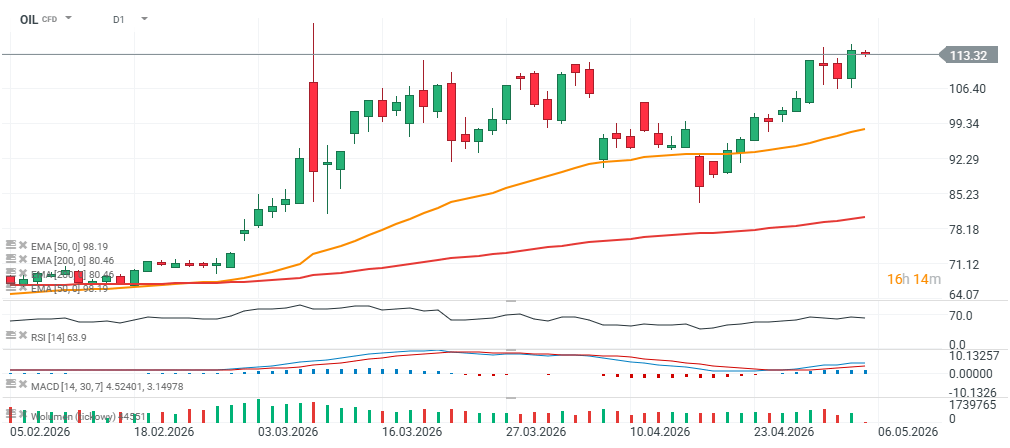
Source: xStation5



Market Wrap: Rebound in China and Falling Oil Prices, France Leads EU Declines



Optimism Returns to Asia❔


Morning Wrap: Nasdaq rebounds ahead of Mag7 earnings, bonds regain favour, oil falls from peak (19.10.2026)

Daily Summary: Friday offers no relief; the US100 drops 2%🚨