



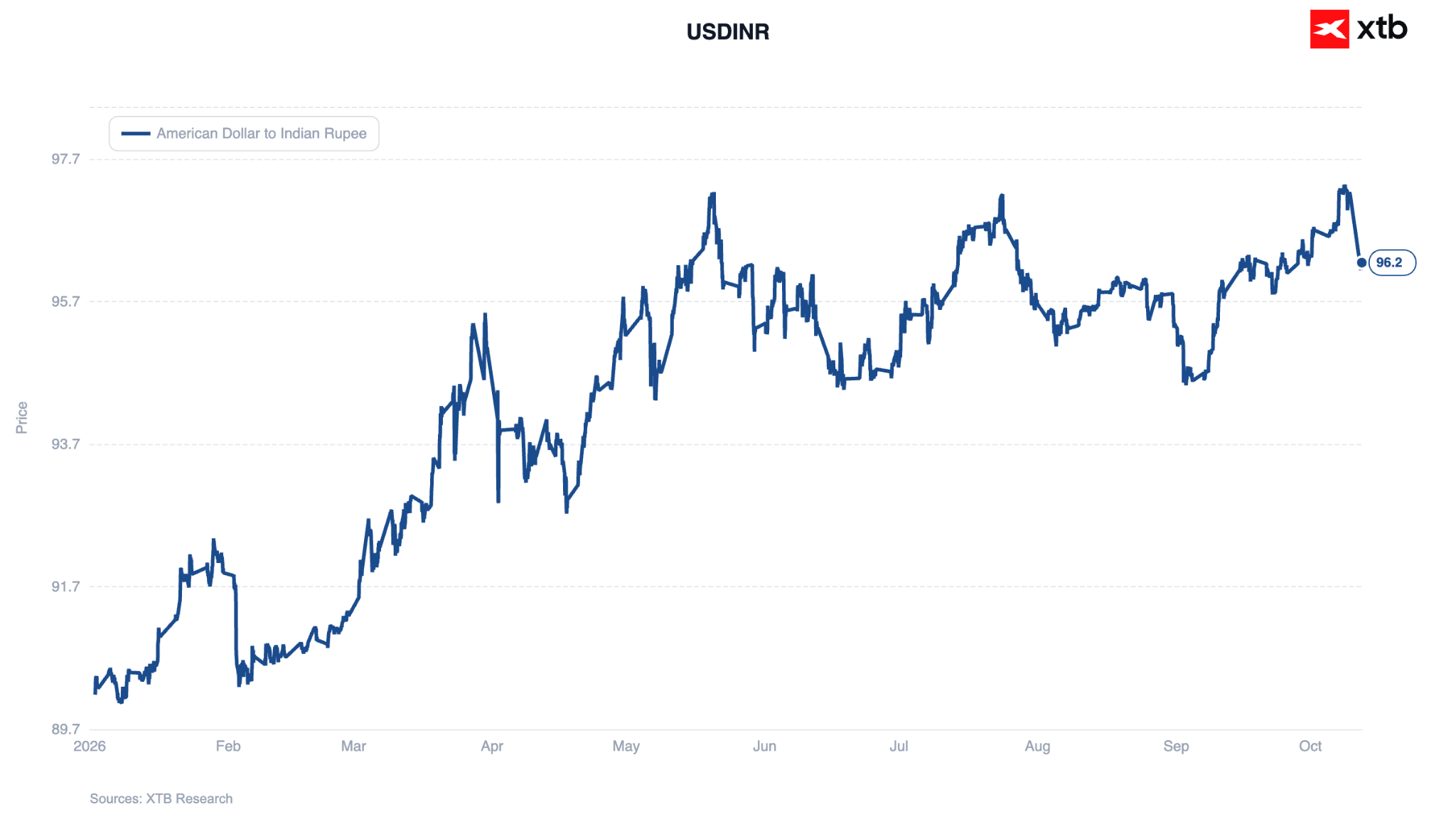
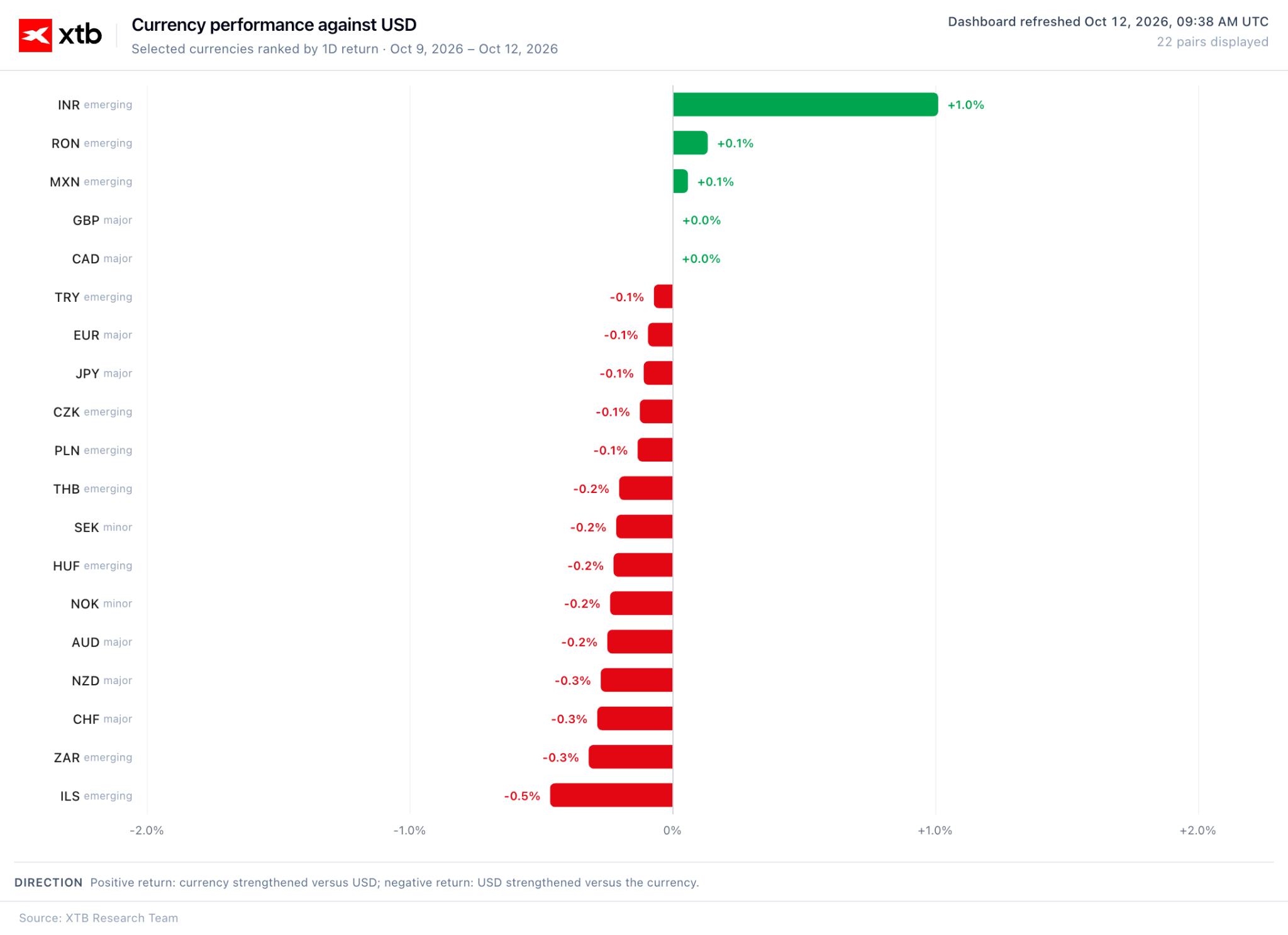
The Indian rupee is posting its strongest performance since April, appreciating by over 1% against the US dollar today.
Figure 1: USDINR (2026)
 Source: XTB Research, 12.10.2026
The rally was triggered by the Reserve Bank of India, which over the weekend announced its most decisive regulatory policy package to support the currency since 2013 (when it was forced to intervene following a sell-off driven by the Fed's taper tantrum).
Figure 2: Performance of G10 and EM Currencies [vs. USD] (12.10.2026)
 Source: XTB Research, 12.10.2026
What measures has the RBI introduced?
The new package includes a dedicated US dollar facility for state-owned oil companies, as well as a new reserve requirement on foreign exchange derivatives. Under the latter rule, commercial banks will be required to maintain reserves with the RBI equivalent to 20% of the nominal value for transactions exceeding $2 million (a measure similar to the tool utilized by the People's Bank of China to manage pressure on the yuan).
What is the dollar facility and why does It matter?
Indian oil companies are required to regularly purchase substantial amounts of US dollars to settle crude oil import bills (with India relying on imports for 85% of its crude needs). Under standard conditions, these purchases are conducted in the open market, generating constant, heavy demand for dollars and adding further downward pressure on the rupee.
Given the sharp rise in commodity prices, the RBI has opened a dedicated, direct supply channel for these companies, providing dollars directly from its foreign exchange reserves. Consequently, a significant portion of predictable dollar demand will be removed from the open FX market, which should help alleviate pressure on the exchange rate.
The second component: regulatory changes to FX derivatives
The imposition of reserve requirements on derivative instruments (including FX forwards, futures, and swaps) is notable, as it appears somewhat at odds with previous RBI communications that encouraged market participants to utilize these hedging tools.
We view this measure primarily as a temporary fix rather than a structural solution. While it is expected to curb speculative positioning, it may do so at the expense of market liquidity.
The wider picture
The rupee has depreciated by around 6% year-to-date, making it one of the weakest-performing currencies in the region. RBI Governor Sanjay Malhotra noted last week that the currency remains undervalued, adding that markets can exhibit irrational behavior in the short term.
The trade deficit remains a key structural concern, having widened significantly due to a rally of over 40% in Brent crude prices.
Investors are also watching closely for upcoming interest rate decisions by the RBI. Last week, the central bank opted to raise interest rates by 25 bps, bringing the benchmark rate to 5.5%. Today at 11:30 AM, a crucial data release for future policy guidance will be published: September CPI inflation. Consensus expectations point to an acceleration in the annual rate to 5.6%.
—
Michał Jóźwiak, Financial Markets Analyst at XTB



Economic Calendar: Where will stock exchanges remain closed today? (12.10.2026)


Morning Wrap: Oil cheaper despite attacks on Saudi Arabia, markets await CPI (12.10.2026)



Daily Summary: A Shallow Rebound Ahead of Earnings Season

Market Wrap: A 4% surge in oil prices weighs on indices (08.10.2026)