



Chinese equities remain under heavy selling pressure, and investor sentiment toward the world's second-largest economy continues to deteriorate. The Hang Seng China Enterprises Index has entered a technical bear market after falling more than 20% from its October peak, while both the Shanghai Composite and Shenzhen Component are also posting sharp losses. Investors increasingly worry that China's economic recovery remains too weak to translate into sustained earnings growth, particularly for technology and consumer-oriented companies. Additional pressure comes from escalating technology tensions between the United States and China following Anthropic's accusations that Alibaba attempted to illicitly extract advanced artificial intelligence capabilities. At the same time, the market is increasingly questioning whether billions of dollars being invested in AI will ultimately generate adequate returns, especially as U.S. export restrictions continue to limit Chinese access to cutting-edge semiconductors. As a result, investors are reducing their exposure to Chinese equities despite increasingly attractive valuations across many companies.
Hong Kong Enters a Bear Market as Sentiment Toward Chinese Equities Worsens
The weakest part of China's equity market is currently Hong Kong. The Hang Seng China Enterprises Index, which tracks the largest mainland Chinese companies listed offshore, has fallen more than 20% from its October high, officially entering a technical bear market. Meanwhile, the Shanghai Composite is down around 1.1% and the Shenzhen Component has fallen nearly 1.6%, highlighting that the sell-off is affecting both offshore and mainland markets.
Only a few days ago, Micron's strong earnings boosted optimism across the global semiconductor and artificial intelligence sectors. That optimism is now fading rapidly as investors refocus on the structural challenges facing China's economy and the rising costs of the global AI race.
Alibaba Returns to the Center of the U.S.-China Technology Conflict
Another catalyst behind the recent sell-off is Alibaba. U.S. artificial intelligence company Anthropic has informed the U.S. Senate that entities affiliated with Alibaba and its AI research lab carried out what it describes as the largest known AI distillation attack against its Claude models.
According to Anthropic, between April 22 and June 5, operators linked to Alibaba allegedly used approximately 25,000 fraudulent accounts to generate nearly 28.8 million interactions with Claude models in an attempt to replicate their capabilities and use the outputs to train competing AI systems.
If these allegations are confirmed, the case could strengthen the argument for further tightening U.S. export controls on Chinese artificial intelligence companies. For investors, this represents another increase in regulatory and geopolitical risk, which has remained one of the primary drivers of valuation discounts across China's technology sector for several years.
Weak Consumer Spending Remains China's Biggest Economic Challenge
However, geopolitical tensions are not the only reason behind the weakness in Chinese equities. Investors are paying increasing attention to domestic fundamentals. Consumer spending remains softer than expected, the property market has yet to stabilize, and the pace of China's economic recovery continues to disappoint both domestic and international investors.
This is particularly important for e-commerce companies such as Alibaba and JD.com, whose long-term revenue growth depends heavily on household consumption. Without a meaningful rebound in consumer demand, it will be difficult for these companies to return to the growth rates seen before China's real estate downturn.
Can Artificial Intelligence Still Drive China's Technology Sector?
Investors are increasingly distinguishing between the global AI boom and the outlook for Chinese technology companies. While U.S. firms continue benefiting from record demand for advanced AI chips and data center infrastructure, Chinese companies must develop their AI models under limited access to cutting-edge semiconductors and increasingly restrictive U.S. technology export controls.
As a result, investors are becoming more cautious about whether the enormous capital being deployed into AI across China will ultimately generate attractive returns.
What Will Determine the Direction of Chinese Equities?
Over the coming months, three factors are likely to determine the direction of Chinese equity markets. First, the pace of recovery in domestic consumption and broader macroeconomic data. Second, developments in U.S.-China technology relations and any additional export restrictions. Third, earnings results from China's largest technology companies, which will reveal whether heavy investment in artificial intelligence is beginning to translate into meaningful revenue and profit growth.
Until these three areas begin sending more positive signals, Chinese equities are likely to remain under pressure despite increasingly attractive valuations and historically low fundamental multiples.
Alibaba and Hang Seng Charts (CHN.cash)
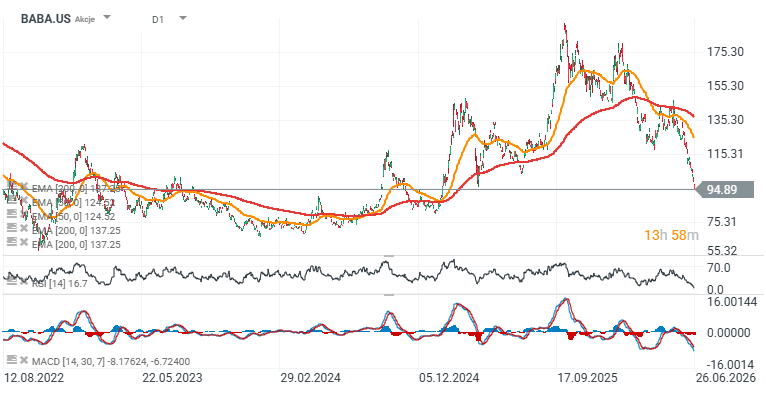
Alibaba shares have already fallen more than 50% from their 2025 peak and are currently trading nearly 30% below their 200-day exponential moving average (EMA200). Sentiment toward Chinese assets remains extremely weak, with other major technology names including Baidu, Tencent, and Yum China also retreating alongside Alibaba.
Source: xStation5
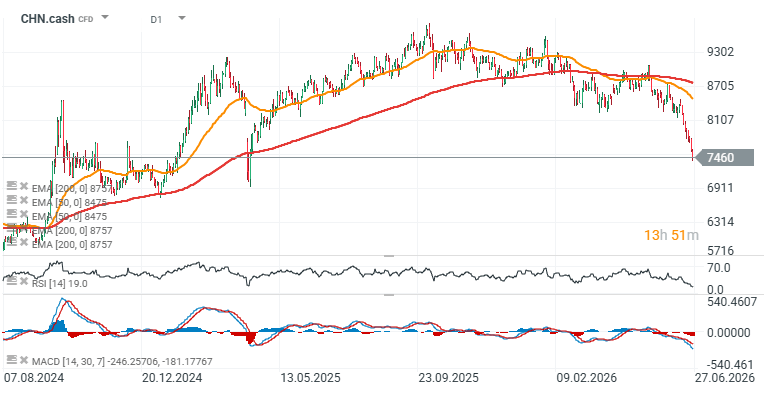
The Hang Seng futures contract has fallen to levels not seen since April 2025, when Donald Trump announced tariffs on Chinese imports, triggering a short-lived trade war.
Source: xStation5



Daily Summary: Rising inflation weighs on markets, semiconductors suffer most (14.10.2026)


US Open: CPI reading weighs on American indices (14.10.2026)
US inflation concerns rise

POET: A “meme stock” in photonics, is there still hope?