


The US networking company reported results for Q2 2026, after which the stock is down about 7% at the Wall Street open. Despite a modest beat versus elevated expectations driven by AI investment, the market reacted negatively to the release.
Earnings
- Revenue rose to USD 17.3bn versus expectations of around USD 16.8bn, representing roughly 15% year-on-year growth.
- EPS was stronger, coming in at USD 1.22 (non-GAAP) versus expectations of USD 1.17, a year-on-year increase of about 100%. It is worth noting that last year’s Q2 2026 reading was an accounting anomaly with an artificially low base, but the result is still impressive: quarter-on-quarter EPS increased by nearly 20%.
- Gross margin was weak, falling from 68.4% to 66.3% in the most recent quarter of the current fiscal year.
More information can be gleaned by looking at specific business segments.
- Networking: total orders up 40%, up 25% excluding orders from “hyperscale” companies. Orders totaled USD 9.3bn in the current fiscal year.
- AI: for the next fiscal year, the company expects USD 7.5bn in AI revenue. This is an increase from USD 4bn in the current year.
- Security: the segment grew 14% year-on-year to USD 2.22bn.
Guidance
- Management’s projections for year-end results came in above the prior consensus. Revenue at the end of the next fiscal year is expected to reach USD 72.8bn, about 6% higher than the previous estimate.
- EPS guidance increased much faster and more clearly: projected EPS for the next quarter is as high as USD 1.33, which would imply a hypothetical year-on-year increase of just under 30%.
- By far the weakest element of the earnings call was the margin outlook for the next quarter, where the company expects a 60 bp decline to below 66%.
Conclusion
Cisco’s results confirmed that the company is benefiting from the ongoing investment cycle, but is struggling with cost optimization.
Demand is strong and broad-based. The main driver remains the networking segment, supported primarily, though not only, by hyperscaler investments.
Growth is visible, but looks somewhat disappointing relative to the rest of the industry, especially given the company’s scale and experience. However, because Cisco expects further growth in AI infrastructure sales, continuation of the network upgrade cycle, and improvement in security and services, the market still has room to price in a more optimistic path. That said, the valuation “ceiling” during earnings-related speculation is much lower for Cisco than for other companies linked to the AI boom.
It is also worth noting that the growth mix is becoming more hardware-heavy, which increases pressure on gross margin and makes further profitability improvement dependent on cost discipline, an area where the company clearly has an issue. In the coming quarters, the key will be not only the pace of converting AI orders into revenue, but also, increasingly, defending margins and improving FCF.
CISCO Technical Analysis (H1)
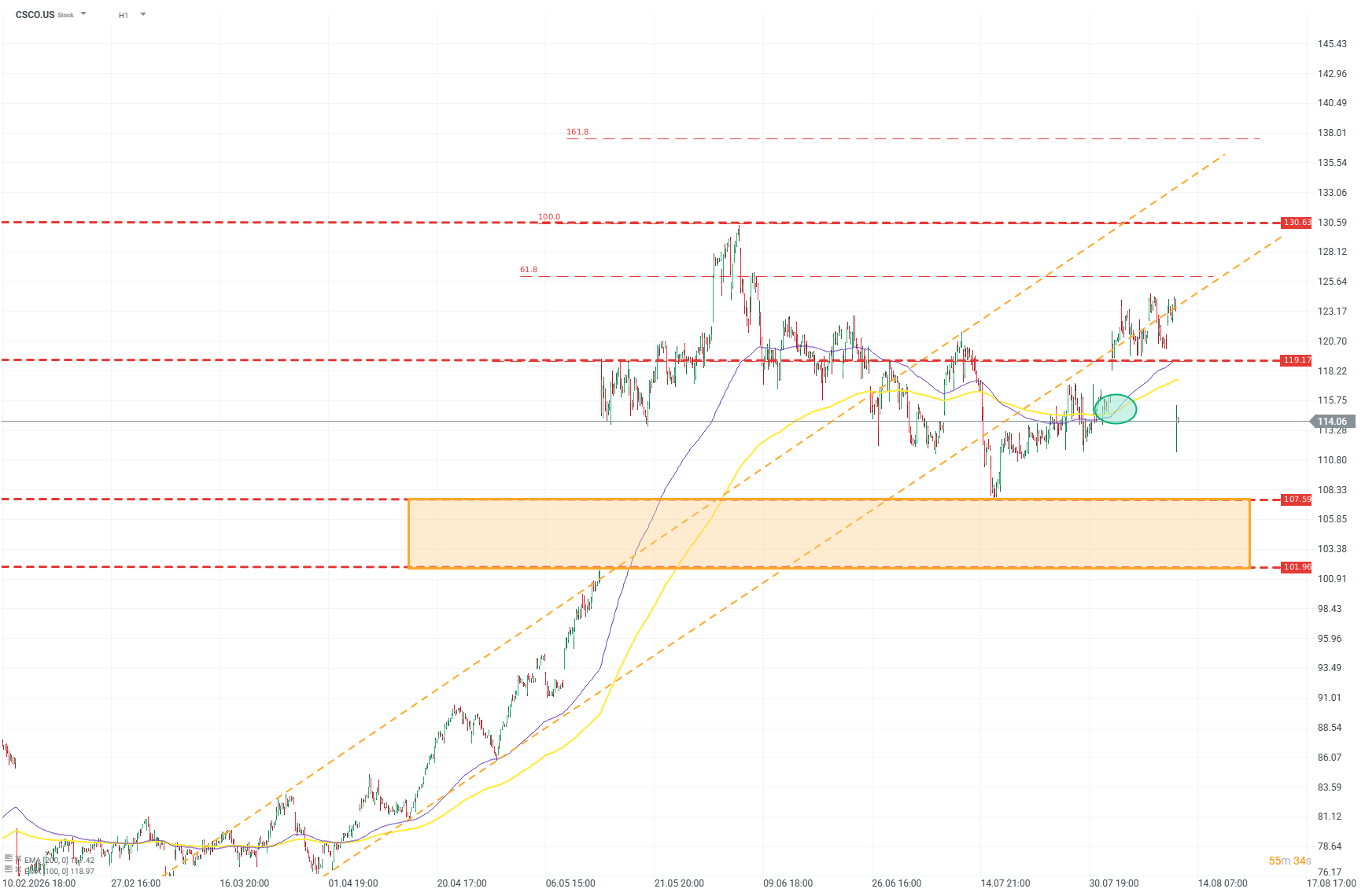
Despite meaningful declines from the latest peak (around 12%) and a downside break from the long-term rising channel, the price still maintains a moderately bullish technical outlook. The resistance zone between 107 and 101 is broad and may prove stronger than sellers currently expect. This could support the stock in the short to medium term if it slips toward the lower boundary of the wide consolidation channel. The next target for buyers from current levels is resistance around 120, followed by a retest of the resistance area between 126 and 130. This move would be supported by the “golden cross” phenomenon (the 100 and 200 EMA). Source: xStation5


ASML disappoints on revenue but delivers stronger profits and raises guidance 🍳 What’s next for the AI sector?



Daily Summary: Earnings Season Kicks Off on Wall Street Amid Mixed Sentiment


SpaceX Wants to Fly Starship Almost Every Day. Musk’s Business Empire Is Betting on It


Micron Expands Share Buybacks to $35 Billion!