



- Arabica futures on ICE are down around 5% today, even though the market benefited from low inventories and a weather premium as recently as last week.
- The key bearish factor remains the supply outlook: the USDA forecasts record global coffee production of 189.7 million bags in the 2026/27 season, up 6% year-on-year.
- According to the USDA, Brazil could harvest around 71.9 million bags of coffee, 14% more than a year earlier, providing a fundamental counterweight to low exchange inventories.
- At the same time, ICE-certified Arabica stocks have recently fallen to around 244,000 bags, their lowest level in approximately two and a half years.
- Brazil’s harvest has progressed more slowly than a year ago, but drier conditions could allow producers to accelerate fieldwork, increasing supply pressure on the market.
- The quality of part of Brazil’s new Arabica crop remains a concern, with reports pointing to weaker cup quality and bean size, potentially limiting the pace at which ICE inventories can be replenished.
- El Niño remains a key risk for the remainder of the season. Potential disruptions to rainfall and temperatures could affect flowering conditions and the outlook for future crops.
Record Crops Return to the Forefront
The prospect of very high supply in the 2026/27 season remains the main fundamental argument for sellers. The USDA expects global coffee production to rise 6% to a record 189.7 million bags, with Arabica output increasing by around 12% year-on-year. Global ending stocks are also projected to rise by 1.9 million bags to 26.3 million.
Brazil remains crucial to this outlook. The USDA forecasts production of 71.9 million bags, which would represent an increase of around 14% year-on-year. Moreover, drier weather conditions could now help accelerate harvesting activity following earlier delays caused by rainfall.
The prospect of Brazilian coffee reaching the market at a faster pace is currently the strongest supply-side argument. Following the previous strong rebound in prices, investors may therefore be shifting their attention back towards the size and availability of the current crop rather than focusing exclusively on future weather risks.
Low ICE Inventories Limit the Bearish Case
The problem is that a large crop does not automatically translate into an equally large supply of coffee eligible for delivery against ICE contracts. Certified Arabica stocks have recently fallen to around 244,000 bags, their lowest level in approximately two and a half years and significantly below levels seen a year ago.
There are also concerns about the quality of Brazil’s harvest. According to information cited by Vesper based on a Sucafina report, part of the new crop has disappointed in terms of both cup quality and bean size. This means that even a large harvest may not quickly solve the shortage of coffee meeting exchange delivery requirements.
The market therefore has plenty of coffee in production forecasts, but still only a limited buffer of coffee readily available through the ICE delivery mechanism. This divergence helps explain why Arabica remains highly volatile and why weather-related developments can trigger sharp price reactions.
El Niño Remains a Risk for the Next Season
Another factor preventing an unequivocally bearish interpretation of today’s decline is El Niño. In recent weeks, the market had started rebuilding a weather premium, with Arabica previously staging a strong rebound from its early-June lows. For Brazil, the key period will be flowering between September and November. Higher temperatures and irregular rainfall could increase plant stress and weaken the production potential of future crops. El Niño therefore represents primarily a risk to future supply, while the large Brazilian harvest is influencing the market here and now. This distinction is crucial: today’s sell-off may reflect the current dominance of the near-term supply argument, but the balance could change quickly once the flowering period begins.
Today’s move should also be viewed in the context of the previous rebound. At the beginning of August, Arabica was still trading around 30% above its June low as investors priced in El Niño risks and exceptionally low ICE inventories. The market is therefore caught between two very different narratives. On one side, record global production, a large Brazilian crop and the prospect of faster harvesting argue for lower prices. On the other, exceptionally low certified stocks, quality concerns surrounding part of Brazil’s Arabica crop and El Niño risks continue to constrain the physical market. The decline strengthens near-term supply pressure but does not resolve the tight availability of high-quality coffee. The pace of Brazil’s harvest and producer selling, developments in ICE inventories and, as September approaches, weather conditions during the crucial flowering period will be particularly important for Arabica’s next directional move.
Coffee Chart (D1 Interval)
Following distribution in the 340–350 area, the contract has pulled back towards the 38.2% Fibonacci retracement of the latest downward move, located around 317. This is also an important technical area because the 200-day and 50-day exponential moving averages, EMA200 and EMA50, converge nearby. A sustained break below this zone could open the way towards 290, corresponding to the 23.6% Fibonacci retracement. Conversely, a rebound from the current area could bring prices back towards 360, where the 61.8% Fibonacci retracement coincides with significant price reactions observed earlier this year.
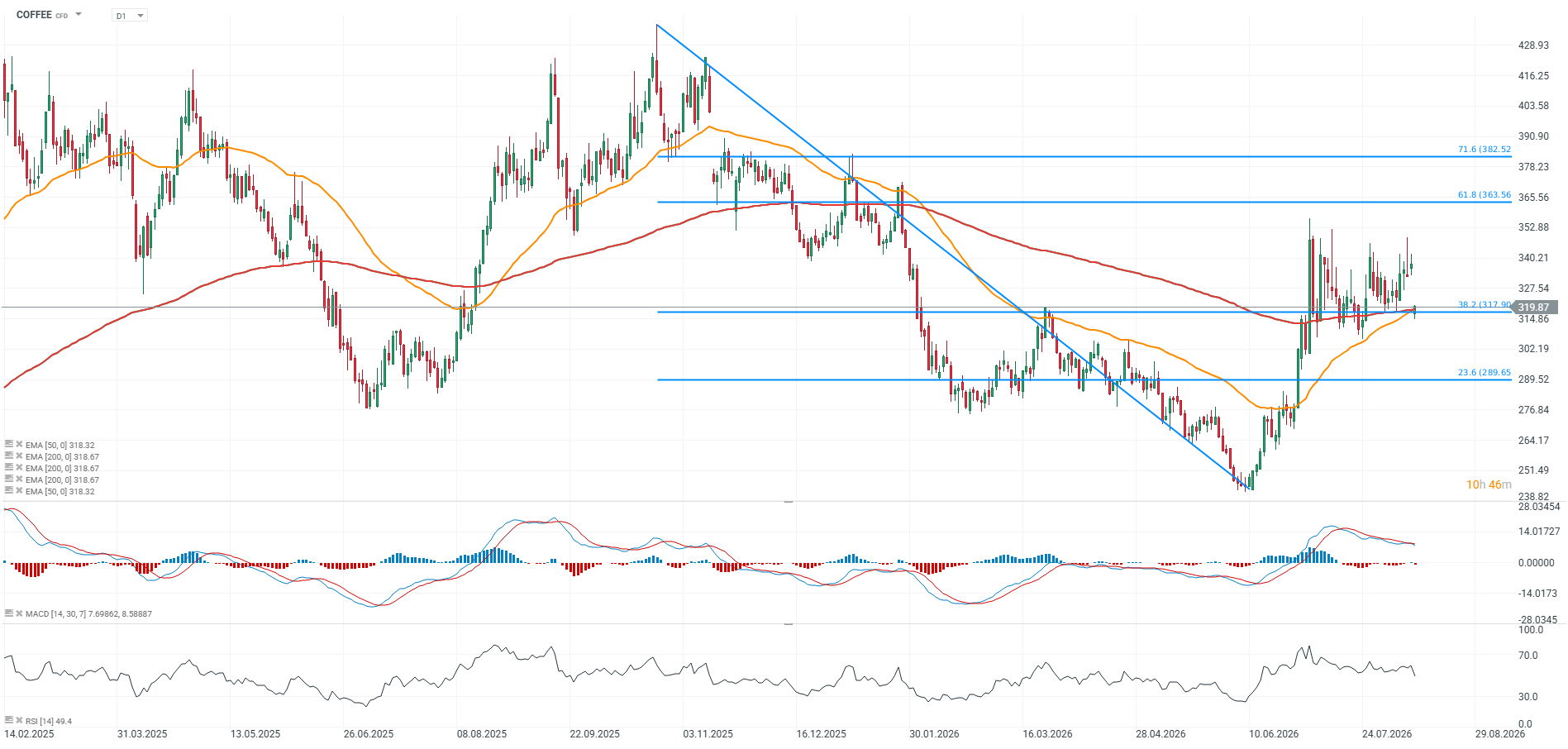 Source: xStation5



Daily Summary: Earnings Season Kicks Off on Wall Street Amid Mixed Sentiment



Market Wrap: European Stocks Rise as Banks Beat Earnings Expectations


🚩 US100 loses 0.7%



Morning Wrap: Tech Crash in Asia and Hawkish Central Banks in the Shadow of an Oil Shock (13.10.2026)