



Wall Street opened sharply lower, pressured by an almost 13% drop in Nvidia shares after Jensen Huang unexpectedly left the company following a series of scandals that emerged in recent days. The major indices managed to erase those losses and briefly move into positive territory, but US equities eventually slipped back slightly below the flatline. Nvidia has meanwhile recovered part of its earlier decline and is down around 5% roughly 4.5 hours after the US open, while oil prices are up nearly 3%.
-
Tensions around Iran are rising again following reports from Fars News of an explosion near Sirik; some sources suggested the sounds may have been caused by warning shots fired toward vessels violating navigation rules. At the same time, Donald Trump said the US “doesn’t need a deal with Iran,” adding uncertainty around negotiations and potentially supporting the geopolitical risk premium in oil.
-
Hawkish comments from Fed officials are strengthening the US dollar, which is posting sizeable gains and pushing EURUSD to its lowest level since April 16, 2025. US labour market data were also solid. Initial jobless claims rose to 200k versus 194k expected and a revised 191k previously, while continuing claims fell to 1.697 million versus 1.71 million expected, still pointing to a relatively stable labour market.
-
US existing home sales fell 5.5% m/m in October versus an expected 3.5% decline and a 1.5% increase previously. The annualised sales pace came in at 3.75 million versus 3.85 million expected and a revised 3.97 million previously, although housing data have recently been largely ignored by markets.
-
Fed’s Mary Daly said inflationary pressure in the US is still rising, making further policy tightening likely. At the same time, tighter financial conditions give the Fed more time to make decisions, while the AI boom is supporting growth and could improve productivity, although its current impact on inflation and the labour market remains limited.
-
Fed’s Austan Goolsbee said the Fed is currently falling short on the inflation side of its mandate and argued that the latest hot CPI print was not a one-off event. He also warned about signs that the economy could be overheating and noted that AI investment is acting partly like an additional investment stimulus, although he does not want to prejudge future rate decisions.
-
Fed’s Michael S. Barr said the impact of AI is currently visible mainly through higher prices and investment rather than widespread worker displacement. He warned, however, that rapid adoption could create more severe labour-market disruptions, add to cost pressures and generate new risks for banks, particularly through the use of agentic AI.
-
Fed’s Beth Hammack said US inflation is once again moving in the wrong direction, price pressures are broadening and secondary effects from higher energy prices are an additional risk. In her view, the Fed should raise rates into restrictive territory, preferably through smaller and steadier moves, while stressing that the central bank is not yet behind the curve.
-
Fitch Ratings said US consumer spending remains strong despite growing affordability pressures, while a larger financial-market correction remains an important risk. Goldman Sachs, meanwhile, expects US GDP growth to reach around 2.4% in 2027.
-
The International Monetary Fund supports the Fed’s focus on price stability and its willingness to take further action against inflation. The IMF believes the Federal Reserve will need to maintain a restrictive monetary policy stance to support disinflation. It also noted that changes in the scale of AI investment could affect US inflation, although it is still too early to assess the ultimate impact.
-
US Trade Representative Jamieson Greer said China is only partially complying with trade arrangements, although the US is receiving some of the rare earths it needs and expects further progress. He stressed that the administration wants strategic technologies and companies such as Nvidia to remain in US and allied hands. Washington is also keeping all tariff options open, while Trump remains prepared to use tariffs against Mexico if necessary.
-
The EIA report showed a broad build in US fuel inventories: crude stocks rose by 4.657 million barrels versus an expected decline of 1.483 million, gasoline inventories increased by 1.799 million versus an expected 0.35 million decline, and distillate stocks rose by 4.071 million versus an expected 2.0 million draw. The data are clearly negative for the short-term oil market balance, as they point to either stronger supply or weaker demand than the market had expected.
-
Precious metals are under heavy pressure, with gold and silver both down around 3%, while broader commodity markets remain moderately volatile. Cocoa and coffee futures are rebounding, gaining around 2–3%.
-
Kremlin adviser Yuri Ushakov said a meeting between Vladimir Putin and Donald Trump is planned in China. At the same time, the White House is expected in the coming days to extend the Jones Act waiver, allowing oil and other commodities to be transported between US ports on foreign-flagged vessels.
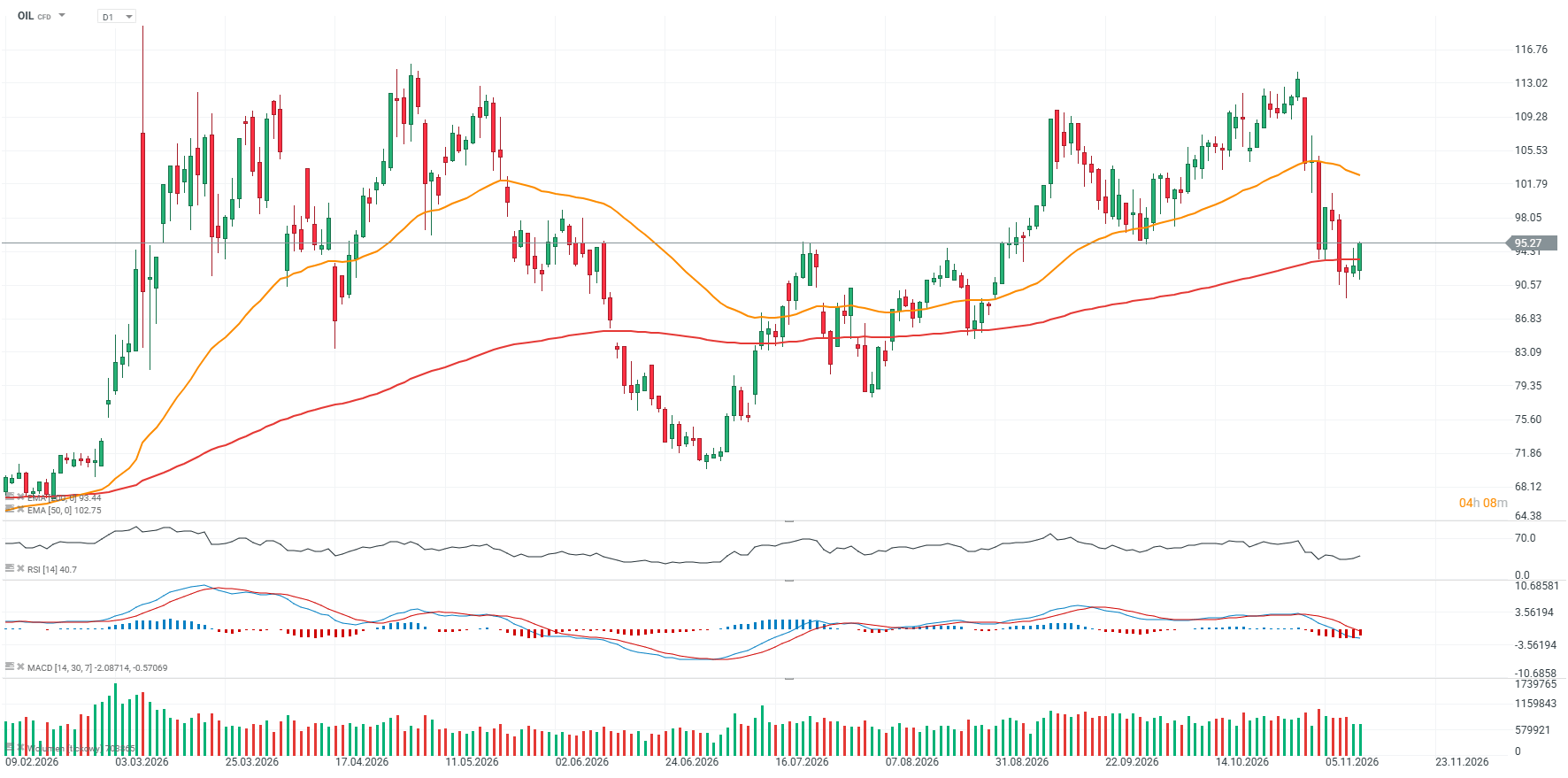
OIL chart (D1 interval)
Oil is posting a solid gain today, extending yesterday’s positive session. From a price-action perspective, the $90 area remains the key support zone, while an important resistance area is located around $98–100 per barrel.
 Source: XTB
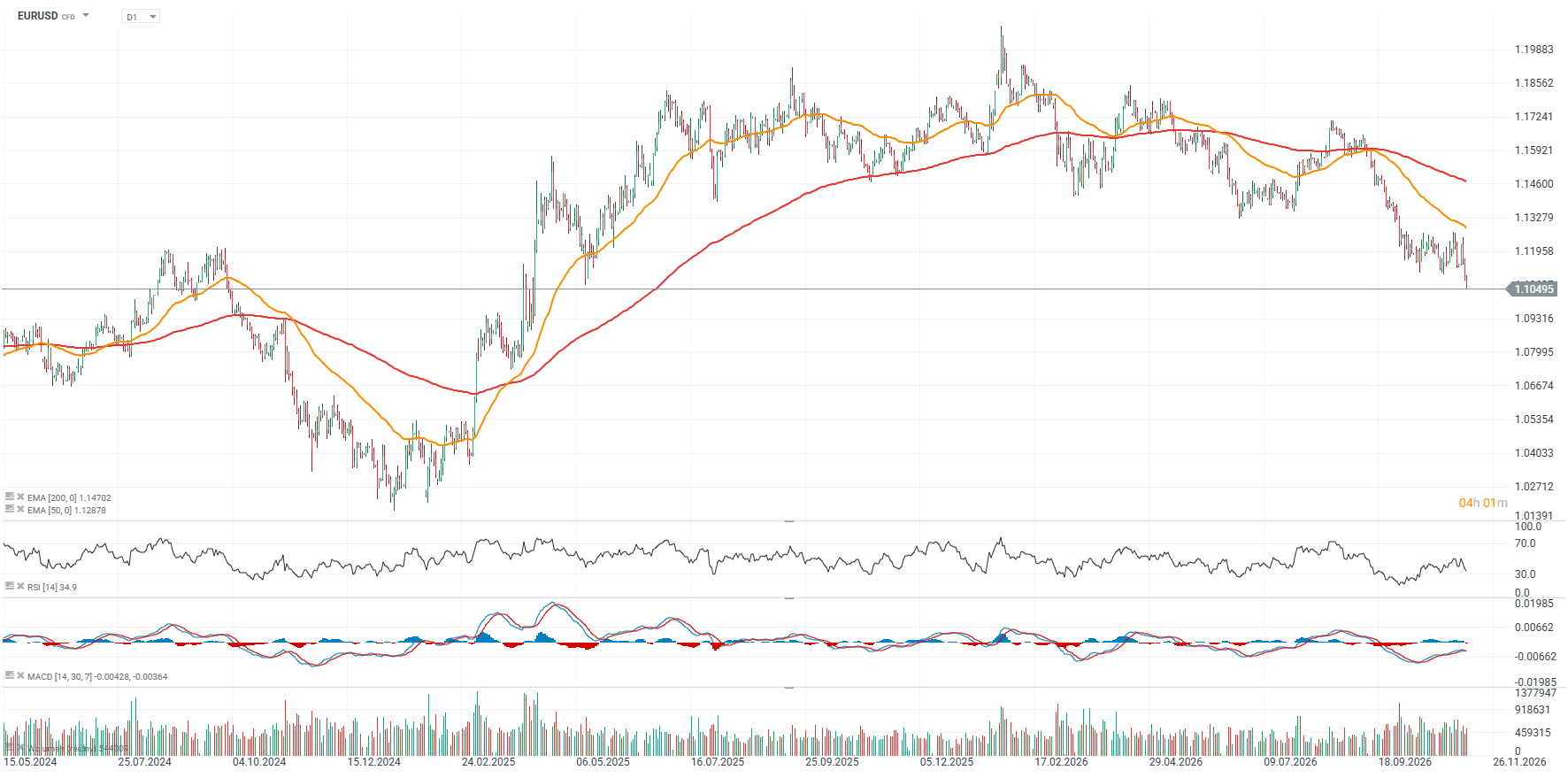
EURUSD has experienced a sharp sell-off, although the daily RSI has fallen only to around 34, still above levels typically associated with extreme oversold conditions. Nevertheless, the decline from levels near 1.17 seen toward the end of the summer has been substantial.
 Source: XTB

Oil Gains Nearly 2% Despite a Sharp Rise in US Inventories 📈


🚩 Gold loses almost 3%


US Open: Wall Street Sentiment Weakens 📉 AMD and Broadcom Benefit from Nvidia’s Sell-Off?

Trump and Nvidia Rattle Wall Street 🚩 US100 Falls Over 1%