


In recent quarters, Nvidia has been almost synonymous with AI infrastructure for the market. Today it remains at the forefront of innovation and the efficiency of AI computing solutions, but even Nvidia is starting to run into technological constraints, at least according to analysts at SemiAnalysis.
In today’s AI industry, it is no longer enough to buy the best GPUs. Increasingly strong emphasis is being placed on complete, integrated computing systems, that is, fully built server racks where every component is designed from scratch, custom-made, and perfectly synchronized with the rest to maximize efficiency.
One such device that is expected to appear in Nvidia’s lineup is the “Kyber NVL144.”
According to analysts at SemiAnalysis, the Kyber NVL144 system could be pushed back by as much as about 12 months, from the planned 2027 to 2028. The reason is said to be a problem with producing a key component (the so-called PCB midplane, a multilayer intermediate board connecting modules inside the entire rack).
The market did not react to these reports with panic, and some analysts even dismissed them as “noise,” but the nature of the problem is more serious than it may seem to investors unfamiliar with technical issues. The information is significant enough that Nvidia representatives commented to Bloomberg, denying the rumors and reassuring that development of the system is proceeding according to plan.
That is precisely why SemiAnalysis reports about a possible delay to the Kyber NVL144 architecture matter. This is not about a cosmetic slip in the roadmap, but a signal that further AI scaling is starting to depend more and more on very down-to-earth engineering constraints.
Kyber NVL144 was meant to be one of the most ambitious elements of the next generation of AI infrastructure. The system, based on the Rubin Ultra architecture, was supposed to house as many as 144 GPUs in a single rack, while also offering integrated liquid cooling. Such a project was expected to deliver a huge performance increase and allow Nvidia to further expand the so-called “scale-up” domain, meaning the number of GPUs connected via the very fast, proprietary NVLink interconnect.
In the largest AI systems, it is not enough to have more chips. You also have to make them communicate with each other fast enough. So if Nvidia has a problem with Kyber, it is not just a problem with a single board. It is a problem with the next leap in the scale of the entire architecture, and with market expectations built on the breakthroughs the company is expected to deliver.
These reports also fit into the broader picture of the growing complexity of Nvidia’s roadmap. For competitors, this could be a potentially important window. SemiAnalysis suggests that a Kyber delay could improve the position of
AMD solutions or in-house chips designed by hyperscalers, such as Google’s TPU.
Analysis of Nvidia and Google price chart (NVDA.US/GOOGL.US) (D1)
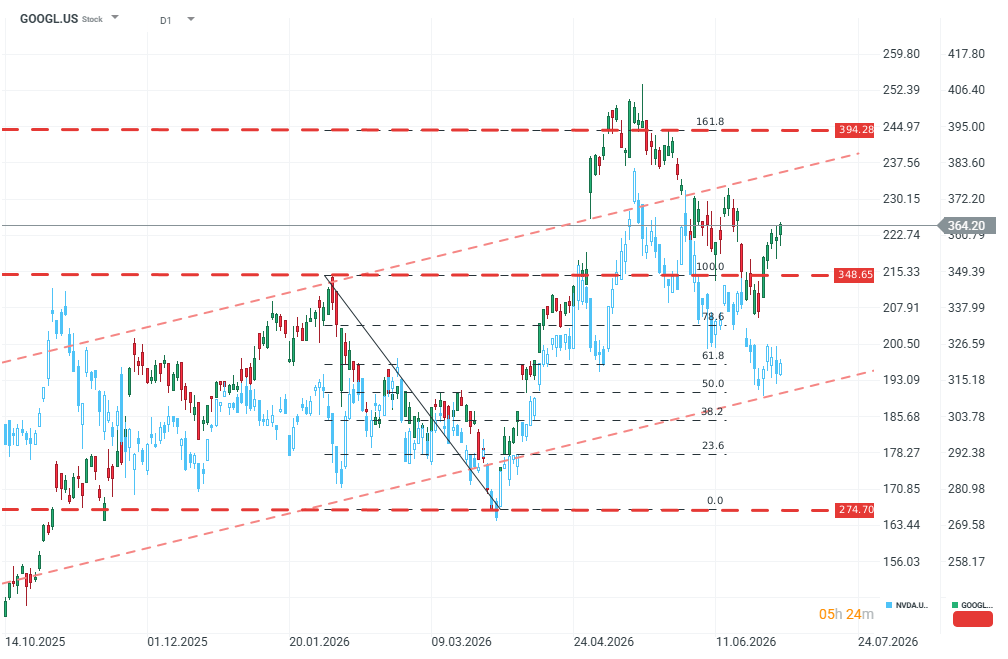
Both companies move in a similar way, based on similar price impulses and broader market trends. However, the market is currently hard to convince that there are further growth catalysts for Nvidia, while Google is increasingly beginning to dominate in terms of the pace and scale of valuation growth, driven in part by many company initiatives aimed at vertical integration and reducing dependence on external suppliers. Source: xStation5
This does not automatically mean the end of Nvidia’s dominance in this segment, but if the analysts’ reports are confirmed, it could mean a major blow to the company’s long-term plans.


Market Wrap: "Decent" results are not enough – tech stocks fall further; oil highest since May (22.10.2026)

Tesla was supposed to burn $5 billion, but posted a positive result. Will Tesla still be a car company in a year?


Record-breaking Meta, though with a cash loss. Investors (for now) are buying Zuckerberg's plan anyway


Daily Summary: SpaceX and the tech sector drive Wall Street, oil retreats sharply below $97