



Today’s trading session will be dominated by a mix of macroeconomic data from Europe, the BoE’s decision, and the fallout from yesterday’s Fed meeting and the escalation of tensions between the US and Iran. The market is starting the day in the wake of the Dow Jones’s worst session since April 2025 (-2.19%) following the Fed’s decision to keep interest rates at 3.5–3.75% by a 9–3 vote.
Economic data from Europe
Before midday, second-quarter GDP figures will be released for Spain, Italy, Germany and the eurozone as a whole (the consensus points to a marked slowdown in year-on-year growth in Spain and Italy), and at 14:00, Germany’s CPI for July is due, with forecasts of a rise to 2.7% year-on-year from 2.3% previously. In the afternoon, attention will shift to the US – at 14:30, a suite of data including the PCE (the Fed’s inflation deflator), personal income and expenditure, Q2 GDP and weekly jobless claims, with the market expecting a jump to 200,000 from 187,000.
The Bank of England’s decision
At 13:00, the Bank of England will announce its interest rate decision – economists polled by Reuters expect a 7-2 vote in favour of keeping the rate at 3.75 per cent, the level maintained since December. Governor Andrew Bailey has been signalling since March that previously anticipated rate cuts have been postponed due to the conflict in the Strait of Hormuz, which is fuelling inflationary pressures; he is expected to deliver a speech at 1.30 pm alongside the publication of the Quarterly Inflation Report.
Geopolitics and oil
The situation surrounding Iran remains a key risk factor – USCENTCOM carried out a retaliatory strike following Tehran’s attack, and Trump threatened Iran with a “severe beating”, which on Wednesday triggered a 7.9 per cent surge in Brent to $90.74 per barrel. Today, however, oil prices are giving back some of their gains – Brent has fallen by 0.9% to around $87.30, as tankers continue to leave the Gulf region despite the escalation. The OPEC+ supply increase of 188,000 b/d for September, announced for 2 August, may limit further gains in the longer term, provided that military tensions do not escalate further.
Wall Street after the close and the chip sector
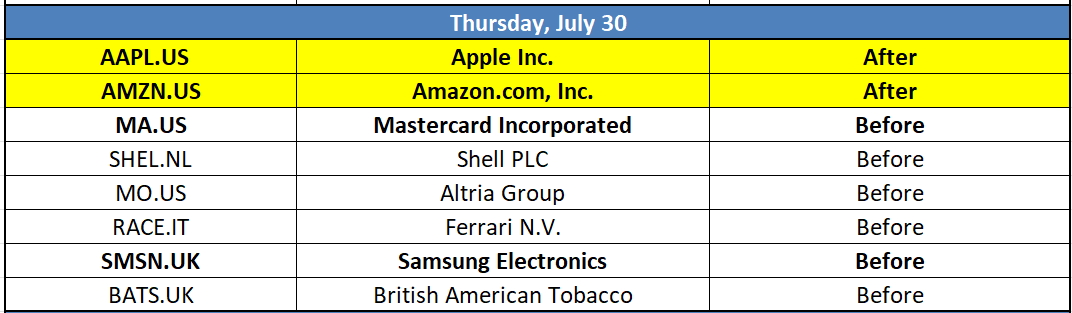
Key quarterly results for Apple, Amazon and Coinbase are due to be published after the market closes – Apple is up 25 per cent over three months and has hit new highs, whilst Amazon is down 14 per cent over three months and Coinbase is down 60 per cent from its October peak, suggesting high implied volatility, particularly for the latter two companies. The South Korean semiconductor sector remains the most volatile segment globally – both Samsung Electronics and SK Hynix saw sharp price movements (up over 8% and down 10% respectively) following their quarterly results, which has repeatedly spilled over into global sentiment towards AI chips. If volatility on the KOSPI persists, we can expect continued pressure on US technology companies linked to memory and AI. Companies such as Mastercard, Altria, Ferrari and British American Tobacco have also presented or are due to present their reports.


Three markets to watch next week (23.10.2026)



Daily Summary: Oil at five-month highs, indices under pressure (23.10.2026)

US Open: Further declines on Wall Street, Brent above 111 USD, AI correction continues (14.10.2026)

BREAKING: France slows down, Germany holds on. Euro falls below 1.12