


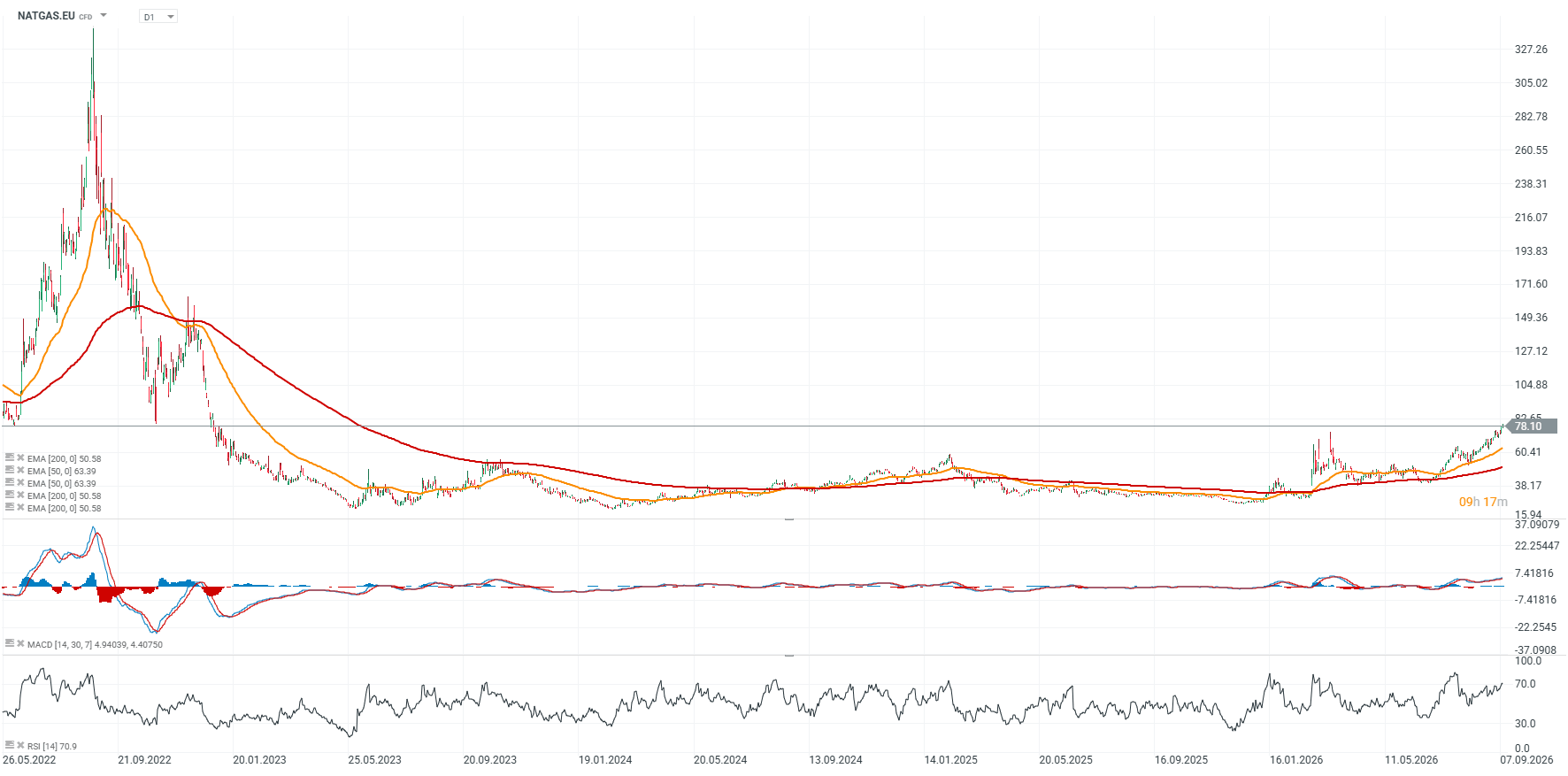
European gas prices are rising, with the front-month TTF contract climbing above €79/MWh on Wednesday morning to its highest level since December 2022. The US–Iran war is restricting LNG availability as Europe prepares for winter with unusually low inventories. At the same time, high near-term delivery prices are making storage less profitable and hampering efforts to rebuild reserves at attractive prices. The International Energy Agency (IEA) argues that supply security requires not only adequately filled storage facilities, but also larger strategic reserves, flexible contracts and cooperation between countries. Buying activity could pick up.
The Hormuz blockade and damage to Qatari facilities constrain supply
Since the beginning of the year, front-month TTF futures have traded between approximately €26.50 and €79/MWh. Escalating tensions in the Middle East have increased the risk premium, as threats to LNG supplies directly affect the cost of securing gas for European buyers. Before the conflict, around 20% of global LNG trade passed through the Strait of Hormuz. Its effective closure has blocked these shipments for several months, reducing the volume of gas available on the global market.
Strikes in March severely damaged two production units at Qatar’s Ras Laffan complex, taking around 17 billion cubic meters of annual capacity offline. According to IEEFA, this represents approximately 17% of Qatar’s LNG export capacity, while the IEA estimates that repairs will take three to five years. The supply problem therefore extends beyond simply restoring shipping through Hormuz. Since the 2022–2023 energy crisis, Europe has added more than 50 billion cubic meters of annual LNG import capacity, replacing a substantial share of Russian pipeline gas with seaborne supplies. More terminals do not, however, guarantee gas availability: European buyers still need to secure cargoes in a competitive global market.
Why are high prices making storage harder to refill?
Gas purchased in summer is usually cheaper than winter deliveries, allowing companies to profit from storing it and selling it later. However, the current crisis has pushed up near-term prices, while the market expects supply conditions to improve later in the year. This price structure weakens the financial incentive to refill storage in some European countries. Low inventories do not automatically mean that Europe will run out of gas. EU consumption remains around 15–20% below its 2021 level, allowing the economy to function with smaller reserves. However, this smaller safety buffer comes at the cost of greater reliance on ongoing LNG deliveries during winter.
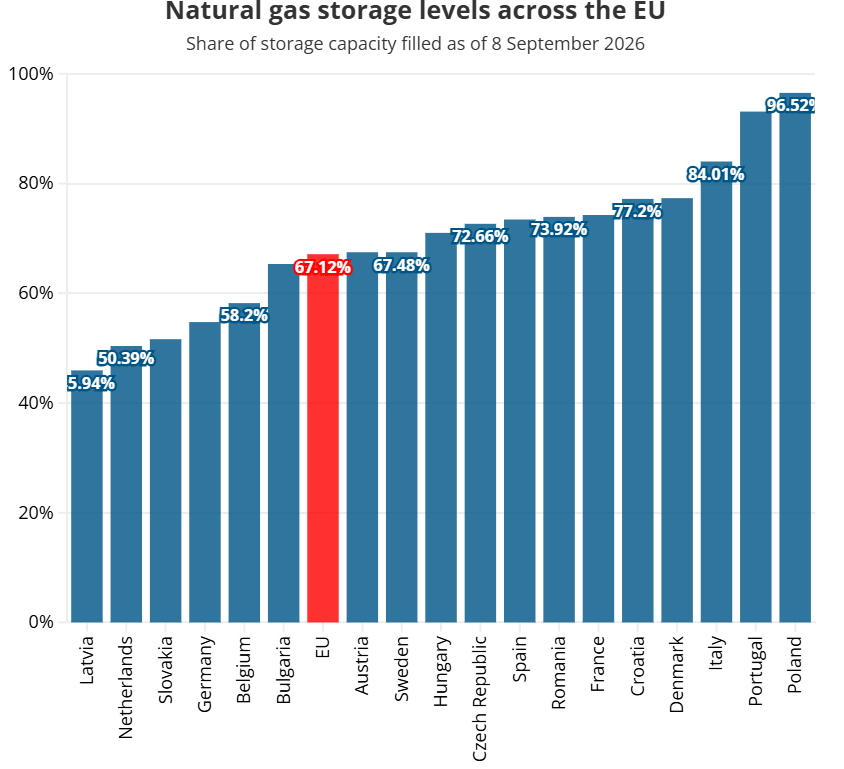
The EU target calls for storage facilities to be 90% full by November 1, although deviations are permitted under unfavorable market conditions. The IEA advocates a more flexible application of these requirements, supported by coordinated purchasing and emergency arrangements. Poland currently faces the least pressure on this front, with storage levels very high at around 96.5% as of September 8. Germany and the Netherlands face difficulties, while the EU average of 67% is historically low.
Source: AGSI
Gas above €100/MWh? Goldman Sachs outlines a risk scenario
Goldman Sachs estimates that, if Middle Eastern exports recover slowly, attracting enough LNG cargoes to Europe may require the December TTF contract to rise above €100/MWh. This is not the bank’s base case, which assumed €50/MWh, but a scenario dependent on persistent supply constraints. Higher energy costs are adding to inflationary pressure. Eurozone inflation reached 3.3% in August, driven primarily by rising energy prices, even as underlying price pressures eased.
Ahead of tomorrow’s ECB decision, investors are almost fully pricing in a 25-basis-point rate increase. Such a move would raise the deposit rate from 2.25% to 2.5%; however, this remains a market expectation rather than an announced decision, which is still around 24 hours away. Concerns that inflation and interest rates will remain elevated for longer are fueling a sell-off in European government bonds. Rising yields mean higher borrowing costs for governments as they refinance maturing debt.
IEA: strategic reserves should complement commercial inventories
In its “Gas Reserve Mechanisms and Flexibility Options” report, published today, the IEA proposes greater use of gas held outside the commercial market and released only in an emergency. Such reserves would provide an additional safeguard, rather than leaving countries reliant solely on mandatory storage targets and competition for LNG supplies.
Poland, Italy and Spain are among the countries that already hold national strategic gas reserves. According to IEA estimates, around 12 billion cubic meters of gas was held under such arrangements across the EU in 2025, equivalent to roughly 3.5% of annual consumption and 12% of working gas storage capacity. The agency encourages governments to expand these mechanisms and consider coordinating them at the EU or international level. Its recommendations align with the European Commission’s AccelerateEU strategy, which includes coordinated purchasing, flexible inventory management, demand reduction and measures to protect consumers from high energy costs.
Reserves abroad, flexible supplies and Ukraine’s potential
Countries could finance emergency gas stocks held abroad or jointly secure the right to purchase additional LNG cargoes in the event of shortages. More flexible contracts and supply swaps would make it easier to direct gas to where it is needed most. The IEA also points to the possibility of storing 10–15 billion cubic meters of gas in Ukraine. However, this would require an end to the war with Russia, which currently appears unlikely, as well as assurances that the facilities are safe. It is therefore not an option for the coming winter.
Other options under consideration include using older LNG vessels as temporary storage and releasing some of the gas normally retained in underground storage facilities. The agency stresses that these solutions require further study. Expanding reserves also requires agreement on who owns the gas, who pays to hold it and under what circumstances it can be released. The IEA notes, however, that while building emergency stocks carries a cost, being unprepared for a crisis could prove far more expensive.
TTF gas futures chart (D1 timeframe)
Source: xStation5


RBA turns increasingly hawkish as markets reprice November rate hike expectations ⚔️



Daily Summary: Buyers Refuse to Give In
US Natural gas extends declines 🔥📉



US OPEN: The wave of AI concerns is building again, oil returns near highs