


Gold extends its sell-off to its lowest level in 14 months, losing more than 30% from the record highs reached in early 2026. The precious metal is down more than 2% today, falling towards $3,750 per ounce, as markets almost fully price in a 25-basis-point Federal Reserve rate hike in December. According to UBS analysts, the recent decline primarily reflects changes in investor positioning rather than a fundamental deterioration in gold's long-term outlook. The Swiss bank has lowered its end-2026 gold price forecast to $4,500 per ounce while maintaining its end-2027 target of $5,000.
-
Gold has lost more than 30% from its peak: Rising US real bond yields, a stronger dollar and expectations of further Fed rate hikes are weighing on the entire precious metals market.
-
UBS expects a recovery in 2027: The bank believes that sustained central bank demand remains an important source of support, although a meaningful price recovery may take time.
-
Key price levels for gold: The $3,800 level has been breached today, increasing the risk of a decline towards $3,600–$3,500. A recovery above $4,000 could provide an initial signal of improving technical conditions.
Why is gold falling? US real bond yields approach 3%
The biggest challenge facing the gold market is not a lack of geopolitical uncertainty or a collapse in physical demand, but the growing attractiveness of US Treasury bonds. The yield on 10-year Treasury Inflation-Protected Securities (TIPS) has risen to around 2.92%, while nominal 10-year Treasury yields remain above 5%. This means investors can earn an inflation-adjusted yield of nearly 3% annually on US government bonds, whereas gold generates neither interest nor dividends.
This distinction is fundamental to portfolio allocation. Gold competes not only with equities and the US dollar but also with relatively safe, income-generating assets. The higher real interest rates rise, the greater the opportunity cost of holding bullion. In such an environment, even persistently elevated inflation may fail to support gold prices if real bond yields are rising simultaneously.
The situation is further complicated by the Federal Reserve's increasingly hawkish stance. According to today's futures market pricing, the probability of a 25-basis-point rate hike in December stands at approximately 95%, with the remaining 5% assigned to a 50-basis-point increase. Comments from Fed officials, including Alberto Musalem, have reinforced expectations of further monetary tightening.
Gold's sell-off does not necessarily signal the end of its long-term trend
UBS analyst Joni Teves believes the latest decline primarily reflects investors reducing their positions rather than a fundamental shift in gold's long-term investment environment. A stronger dollar, rising bond yields and investors shifting their attention towards artificial intelligence and energy stocks have limited capital inflows into precious metals. Furthermore, during the recent sell-off in US technology stocks, gold may have been sold to raise liquidity and reduce overall portfolio risk.
This is an important distinction: gold can decline during periods of heightened risk aversion when investors need cash to cover losses or meet margin requirements elsewhere. In the short term, its high liquidity can paradoxically work against its price. However, UBS believes long-term investors remain relatively resilient despite the correction, while gold ETF holdings show little evidence of widespread capitulation. The bank also highlights increased central bank buying activity during periods of falling prices.
Current forecasts suggest that several major financial institutions still anticipate a significant recovery in gold prices in 2027:
-
UBS: $4,500 per ounce by the end of 2026.
-
UBS: $5,000 per ounce by the end of 2027.
-
ANZ: $4,800 per ounce in 2027.
-
Goldman Sachs: $4,800 per ounce by the end of 2027.
At approximately $3,750 per ounce, UBS's end-2027 forecast would imply potential upside of around 33%. However, this does not mean the correction is expected to end quickly. On the contrary, persistently high bond yields and a strong US dollar could continue to limit the scale of any recovery over the coming quarters.
Central banks continue buying gold, but their demand has failed to stop the sell-off
One of the most interesting aspects of the current market environment is the divergence between investment demand and central bank purchases. According to the cited figures, central banks purchased more than 1,000 tonnes of gold annually between 2022 and 2024, followed by approximately 863 tonnes in 2025. Meanwhile, global gold ETF holdings reportedly reached a record 4,275 tonnes in October 2026. Despite continued institutional interest, bullion has fallen below the psychologically important $4,000 level.
Why, then, have central bank purchases been insufficient to stabilize prices? The answer may lie in the difference between structural, long-term demand and the financial flows that determine prices in futures markets. Central banks primarily purchase gold to diversify their reserves, whereas financial investors react much more quickly to changes in bond yields, currency movements and liquidity conditions. Stable physical demand can therefore help cushion price declines without necessarily preventing a short-term sell-off.
Another, less obvious factor worth considering is the financing of the artificial intelligence investment boom. According to BloFin Research, the largest US technology companies issued approximately $220 billion in bonds during the first eight months of 2026, increasing the supply of debt in financial markets. If growing AI infrastructure financing needs contribute to higher risk premiums and bond yields, they could indirectly put pressure on gold prices. A slowdown in debt issuance and a subsequent decline in real yields could eventually create more favorable conditions for a recovery in bullion, although such an outcome is far from certain.
What comes next for gold prices? Investors focus on December's Fed decision
The direction of US real bond yields is likely to remain the most important factor influencing gold prices. If the Fed maintains its hawkish stance and persistent inflation forces policymakers to raise interest rates further, bullion could remain under pressure despite continued central bank purchases. Conversely, deteriorating economic conditions, falling real yields or renewed weakness in the US dollar could improve the outlook for the precious metal.
The current correction demonstrates that gold is not an automatic hedge against every form of economic uncertainty. An environment in which an inflationary shock pushes real interest rates higher, rather than lower, can be particularly unfavorable for bullion. This mechanism helps explain why gold is falling despite geopolitical tensions, elevated government debt and continued central bank demand.
Gold technical analysis (GOLD, D1 timeframe)
From a technical perspective, the break below $3,800 has weakened a previously important support area and increased the significance of lower price levels. The $3,500 region now represents a potential downside target following a sustained break below $3,800, although the market could also begin stabilizing around current prices. An initial sign of improving technical conditions would be a recovery above $4,000, potentially opening the way towards $4,250, where the 200-day exponential moving average (EMA200, red line) is located. However, even a break above these levels would not necessarily confirm the end of the downtrend. A similar recovery attempt around late August and early September was followed by a rapid deterioration in market sentiment.
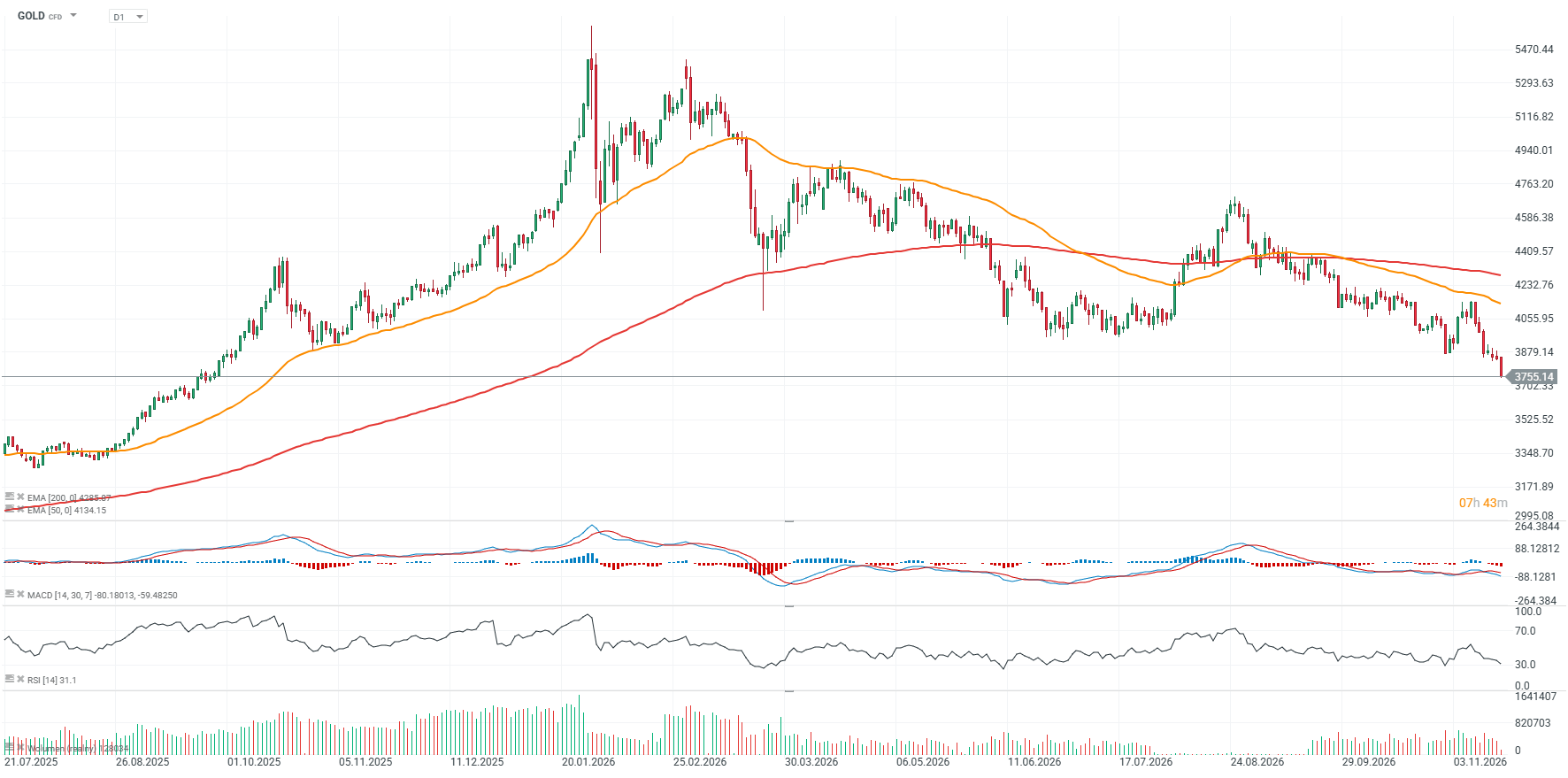 Source: XTB

US OPEN: Nvidia Isn’t Enough as Wall Street Slips Back Into the Red


🚩 Silver loses 3%

Gold falls despite Middle East war. Is the Fed a bigger threat than geopolitics? 🪙


Morning wrap (18.11.2026)