



Less than a month after a spectacular victory in the parliamentary elections, Péter Magyar has reached an agreement with the European Commission to unlock frozen EU funds.
Hungary’s new Prime Minister presented an ambitious reform plan in Brussels, which received preliminary approval from Ursula von der Leyen. The agreement paves the way for the release of €16.4 billion, including €10 billion from the Recovery and Resilience Facility (RRF), €4.2 billion from cohesion funds, and €2.2 billion linked to reforms aimed at restoring academic freedom.
However, the funds will not flow to Budapest immediately. Brussels will disburse the capital in tranches, conditional upon the prior implementation and official EC approval of specific legislative changes. The new cabinet's most critical commitments include:
- Hungary joining the European Public Prosecutor's Office (EPPO);
- Strengthening the independence of the national Integrity Authority, which is responsible for combating corruption;
- Dismantling the public interest asset management foundations (PITs) that have controlled Hungarian universities, enabling local students to immediately rejoin the Erasmus program for the upcoming academic year.
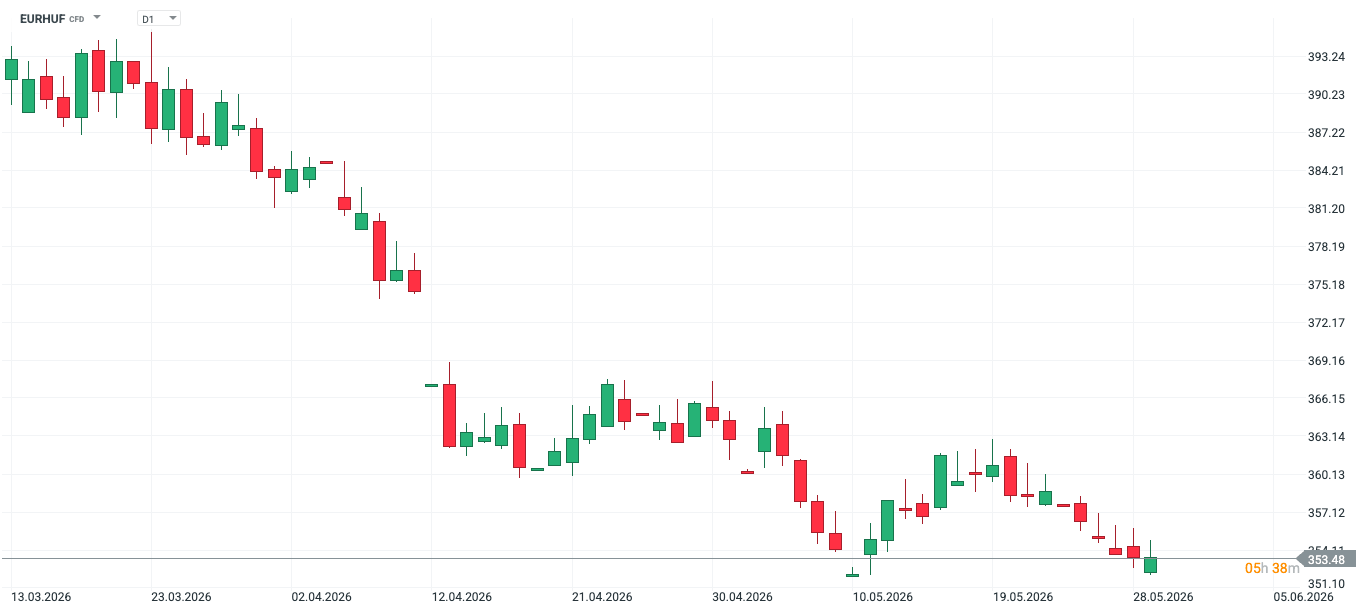
Financial markets reacted swiftly to the news. The prospect of massive capital inflows and normalized relations with the EU provided a clear boost to the local currency, causing the EUR/HUF pair to drop by 0.5%. However, because a swift unfreezing of EU funds had already been largely priced in by market participants, the scale of the currency move remained somewhat limited.
Figure 1: EUR/HUF (13.03 - 29.05)
 Source: xStation, 29.05.2026
Substantial gains were also recorded on the Budapest Stock Exchange, where the benchmark BUX index surged by 2.4%.
—
Michał Jóźwiak, Financial Markets Analyst at XTB



Daily Summary: Oil at five-month highs, indices under pressure (23.10.2026)


BREAKING: France slows down, Germany holds on. Euro falls below 1.12



Daily Summary: Valuations Under Pressure, Capital Moves Away From Technology

Market Wrap: "Decent" results are not enough – tech stocks fall further; oil highest since May (22.10.2026)