


Despite the market’s focus on stocks such as Micron and Apple, some investors are turning their attention to IBM.
The company has unveiled chip technology below 1 nanometer. The new architecture, referred to as “nanostack,” is intended to enable vertical stacking of transistors and further increases in computing density at a time when traditional semiconductor scaling is approaching physical limits.
According to IBM, the new 0.7 nm technology could fit up to 100 billion transistors on a chip the size of a fingernail. That is twice as many as the earlier 2 nm chip presented by the company in 2021. In its 2022 report, IBM indicated that it had signed a three-year joint development/licensing agreement with a Japanese consortium regarding IP and know-how in advanced semiconductors, which was expected to generate around USD 100 million in revenue in 2022. Monetizing the next phase of IBM’s technology development will take time, but it could be more impressive.
Other potential benefits include (estimated) 50% higher performance or up to 70% lower power consumption versus the 2 nm generation. Particularly in the context of AI, the claimed improvement in SRAM memory scaling may also matter, data bandwidth and efficiency are increasingly becoming key constraints on the development of AI accelerators.
From a technology standpoint, IBM’s announcement strengthens the long-term thesis that the semiconductor industry still has room to increase computing power despite growing constraints. For the AI market, this potentially means a further decline in the cost per unit of computation and greater data-center efficiency.
At the same time, the breakthrough is, for now, research-and-development in nature rather than commercial. Any deployment, mass production, and monetization are likely a matter of years and would probably occur mainly through technology licensing and cooperation with a foundry company (e.g., Intel).
In the short term, it is difficult to expect a significant impact on IBM’s revenues and margins. The information improves perceptions of the company’s technological capabilities and strengthens its position in strategic areas, including AI. Over time, the breakthrough may also start to support the broader market, which is questioning the rationale and quality of hyperscalers’ capital expenditures.
IBM.US (D1)
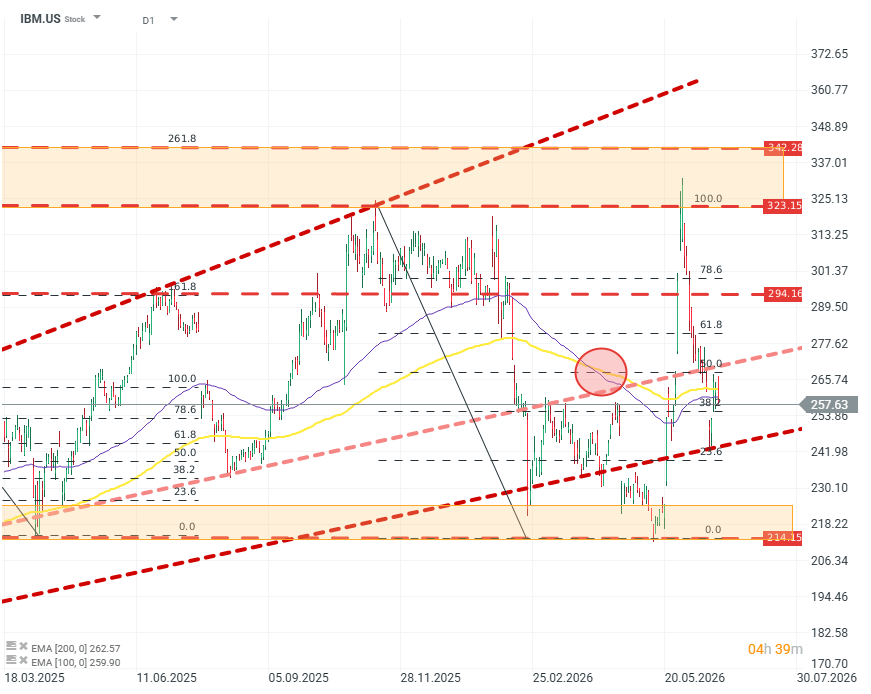
The market reaction is muted. The stock initially gained about 2% in Thursday’s session, but as overall sentiment deteriorated, the price move turned downward. The stock remains in a broad rising trend channel and a consolidation channel between $330 and $220, currently closer to its lower boundary. Source: xStation5.

Marvell: Memory-market problems and opportunities


⛩️Chart of the Day: JP225, Nikkei Plays Its Own Tune (01.10.2026)



Morning Wrap: Tech Rally in Asia Following Micron Results and Weakening Yen Despite Hawkish BoJ

Record after record: Micron smashes Q4 results, server overload crashes website, stock surges post-market