



Texas Instruments, one of the largest producers of analog and embedded signal processing chips, has confirmed that its capital expenditures (CapEx) for fiscal year 2026 will be significantly reduced to $2–3 billion, down from approximately $4.6 billion spent in 2025. This decision has put short-term pressure on the stock, as markets interpret it as a cautious signal in the face of uncertain conditions.
Financial Results and Company Strategy
In its fourth-quarter 2025 results, Texas Instruments reported $4.42 billion in revenue, representing a 10% year-over-year increase, although earnings per share (EPS) of $1.27 came in slightly below market expectations. Management highlighted a slowdown in revenue growth dynamics and the need to remain flexible in responding to market conditions. Guidance for the first quarter of 2026 anticipates $4.32–4.68 billion in revenue and EPS of $1.22–1.48, which the market perceives as better than seasonal expectations.
Among key growth segments, demand for data center solutions stands out, growing at a double-digit pace, partially offsetting concerns over slower recovery in other semiconductor segments.
CapEx and Capital Management
The reduction in CapEx guidance has two main drivers. First, the company continues to build out its own production infrastructure, including advanced 300mm wafer fabs, which previously drove higher capital outlays. Second, management has opted to exercise greater control over spending, improving free cash flow rather than aggressively expanding production capacity. This approach can be seen as a response to market expectations and investor pressure to increase capital efficiency while focusing on profitability rather than simply expanding capacity.
Current Market Challenges
We are currently living in extremely dynamic and demanding times. Some companies announce massive capital expenditures, signaling ambition and expansion plans, but also raising investor concerns about potential overinvestment and capital waste. As a result, even the largest tech stocks can see share prices decline following such announcements. At the same time, companies that reduce their CapEx also face market pressure, as investors worry that they are not investing in growth and future technologies.
In this environment, finding the right balance is extremely challenging. Markets are now highly selective regarding capital allocation and growth strategies. Simply announcing chip production in the U.S. or increasing exposure to artificial intelligence no longer guarantees automatic stock price gains. Investors increasingly expect a balanced approach that combines cost control, efficient capital management, and simultaneous execution of growth strategies.
Strategic Market Implications
-
The reduction in 2026 CapEx signals that Texas Instruments is prioritizing capital discipline, which could strengthen free cash flow generation and provide a foundation for more stable financial results in the medium term.
-
Higher free cash flow per share remains a key valuation metric, and the CapEx cut supports this focus.
-
The analog chip segment is still in a phase of uncertain demand recovery. While some product groups show improvement, the market remains sensitive to global industrial demand and automation trends.
-
The CapEx reduction may limit short-term investor enthusiasm, but prospects for operational improvement and a strong position in key segments could have a positive impact on valuation over the longer term.
-
Strategic investments in U.S. fabs and the acquisition of Silicon Labs show that the company is balancing cost control with portfolio expansion, particularly in wireless connectivity and IoT.
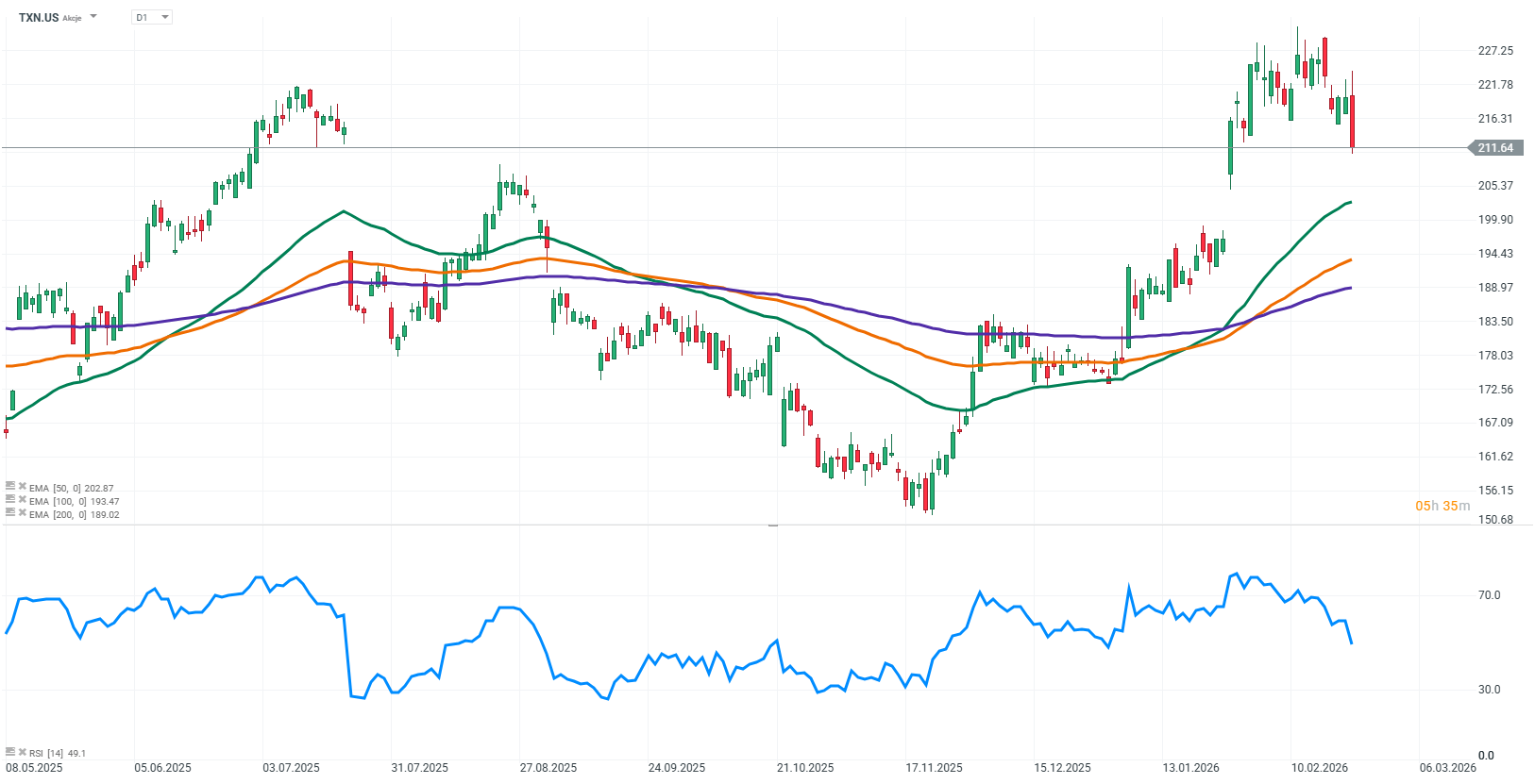
Source: xStation5


Market wrap: European indices rebound 🔼 Defence stocks on the rise


TSMC in Talks with Elon Musk Over Terafab


Daily summary 📈 Precious metals and stock indices rebound as Treasury yields fall


US Open: Nasdaq 100 extends losses 🚩 AI stocks under pressure, CoreWeave falls 8%