



Laser Photonics (LASE) shares surged nearly 170% after the company announced that its Laser Shield Anti-Drone System (LSAD) had been selected for a U.S. government defense technology evaluation program. The company emphasized that this does not represent a contract award or purchase order, but rather participation in a technical assessment process. The current share price surge appears largely speculative, as participation in a technical evaluation process does not guarantee a future defense contract.
- The LSAD system was selected through the Mission Engineering and Integration Activity (MEIA) Vulcan Call for Solutions and received a top ranking in the Counter C5ISR-T category, which covers command, control, communications, cybersecurity, intelligence, surveillance, reconnaissance, and targeting technologies.
- The next phase involves direct technical engagement with government engineers to evaluate the system's effectiveness, scalability, and suitability for military operational requirements.
- Projects that successfully complete this stage may advance to prototype programs or receive funding for further testing and experimentation.
- CEO Wayne Tupuola stated that the selection validates the readiness and operational relevance of the company’s directed-energy technology for military applications.
- Despite the sharp rally, Laser Photonics remains at a very early stage of commercializing its defense technologies. In 2025, the company generated $8.3 million in net sales while reporting a net loss of $17.5 million. Revenue growth was driven primarily by acquisitions and industrial demand, but the company remains unprofitable.
Securing defense contracts in the United States can take years and typically involves multiple testing, validation, and certification stages. Meanwhile, Laser Photonics remains under regulatory pressure from Nasdaq. On May 22, the company received a non-compliance notice due to a delayed filing of its quarterly report (Form 10-Q for Q1 2026). Laser Photonics has 60 days to submit a remediation plan and could have until November 16, 2026, to regain full compliance.
At the same time, the counter-drone market continues to expand rapidly as low-cost drones become increasingly prevalent on modern battlefields. More companies are investing in laser-based defense technologies. AeroVironment is developing its Locust X3 anti-drone laser system, while Australia’s Electro Optic Systems (EOS) is expanding high-energy laser production capacity in Singapore.
A key advantage of laser weapons is their low cost per engagement compared with expensive interceptor missiles, making directed-energy systems increasingly attractive to military customers worldwide.
Laser Photonics shares (LASE.US, D1 timeframe)
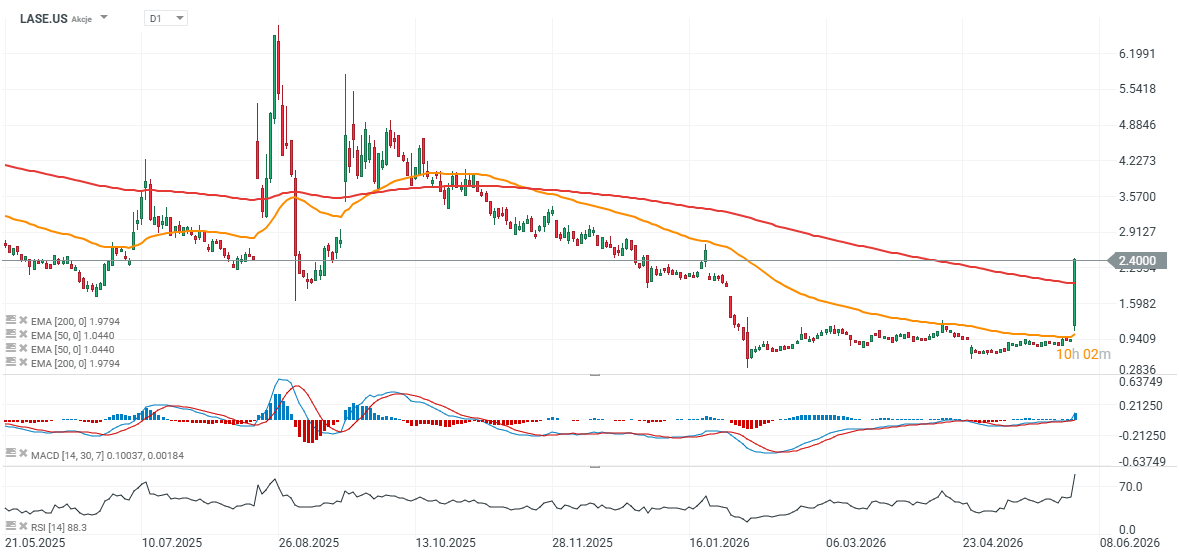
Source: xStation5



Daily Summary: A Shallow Rebound Ahead of Earnings Season


Lumentum: Demand for AI infrastructure exceeds capacity



US OPEN: Trump de-escalates, OpenAI supports Wall Street sentiment


Morning Wrap: OpenAI Revenue Concerns Weigh on Wall Street