



📉 Equity Markets
- Friday’s session on European equity markets is marked by mixed sentiment. The UK’s FTSE 100 and France’s CAC 40 are leading modest gains, although their upside remains limited.
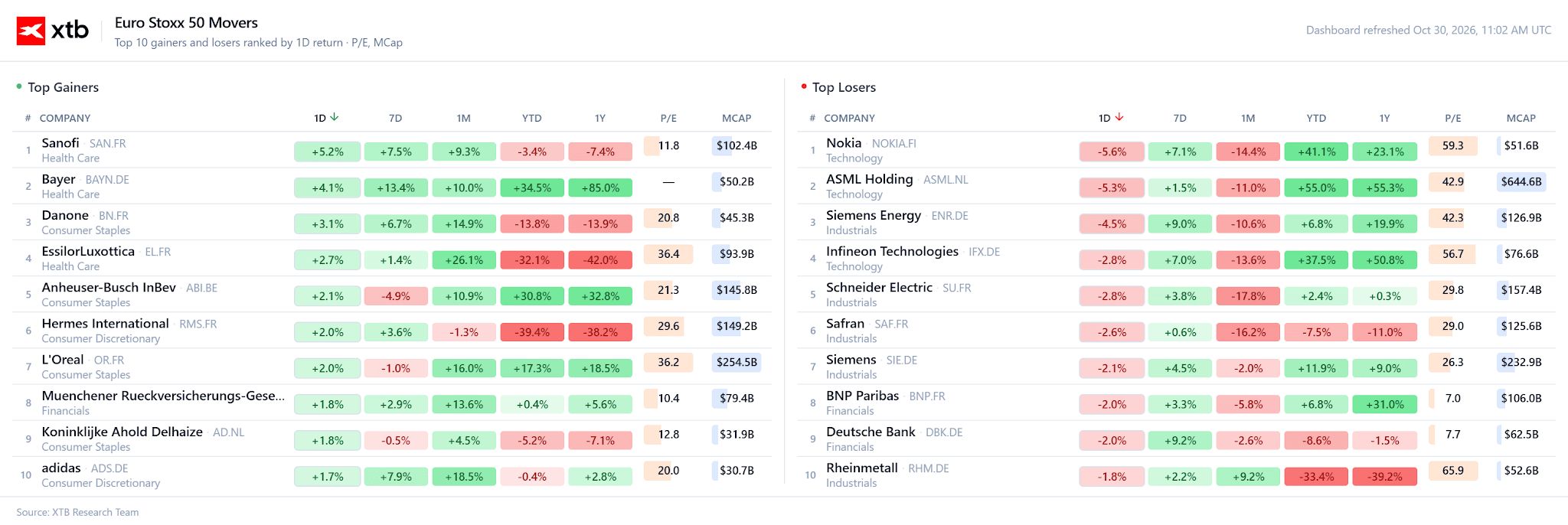
- At the other end of the performance table, Germany’s DAX and Spain’s IBEX 35 are both down around 0.5%, while the pan-European Euro Stoxx 50 is also facing notable selling pressure.
- Sentiment across European markets is being shaped by a global sell-off in technology stocks, initially triggered by Alphabet’s quarterly results and subsequently deepened by earnings reports from Amazon and Intel.
- Investor sentiment is deteriorating primarily amid growing concerns over the enormous capital expenditure required to develop AI infrastructure.
- Amazon is reporting negative free cash flow of $42.4 billion, while capital expenditure alone reached $77.3 billion in the third quarter.
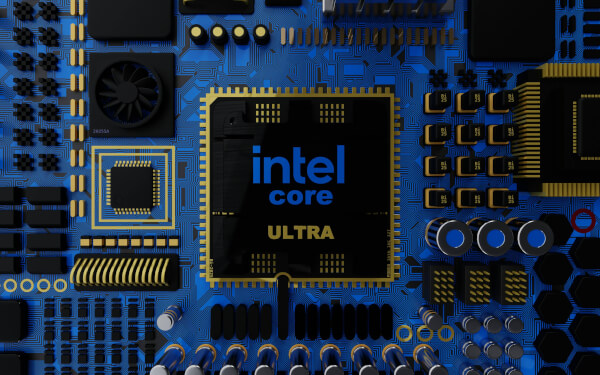
- Intel’s results are also disappointing. The company has issued fourth-quarter revenue guidance below market expectations, pointing to a clear slowdown in demand across the personal computer segment.
- The sell-off is spilling over into Europe’s semiconductor and technology sectors, putting shares of ASML, ASM International and Infineon under significant pressure, particularly companies supplying infrastructure for data centres.
🏛️ Macroeconomics and Central Banks
- Macroeconomic data released during the session point to greater-than-expected resilience in the European economy. Eurozone GDP grew by 0.4% quarter on quarter and 1.3% year on year in the third quarter, exceeding market forecasts of 1.1% annual growth.
- Germany and Spain remain the main pillars of economic activity across the euro area, while Italy continues to stagnate and France is showing a marked slowdown in growth.
- In Germany, GDP expanded by 0.2% quarter on quarter, beating market expectations of 0.1%, bringing annual growth to 1.3%.
- Despite the positive headline figure, the German economy continues to face structural challenges. The third quarter saw a slowdown in export growth, which has traditionally been the main engine of the economy, alongside declining capital investment and only marginal increases in household consumption and public spending.
- Italy’s figures were considerably weaker. GDP was unchanged quarter on quarter, with annual growth standing at 0.8%. Positive contributions from the services and agricultural sectors were entirely offset by a sharp downturn in industrial activity and a negative contribution from net exports.
- Inflation remains a major concern across Europe, with price growth accelerating again in the eurozone’s largest economies and significantly complicating the European Central Bank’s policy outlook.
- The biggest negative surprise came from Italy, where CPI inflation rose to 5.4% year on year in October, up from 4.2% in September, while prices increased by 0.9% month on month. The acceleration was driven primarily by rising energy costs, with core inflation also climbing from 1.6% to 2.0% year on year.
- Inflationary pressures are also intensifying in France, where CPI accelerated to 3.4% year on year from 3.1% in September, driven by higher energy, gas and fuel prices, as well as rising costs across transport and hospitality services.
- Spain presents a more stable picture, with CPI inflation holding at 4.9% year on year and core inflation unchanged at 3.1%. Higher energy and gas prices are being partly offset by lower fuel prices and a slower pace of food price increases.
- The combination of relatively resilient economic activity and a renewed inflationary rebound leaves the European Central Bank in an especially difficult position.
- Stronger-than-expected GDP growth weakens the case for further aggressive monetary easing, while the return of price pressures raises the risk that inflation will remain elevated over the coming quarters.
- As a result, the ECB’s December meeting is emerging as a key source of market risk. Investors will be closely watching upcoming inflation data and developments in energy prices.
🛢️ Commodities
- Precious metals are firmly in negative territory during Friday’s session, with sellers clearly dominating trading.
- Gold is down by more than 1%, breaking below the psychologically important $4,000-per-ounce level.
- Silver is facing an even sharper sell-off, falling nearly 3% and testing a key support level around $50 per ounce.
- Sentiment is markedly different in energy markets, where crude oil prices are moving higher.
- Brent crude futures are up nearly 2%, testing the $114-per-barrel level, while WTI is gaining almost 1.5%, approaching $105 per barrel.
🪙 Cryptocurrency Market
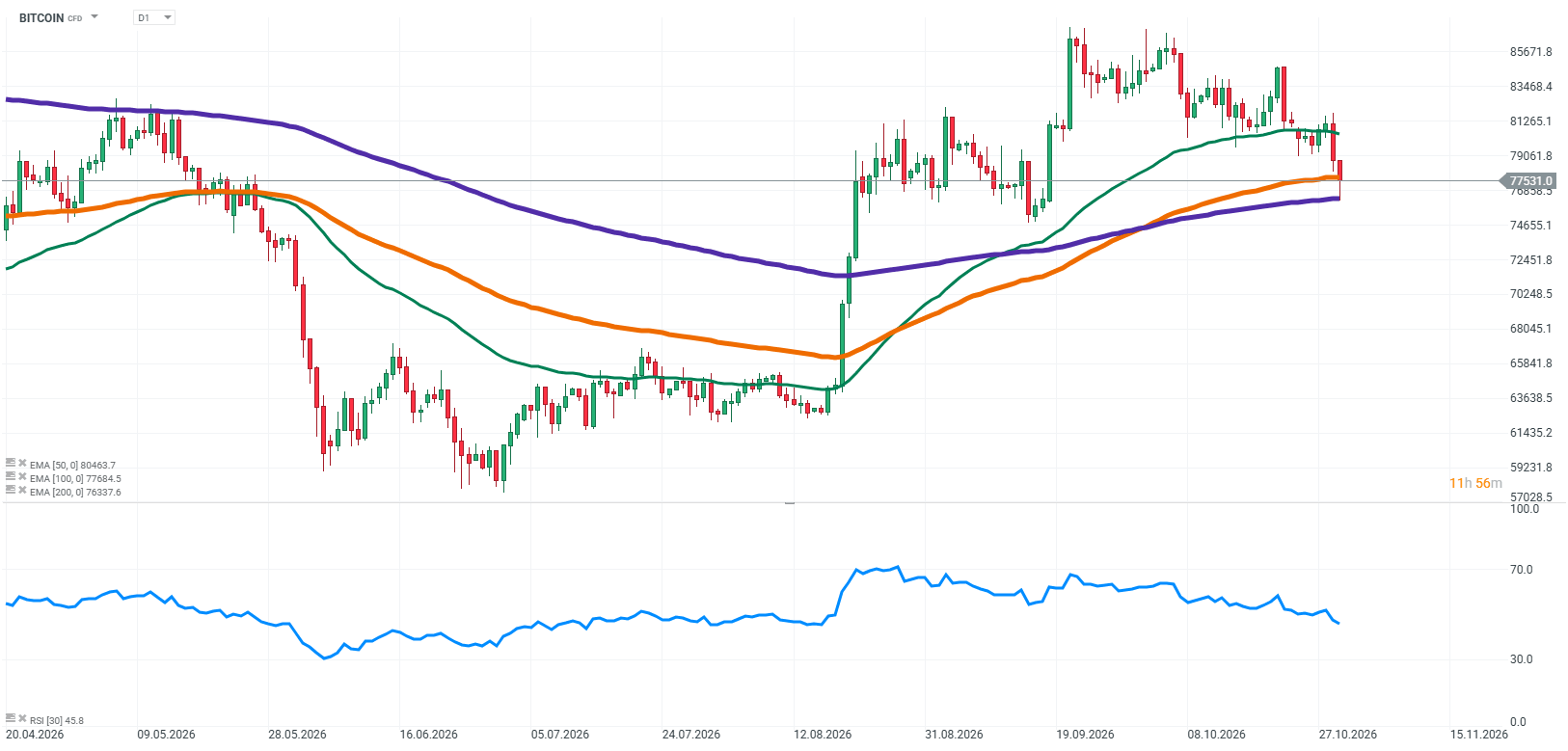
- Digital assets are under significant pressure following what is being described as the largest cyberattack in Binance’s history, with estimated losses of $6.3 billion.
- According to preliminary reports, the breach was made possible by the successful compromise of a work laptop belonging to one of the platform’s key engineers.
- In response to the incident, Binance has temporarily suspended deposits and withdrawals while implementing emergency procedures in cooperation with specialist blockchain security firms.
- Operational measures taken so far have resulted in approximately $3 billion worth of stolen assets being frozen. However, the recovery of the remaining funds remains uncertain.
- Concerns are mounting over whether customer claims can be fully covered. Binance’s Secure Asset Fund for Users (SAFU) holds reserves of approximately $1 billion, meaning the exchange may need to commit a substantial amount of its own capital to cover the shortfall.
Source: XTB Reseach


Chart of the Day: USDJPY After Fed and BoJ decisions. Is Japan getting closer to another rate Hhike?

Intel has come face to face with reality. A Turnaround is still a long way off.



Binance Hit by the Largest Hack in Cryptocurrency Market History. Losses Could Reach USD 6.3 Billion



Economic Calendar: Preliminary European GDP and German Inflation in Market Focus