



- The United States and Iran have exchanged military strikes for a sixth consecutive day, raising the risk of further disruptions to global energy markets.
- Rising oil prices have revived concerns that inflation could remain elevated for longer, making it more difficult for central banks to continue easing monetary policy.
- European markets are significantly outperforming their Asian counterparts, largely because European indices have much lower exposure to large-cap technology stocks.
- The semiconductor sector came under pressure, with STMicroelectronics falling around 5% and ASML down approximately 3.5%.
- Investors are partly looking through the geopolitical tensions thanks to a strong start to the earnings season, particularly from major European banks, which supported equity markets earlier this week.
- At the same time, leading strategists are becoming increasingly optimistic about European equities. According to a Bloomberg survey, UBS and Deutsche Bank have raised their year-end targets for the STOXX 600, citing accelerating corporate earnings growth and the market's resilience to geopolitical risks.
- UBS is now among the most bullish firms on European equities, forecasting that the STOXX 600 could gain around 8% by the end of the year.
- Better-than-expected U.S. inflation data has eased concerns about an immediate rise in interest rates, although higher oil prices are once again complicating the inflation outlook.
- Investors are now turning their attention to next week's European Central Bank policy meeting.
- Most economists expect the ECB to leave interest rates unchanged, although money markets have begun pricing in a higher probability of a rate hike later this year.
- London's FTSE 100 was down around 0.3%, while France's CAC 40 lost approximately 0.6% and Germany's DAX declined about 0.5%.
- Southern European markets also traded lower, with Italy's FTSE MIB down roughly 1% and Spain's IBEX 35 slipping around 0.3%.
Charts of EU50 and DE40
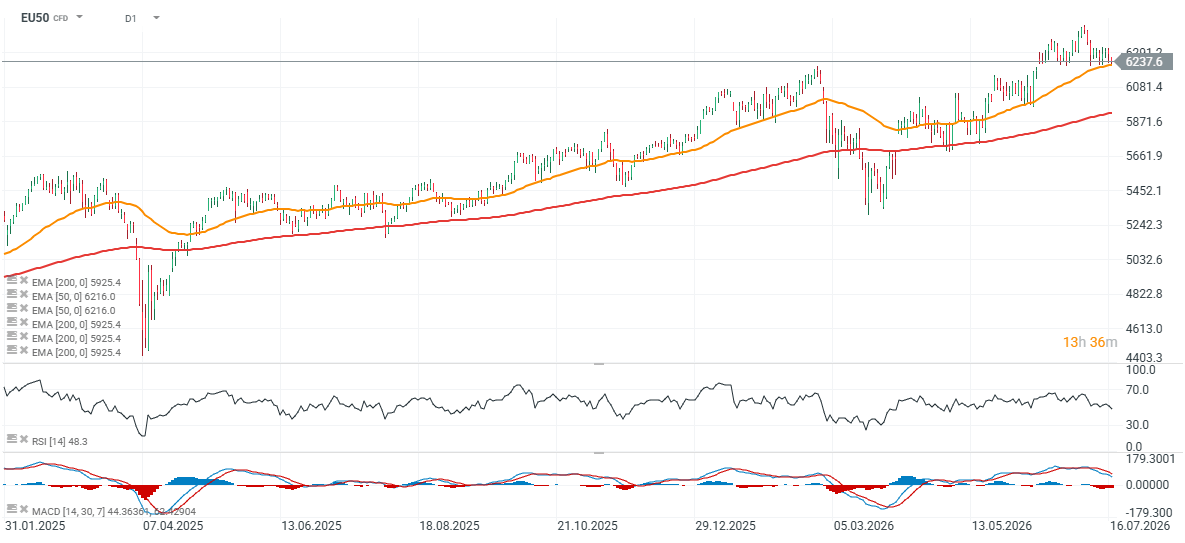
Looking at the chart of Euro Stoxx 50 futures (EU50) we can clearly see that the EMA50 average become the support. Falling below the 6216 level may open the way for the longer correction even to 5925 points, where we can see the EMA200 (the red line). Inflation concerns and higher oil prices may drive the decline.
Source: xStation5
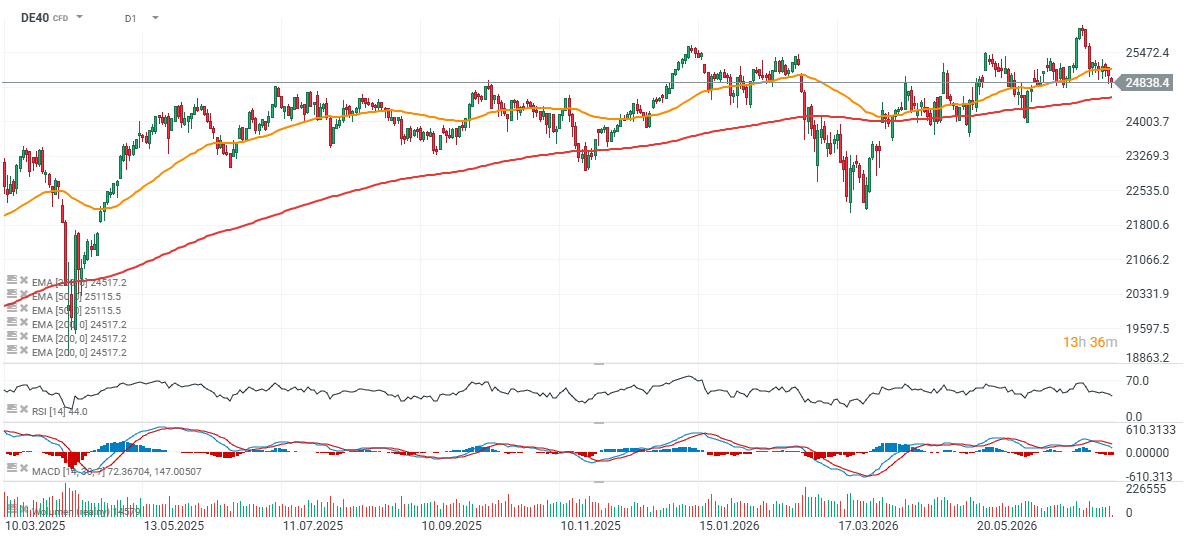
Futures on German DAX are falling today also, and are only slightly higher than the EMA200 (the red line) level, at 24,500 points. The RSI is close to the neutral levels at 44, but on the volume side we can see the dominating power of bears.
Source: xStation5
Tomra Systems gains 15% after earnings
Shares of Tomra Systems (TOM.NO), Europe's leading manufacturer of reverse vending machines, are up nearly 15% on Friday, reaching their highest level since late April.
Investors welcomed stronger-than-expected second-quarter results and exceptionally strong growth in the company's Collection division, which manufactures reverse vending machines for bottle and can deposit return systems.
Globally the company's reverse vending machines collect more than 50 billion empty bottles and cans every year.
New deposit return systems drive revenue growth
Group revenue increased 25% year-over-year to €405 million, while adjusted EBITA rose 30% to €57 million. Adjusted earnings per share increased from €0.08 to €0.10, although the gross margin declined to 41.3% from 44.3% a year earlier due to a less favorable product mix.
By far the strongest-performing business was the Collection division, where revenue surged 45%. Growth was driven by the rollout of new deposit return schemes in Poland, Portugal, Singapore, and Romania, boosting demand for the company's reverse vending machines.
Another important catalyst is Tomra's recently announced contract to supply around 1,200 reverse vending machines to a major UK retailer ahead of the country's nationwide deposit return scheme, scheduled to launch in 2027. According to Barclays, the UK market could ultimately require as many as 17,000 TOMRA machines.
The company's remaining business segments delivered mixed results. Revenue in the Food division increased 5%, while Recycling revenue declined 11% due to weaker demand across Asia. Tomra maintained its full-year guidance and expects Collection revenue of €400-440 million in the second half of 2026, compared with €454 million in the first half.
The company also forecasts €200-215 million in full-year Recycling revenue and €340-360 million for the Food division. Management warned that trade tensions, tariffs, and broader market uncertainty could delay customer investment decisions. Around 15% of group revenue comes from the United States, while more than 90% of U.S. sales are supplied from Europe, leaving the company exposed to potential tariffs. Despite these risks, investors focused primarily on the strong momentum in the Collection business and the long-term growth opportunity created by the global expansion of deposit return systems.
Tomra Systems (TOM.NO) chart
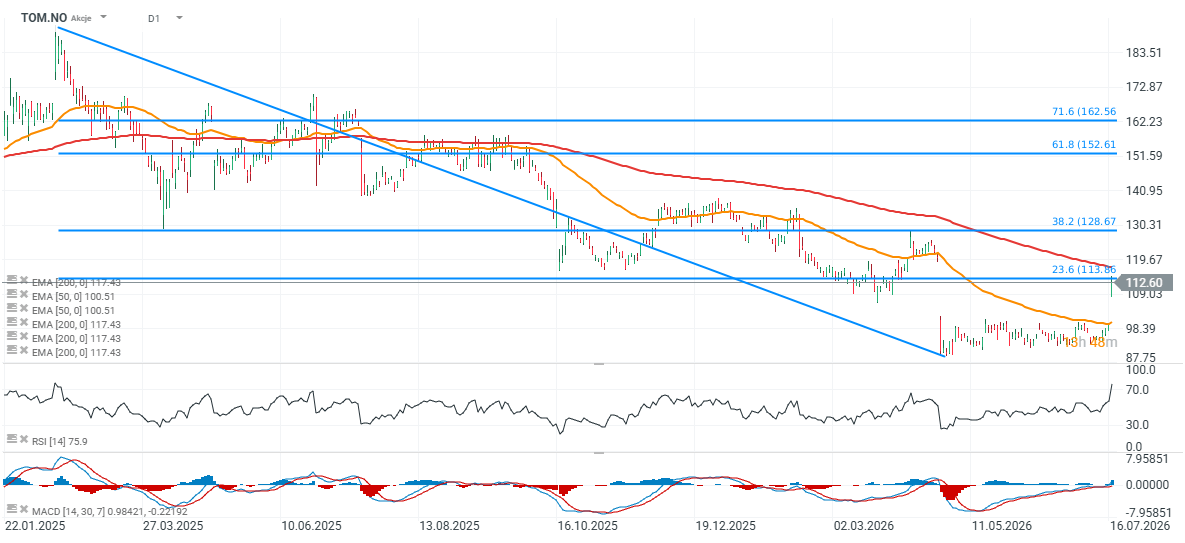
The stock is posting a double-digit gain today, but it has remained in a long-term downtrend for several years. Even after today's rally, the shares are still around 5% below the 200-day EMA (red line), which is widely regarded as the dividing line between long-term uptrends and downtrends.
For the bulls, the key technical hurdle is not only a breakout above the 200-day EMA near NOK 117, but also a move above the 38.2% Fibonacci retracement of the latest downward impulse at around NOK 128. Important support levels are located near NOK 109, today's opening price, and the NOK 98-100 area, where the stock traded before today's gap higher.
Source: xStation5


Chart of the Day 📉 DE40 Falls 0.7% and Tests Key Support Amid Weak European Market Sentiment (October 8, 2026)


Morning wrap: Wall Street and precious metals attempt to stabilize as oil gains nearly 2%


🚩 Caterpillar shares extend decline, down 30% from record high


Webull shares down 20% amid fears over potential China ties