



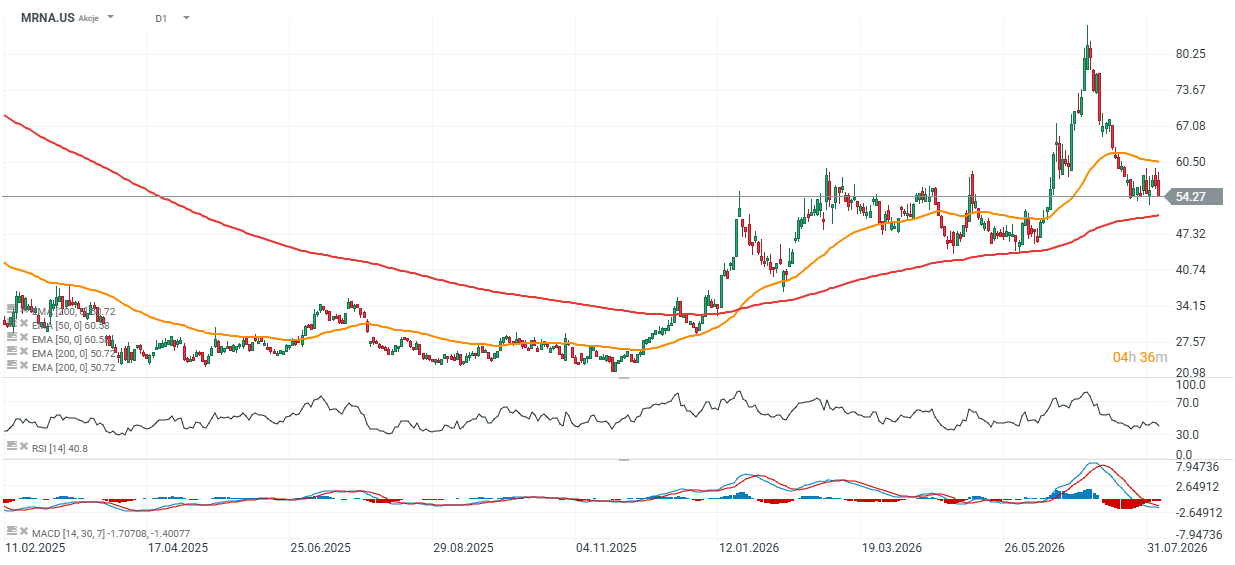
Moderna shares initially opened Thursday's session around 5% higher, climbing to approximately $58, before reversing lower to trade near $53 despite positive news surrounding the company's influenza vaccine. The move provides a good opportunity to revisit Moderna's valuation and overall financial position, as the company transitions from being one of the biggest beneficiaries of the post-pandemic biotech boom to a business increasingly valued on the strength of its future pipeline. Earlier today, the US Food and Drug Administration (FDA) approved Moderna's mRNA-based influenza vaccine, mFlusiva, for adults aged 50 and older. Interestingly, Moderna shares had rallied almost fourfold from their 2025 lows before entering a correction of roughly 30%, which continues today. Even so, the company's fundamentals appear increasingly supportive of its long-term growth prospects in the next-generation vaccine market.
Source: xStation5
Balance sheet and liquidity: Moderna still boasts one of the strongest balance sheets in biotech
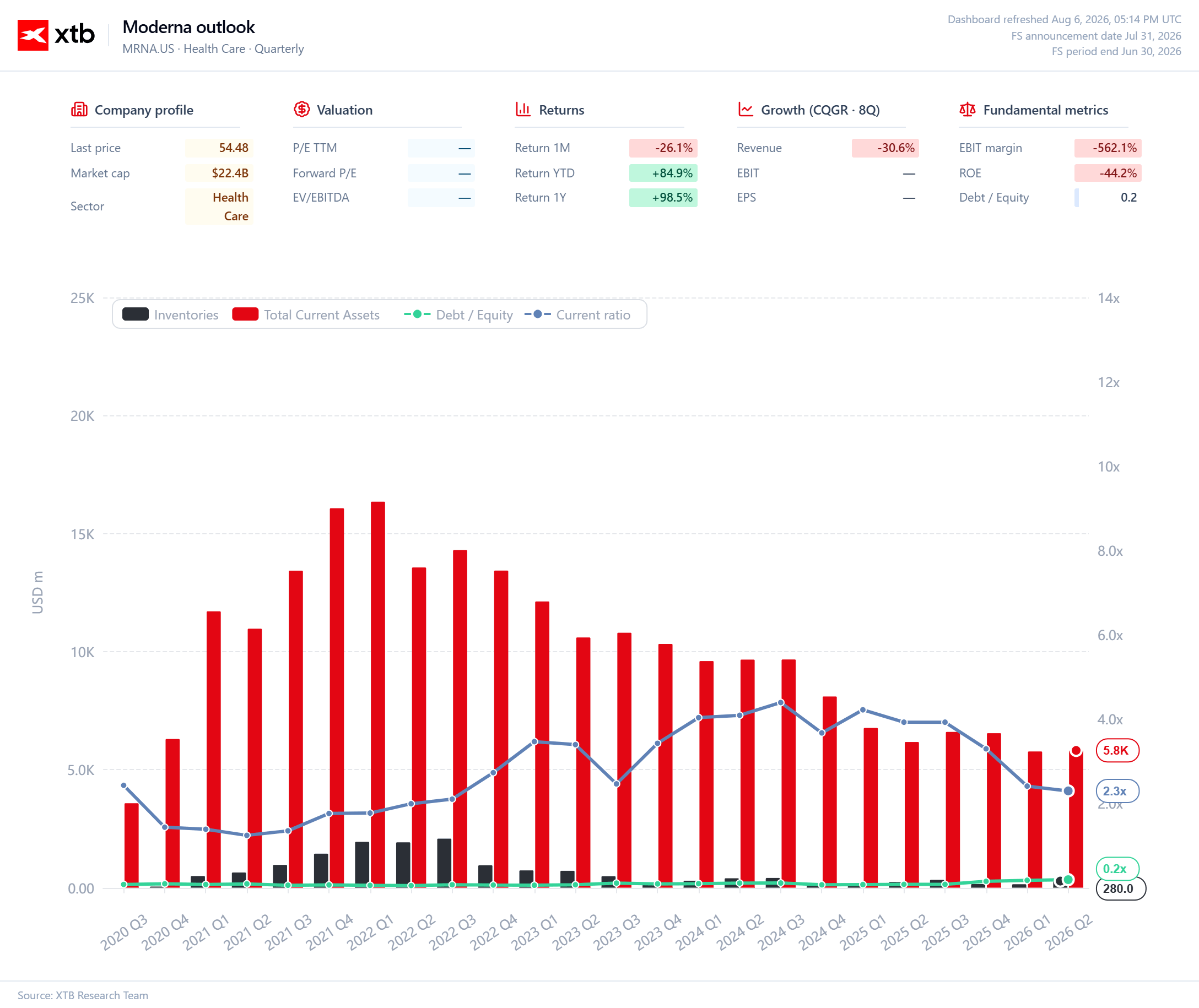
Moderna is in a very different position today than it was at the height of the pandemic, yet its balance sheet remains one of the company's greatest competitive advantages. Current assets have gradually declined as the cash generated during the COVID vaccine boom has been deployed, but the company still holds roughly $5.8 billion in liquid assets, providing ample resources to fund years of clinical development. At the same time, leverage remains exceptionally low, with a debt-to-equity ratio of around 0.2, meaning Moderna continues to finance its growth without relying heavily on debt. The decline in the current ratio from its historical highs should therefore be viewed as a natural consequence of deploying pandemic-era cash rather than as a deterioration in financial quality. For any biotechnology company, the length of its cash runway is a critical valuation factor, and Moderna remains among the strongest names in the industry on that measure. From a fundamental perspective, investors are placing less value on the company's cash balance itself and more on management's ability to convert that capital into commercially successful products. Ultimately, capital allocation, rather than the size of the cash reserve, is likely to determine Moderna's long-term intrinsic value.
Source: XTB Research
Revenue and profitability: The market is shifting from COVID dependence to pipeline valuation
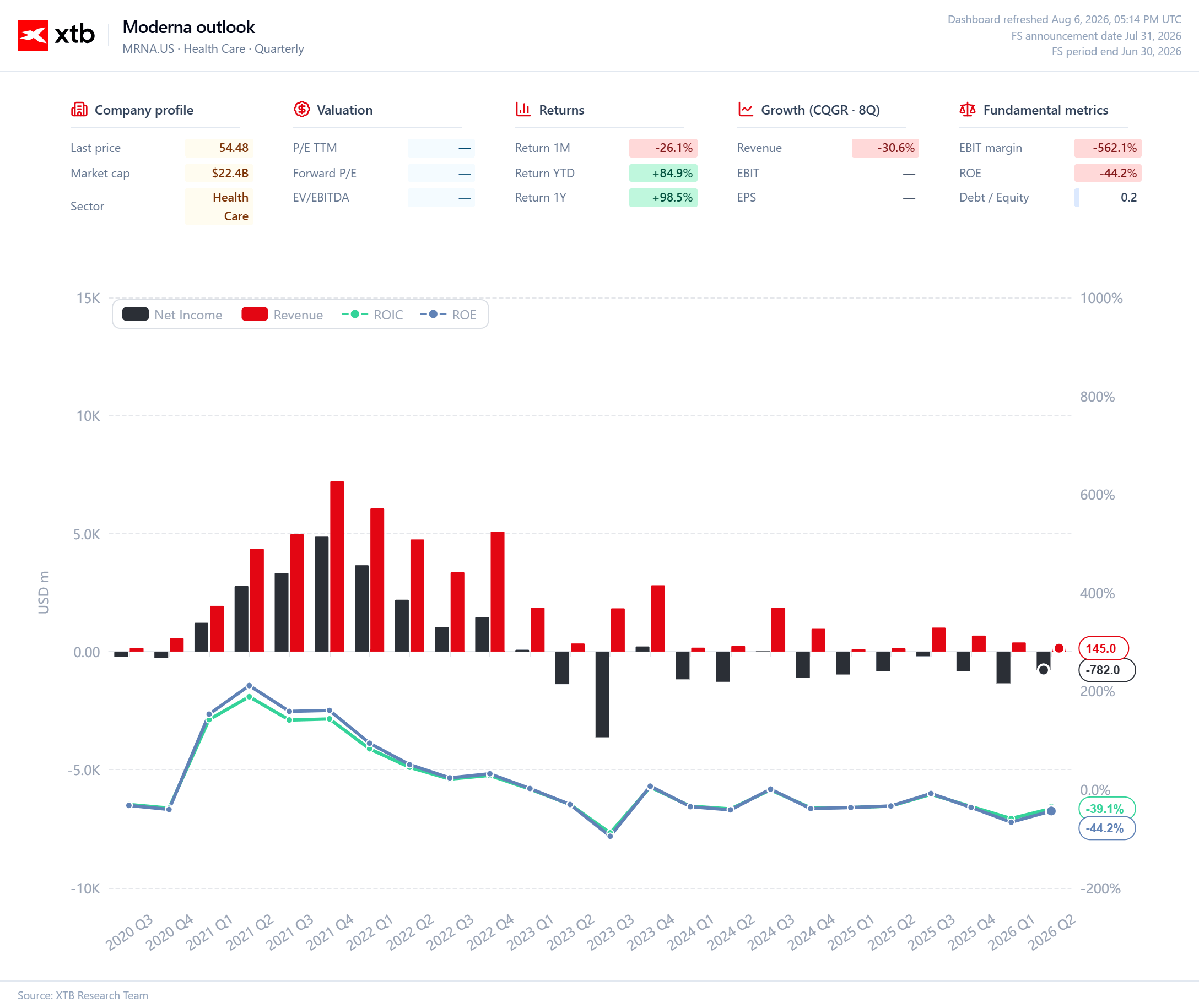
The sharp decline in revenue shown in the chart is primarily the result of the normalisation of the COVID-19 vaccine market rather than any loss of Moderna's technological edge. The company has moved from generating quarterly profits exceeding $4–5 billion during the pandemic to reporting losses once again, a common phase for biotechnology firms investing aggressively in future therapies. Investors are therefore no longer valuing Moderna on its current earnings profile but on the economic potential of its mRNA platform and the probability of successfully commercialising new products. From a valuation standpoint, negative ROE and ROIC matter less today than the pace at which Moderna expands its portfolio of approved vaccines and therapeutics. The recent FDA approval of mFlusiva demonstrates that this diversification strategy is beginning to deliver tangible results. If additional late-stage clinical programmes prove successful, the current revenue trough could ultimately represent nothing more than a transition between two growth cycles. Biotechnology markets have repeatedly shown that share prices often recover well before accounting profits return.
Source: XTB Research
Operating expenses: Moderna is deliberately sacrificing near-term profitability to fund future growth
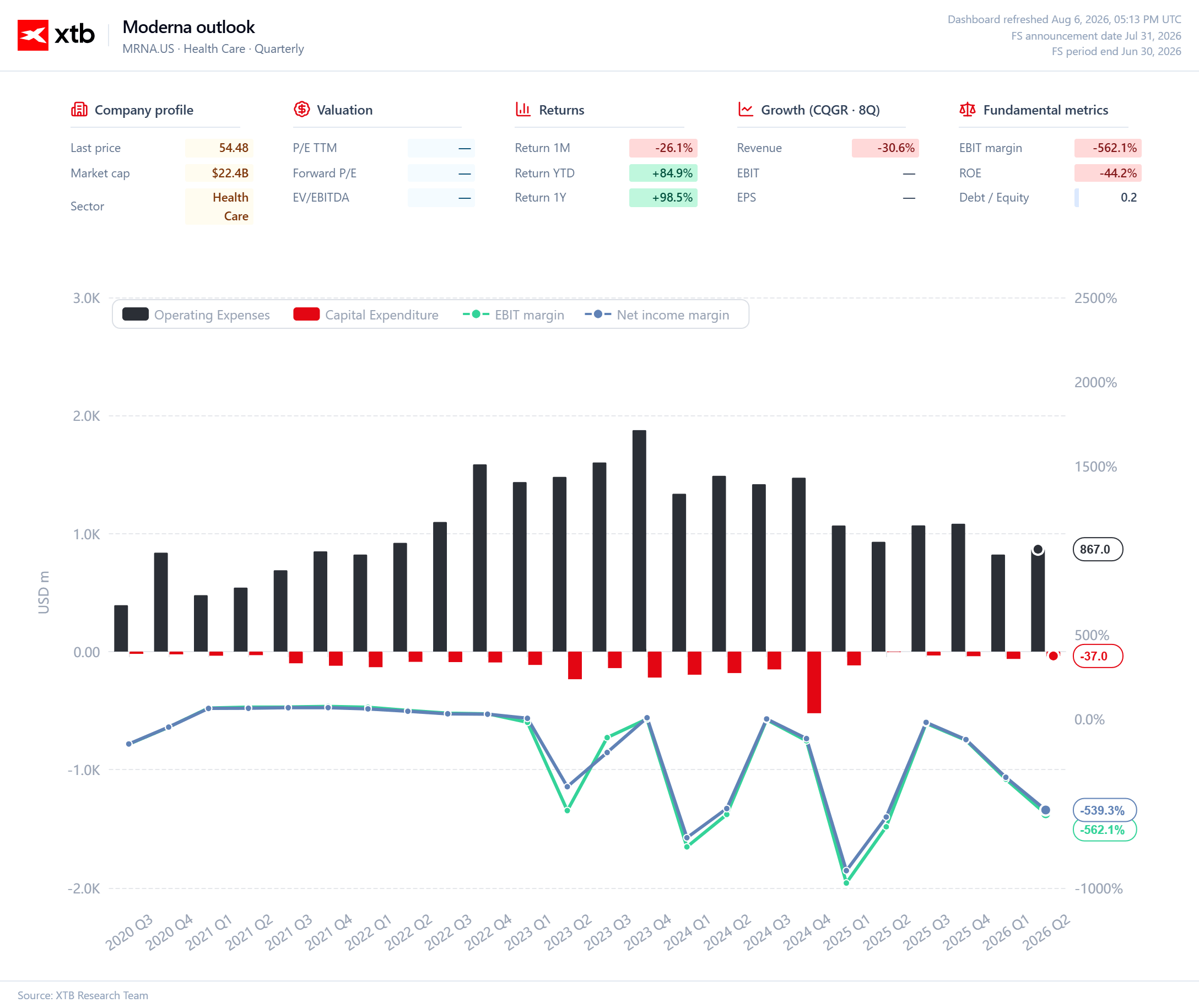
At first glance, deeply negative EBIT and net margins may appear concerning, but Moderna's financial profile requires a different analytical framework. The company continues to maintain elevated operating expenses because it is developing one of the broadest mRNA pipelines in the global biotechnology sector. Research and development spending should therefore be viewed as an investment in future cash flows rather than simply a cost weighing on current earnings. Meanwhile, capital expenditure remains relatively modest, highlighting the asset-light nature of Moderna's business model compared with traditional pharmaceutical companies that require substantial manufacturing infrastructure. As a result, the company's valuation depends far more on the expected value of future clinical programmes than on today's profitability metrics. This is a classic example of a business whose intrinsic value is driven primarily by growth options rather than current free cash flow generation. As long as Moderna preserves its strong balance sheet and retains the ability to finance innovation without materially increasing leverage, negative margins should be interpreted as a strategic choice rather than evidence of structural weakness.
Source: XTB Research



Is Starbucks eyeing Chipotle❓ The market reacts nervously to the FT's reports of a takeover🔥


Stock of the Week: Marvell Technology and the Race for AI Infrastructure’s Most Valuable Resource



Market Wrap: A 4% surge in oil prices weighs on indices (08.10.2026)


🚩 Caterpillar shares extend decline, down 30% from record high