



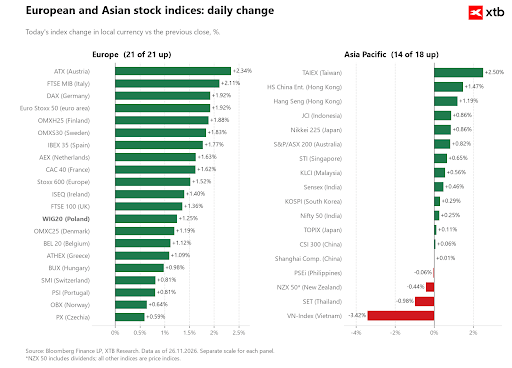
After several days of heavy volatility, buyers are returning to equity markets. The broad Stoxx Europe 600 is gaining approx. 1.6–1.7%, while the Euro Stoxx 50 is up nearly 2% and back above 6,000 points, with only 3 companies in the index trading in the red today (EssilorLuxottica, AB InBev, Danone). Yesterday, the index lost almost 2%, so today’s session largely recoups those losses.
In Europe, gains are led primarily by banks and technology, the exact sectors that spearheaded Wednesday’s sell-off. The banking sector is up approx. 2.4%, pulling the index higher the most, while tech stocks are rising by nearly 2.5%. Trade policy is also helping. The Office of the U.S. Trade Representative announced that new tariffs will not exceed the rates agreed upon in concluded or negotiated deals. For the EU, this means 15%, easing fears of further escalation. Miners and automakers are also moving higher.
However, the move can be viewed as purely technical. It is Thanksgiving in the U.S., exchanges are closed, trading volumes are lower, and the tech rebound lacks a specific catalyst. In the background remains the December Fed rate hike, which continues to raise the cost of capital for AI companies. On a positive note, the credit market is holding up so far, which is usually where early signs appear if equity stress is becoming more serious. The real test of the rebound's durability will be Friday’s session. S&P 500 and Nasdaq 100 futures are up approx. 0.5%.
A similar trend played out in Asia, where semiconductor stocks led the way. Taiwan’s Taiex gained approx. 2.5%, recovering a significant portion of Wednesday’s nearly 5% drop, while Japan’s Nikkei rose by nearly 0.9%. Kioxia posted the biggest gain, surging over 12%, after unveiling a concept with Nvidia to use its SSDs to expand memory available to GPUs for large AI datasets. SK Hynix rose approx. 2–3%. In Seoul, however, gains largely evaporated and the Kospi closed up less than 0.3%, as the Bank of Korea raised rates to 3.25% as expected. This is its third hike this year, and the bank is signaling more to come. In contrast, Vietnam’s benchmark index is posting steep losses amid concerns over potential U.S. tariffs and the pressing need to negotiate a trade deal with the Trump administration.
Graph 1 presents moves across different stock indices across the world
Soon, Spain may take center stage in the European market. Parliamentary elections will be held there on Sunday. The center-right People's Party (PP), together with Vox, is projected to win a majority to form a government, with Alberto Núñez Feijóo becoming Prime Minister. In the final days of the campaign, however, the Socialists have noticeably narrowed the gap, and many voters are deciding at the last minute. Key for the market are the pledges of both right-wing parties: tax cuts and stricter migration policies. The influx of immigrants has been one of the main drivers of Spanish growth, which since 2019 has been twice as fast as in the eurozone as a whole. If tax cuts are unfunded, the deficit could rise to around 5% of GDP by 2030, up from approx. 3%. So far, Spain has avoided the bond market sell-off that hit France and Italy, and it is precisely this position that could be at risk. Initial results will be known around 11:00 PM on Sunday, though a new government will not be formed before January.
Currency Market
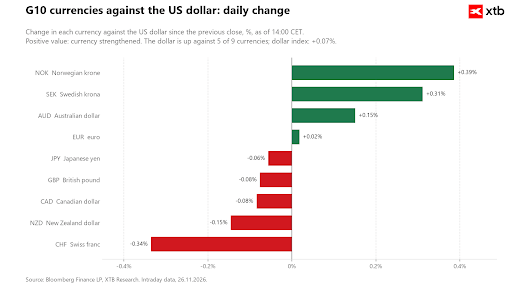
- USDNOK and USDSEK: Scandinavian currencies are gaining the most against the dollar. The Norwegian krone is up nearly 0.4%, and the Swedish krona is up approx. 0.3%. These are typical currencies that see increased demand when risk appetite returns. Earlier in November, they fell sharply: the Norwegian krone was the weakest G10 currency following falling oil prices and the equity sell-off. The rebound is also supported by central bank policy. Norges Bank is keeping rates high at 4.5% and is not ruling out a hike. The Riksbank raised rates in early November for the first time in over three years and is signaling further moves. The Norwegian krone is additionally supported by slightly higher oil prices.
- AUDUSD: The Australian dollar is gaining approx. 0.15% thanks to the rebound in Asian equities and rising copper prices. The market treats these two factors as a barometer of commodity demand.
- EURUSD: The euro is virtually flat around 1.097. With U.S. exchanges closed and low volumes, there is no catalyst for a larger move.
- USDCHF: The Swiss franc is the weakest G10 currency, losing approx. 0.3% against the dollar. This is a reversal of Wednesday’s move, when investors sought safe-haven assets during the AI stock sell-off and the franc traded near a two-week high. Today, that demand is fading. The franc is also losing ground due to the widening interest rate differential: the Fed is expected to raise borrowing costs further, while the SNB is holding rates at zero.
Commodities Market
- Brent Crude: Oil is rising by approx. 0.5%, to around $91 per barrel, amid a broader improvement in sentiment and despite a slightly stronger dollar.
- Gold: The precious metal is losing approx. 0.6%, sliding to around $3,565 per ounce. As investors return to equities, demand for safe-haven assets is waning, and expectations of another Fed rate hike are weighing on non-yielding assets.


📈 Gains across global stock markets


Daily Summary: Trump's New Tariffs and AI Sector Slowdown Trigger Wall Street Sell-Off

🐻Nasdaq 100 (US100) on the brink of a bear market



US OPEN: AI sector slump and return of inflation push Wall Street toward 7,000 pts