


By Friday afternoon, market sentiment is dominated by fears of further military escalation in Iran. The concentration of U.S. forces in the Persian Gulf is expected to increase, and markets are increasingly concerned that any potential offensive by the U.S. and Israel could also involve Saudi Arabia. Such a scenario would represent an extreme escalation, potentially leading to reciprocal strikes on critical infrastructure across the region—from power plants to desalination facilities. Markets have largely ignored yesterday’s statement from Donald Trump, who announced overnight that the period of non-aggression toward Iran’s energy infrastructure had been extended by another 10 days, until April 4.
European equities are under pressure, with broad-based declines across major indices. The Euro Stoxx 50 is down more than 1.3%, while Germany’s DAX is falling over 1.5%. ECB President Christine Lagarde warned yesterday that markets may be underestimating the scale of the energy shock gradually feeding into the global economy. She highlighted that Europe could be particularly exposed through energy markets, supply chains, and critical inputs such as helium, which is essential for semiconductor production. Lagarde also noted that the shock could persist for years, with the economic adjustment unfolding gradually. European heavy industry, as well as sectors such as chemicals and logistics, appear especially vulnerable to a potential downturn driven by elevated oil and gas prices.
- The cyclical media sector is among the worst performers today, with European companies in the segment down around 3% on average. CTS Eventim is in focus, with shares plunging 16% following a disappointing full-year outlook.
- Markets remain highly sensitive to headlines regarding further military escalation, including the possibility of increased U.S. ground troop involvement in the region. Ahead of the weekend, investors are clearly reducing risk exposure.
- The Strait of Hormuz remains a key focal point for global markets. In the view of market participants, only tangible progress toward reopening the strait would provide a more durable improvement in sentiment.
- The economic impact of the conflict is increasingly visible in macro data, with recent readings pointing to a sharp slowdown in private sector activity in March. This reinforces concerns about a mix of weaker growth and rising inflationary pressures.
- Interest rate markets have also repriced expectations for the ECB. The probability of a rate hike in April has risen to around 71%, compared to expectations of no hikes for most of the year prior to the outbreak of the conflict.
- Rising bond yields are adding further pressure to equities, with the German 10-year Bund yield climbing to its highest level since 2011, reducing the relative attractiveness of stocks and increasing the cost of capital.
- Against the broader market weakness, Pernod Ricard stands out, gaining around 3% after confirming discussions regarding a potential merger with Brown-Forman, the owner of Jack Daniel’s.
- AstraZeneca is also outperforming, with shares up 3.4% after its experimental respiratory treatment Tozorakimab met primary endpoints in two late-stage trials, supporting the broader healthcare sector.
- Overall, the session reflects a consistent pattern: investors are reducing risk, bond yields are rising, and the main transmission channels of geopolitical tensions into markets remain energy prices, inflation expectations, and central bank policy.
- Earlier this week, the STOXX 600 briefly approached correction territory, falling around 10% from its February peak. However, subsequent comments from Donald Trump regarding a potential extension of the deadline for reopening the Strait of Hormuz helped to partially stabilize market sentiment.
Charts: DE40 and US100 (D1 interval)
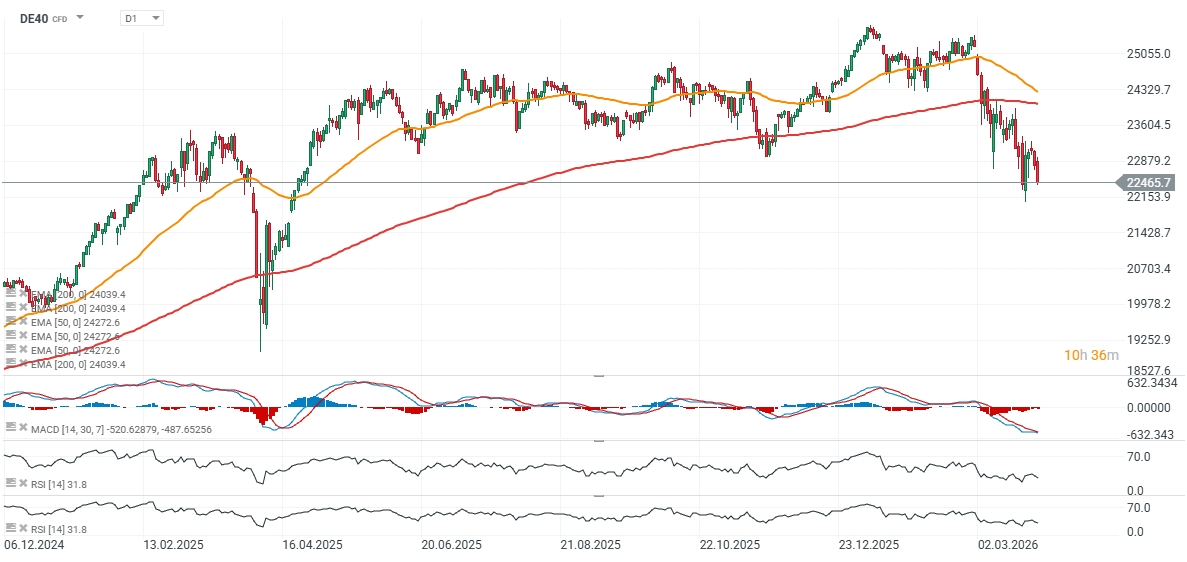
Source: xStation5
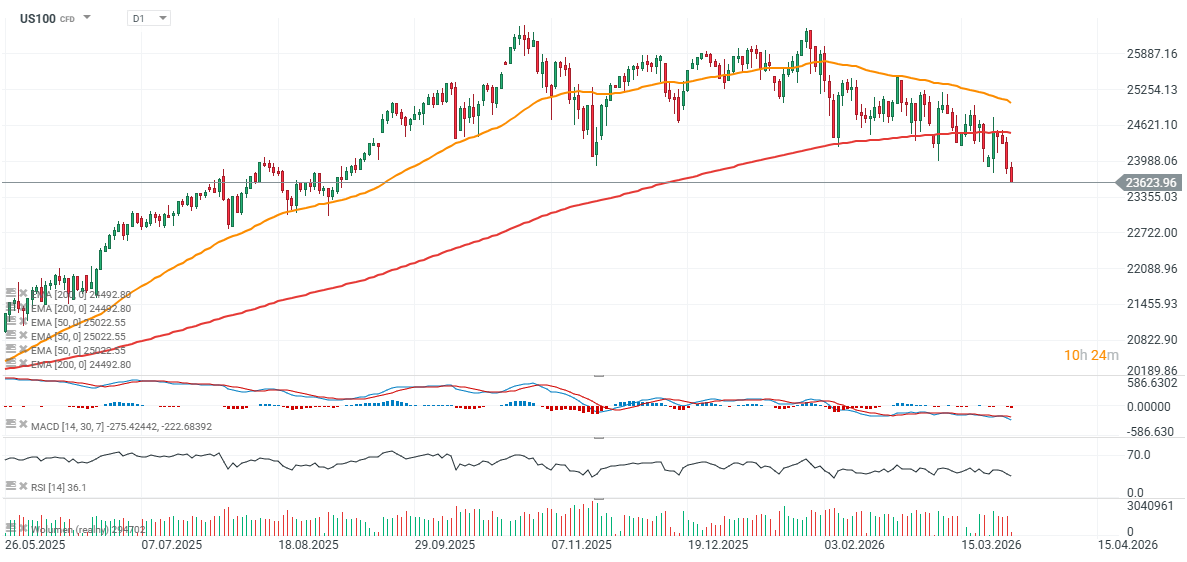
Source: xStation5



Is Starbucks eyeing Chipotle❓ The market reacts nervously to the FT's reports of a takeover🔥


Stock of the Week: Marvell Technology and the Race for AI Infrastructure’s Most Valuable Resource



Market Wrap: A 4% surge in oil prices weighs on indices (08.10.2026)


Chart of the Day 📉 DE40 Falls 0.7% and Tests Key Support Amid Weak European Market Sentiment (October 8, 2026)