



One of the leading memory-chip manufacturers, Micron Technology, will report its fiscal fourth-quarter results today after the US market close. The report could prove to be one of the most important tests yet for the ongoing rally in AI-related stocks. The results will shed light not only on demand for HBM memory used in data centres, but also on DRAM and NAND pricing, margin trends and the outlook for investment in the next generation of AI infrastructure. The significance of Micron’s report therefore extends well beyond the company itself. Investors will be looking for an answer to a broader question: is the AI investment boom still translating into tangible growth in revenue, cash flow and profitability across the semiconductor supply chain, or have valuations already begun to run ahead of fundamentals?
Micron has become one of the biggest beneficiaries of the AI boom
Micron was once viewed primarily as a traditional memory producer whose results were heavily dependent on supply-and-demand cycles in the DRAM and NAND markets. The development of generative artificial intelligence could fundamentally change that model. Why? Modern AI accelerators require enormous amounts of extremely fast memory, and HBM has become one of the most important components of data-centre infrastructure. This means that rising hyperscaler spending on AI servers translates directly into demand for Micron’s products.
The scale of this transformation is visible in the company’s results. In the previous quarter, revenue rose to $41.46 billion from $23.86 billion in the prior quarter and $9.30 billion a year earlier. Gross margin reached 84.6%, compared with 74.4% in the previous quarter and 37.7% a year earlier. Such a dramatic improvement shows that Micron is currently benefiting from several factors at once: higher volumes, strong memory pricing, a more favourable product mix and constrained supply of the most advanced components.
The market expects another very strong quarter
For the fiscal fourth quarter, Micron is guiding for around $50 billion in revenue, plus or minus $1 billion. The company also expects an adjusted gross margin of approximately 86% and earnings per share of around $31.
Market expectations are even higher than Micron’s own guidance. Consensus forecasts point to revenue above $51 billion and earnings per share of roughly $31.6.
If those estimates are confirmed, year-on-year growth will remain exceptionally strong. That would reinforce the view that data-centre demand is still powerful enough not only to drive Micron’s sales higher, but also to sustain historically elevated profitability.
The challenge, however, is that the market is already expecting very strong results. Following the sharp rise in Micron shares in 2026, simply beating quarterly estimates may no longer be enough if management adopts a more cautious tone on the coming quarters. For investors, the most important part of the report may therefore not be revenue or EPS themselves, but rather management’s commentary on future HBM demand.
Micron has already begun high-volume shipments of HBM4 to key customers and is preparing to introduce HBM4E in 2027. The next generations of HBM have become one of the central battlegrounds in the technological race between semiconductor manufacturers.
In the previous quarter, the Cloud Memory segment generated $13.77 billion in revenue, up from $7.75 billion in Q2. Data-centre-related sales also more than doubled sequentially. If Micron confirms that order growth remains strong and that multi-year contracts continue to expand, investors may see it as further evidence that AI spending is becoming a structural rather than merely cyclical source of demand.
Micron’s margins are a test of the strength of the entire memory cycle
Micron’s results are particularly important because the memory industry has historically been characterised by violent swings in the business cycle. During periods of oversupply, DRAM and NAND prices can fall rapidly, causing margins to collapse even for the largest manufacturers.
The current cycle looks different because a significant share of new production capacity is being directed towards more advanced HBM memory. This limits the availability of conventional DRAM products and may indirectly support pricing outside the AI segment as well.
Micron’s forecast for an adjusted gross margin of around 86% suggests that market conditions remain exceptionally favourable. Investors will therefore scrutinise management’s comments on average selling prices for DRAM and NAND. The first signs of weaker pricing could be interpreted as an indication that the most profitable phase of the cycle is beginning to approach its peak.
The AI market today is built on an enormous scale of capital expenditure. The world’s largest technology companies are spending tens of billions of dollars on data centres, processors, memory and network infrastructure. Micron sits at one of the most critical points in this entire supply chain.
If HBM demand continues to grow faster than supply, it could suggest that hyperscaler investment remains very strong. Such a scenario would support not only memory manufacturers, but also suppliers of GPUs, server infrastructure, networking equipment and data-centre cooling technology.
If, however, Micron begins to signal slower order growth or greater caution from customers, investors may start questioning the pace of returns on the multi-billion-dollar investments being made in AI. In this sense, Micron has become one of the key barometers of the entire artificial-intelligence investment cycle.
CapEx could show whether producers believe in a multi-year supercycle
Another key element of the report will be investment spending.
Micron spent $7.1 billion on capital expenditure in the previous quarter, while full-year fiscal 2026 CapEx is expected to reach around $27 billion. The company has also indicated that spending could be even higher in 2027.
Such large investments are necessary to increase production of advanced memory products and meet growing demand from data centres. At the same time, this remains one of the biggest long-term risks.
The history of the memory industry shows that periods of very high profitability often lead to excessive investment. If several major producers expand capacity faster than demand grows, today’s memory shortage could eventually turn into oversupply.
Multi-year agreements could change the nature of the memory industry
One of the most interesting features of the current cycle is the growing role of strategic, multi-year customer agreements.
For Micron, such contracts are particularly important because they could reduce the traditional volatility of the memory business. If a significant share of future HBM production is secured by agreements with the largest data-centre operators, the visibility of future revenue and cash flow could become much stronger than in previous cycles.
This is also one of the arguments behind the view that AI could change the way investors value memory producers. Rather than treating them purely as deeply cyclical businesses, investors may gradually assign them higher valuation multiples if a growing portion of their business becomes based on long-term contracts and strategically important products.
The 2027 outlook may matter more than the quarterly results
Today’s report will be particularly important because expectations for the next fiscal year are already very high.
Investors will be looking for answers to several key questions: is HBM demand still growing faster than supply, will DRAM and NAND prices remain elevated, how quickly will HBM4 and HBM4E production ramp up, and can margins stay near current levels?
The fiscal 2027 outlook could ultimately determine the market reaction. A very strong Q4 report combined with more cautious guidance could be interpreted as a sign that the memory market is approaching a local peak. By contrast, continued strong order growth and sustained high margins could reinforce the narrative of a longer, structurally driven AI cycle.
Micron’s sharp improvement in profitability is also translating into cash flow. In the previous quarter, the company generated around $25.4 billion in operating cash flow and more than $17 billion in free cash flow. At the end of the quarter, it held more than $30 billion in cash, marketable investments and restricted cash.
This means that the way Micron deploys its growing financial surplus is becoming increasingly important. The company still has unused capacity under its existing share-repurchase programme, although its ability to conduct buybacks has been constrained by conditions attached to US CHIPS Act funding. Those restrictions are expected to expire in December 2026.
If Micron signals a greater return of capital to shareholders once those restrictions lapse, it could provide an additional catalyst for the stock.
Micron faces a major test of the current AI rally
Today’s Micron report will be one of the clearest tests of how deeply the AI boom is translating into the real fundamentals of the semiconductor industry.
Very strong demand for HBM, rising memory prices, record margins and powerful cash generation show that the current wave of artificial-intelligence investment is not merely a story built on expectations. So far, it is also generating very tangible revenue and profits.
At the same time, the scale of the increase in valuations means that the bar has been set exceptionally high. Investors are therefore likely to focus less on whether Micron simply beats quarterly consensus and more on what management says about demand, pricing, new production capacity and margins in 2027.
If the company confirms that shortages of advanced memory could persist for several more quarters, the results could become another argument supporting the continuation of the AI rally. If, however, the first signs of slowing orders or normalising prices begin to emerge, investors may start taking a much more critical view of valuations across the technology sector.
Micron chart (D1 interval)
Micron shares are currently trading around 10% below the all-time high reached in June this year. A strong earnings report and outlook could, in theory, trigger elevated volatility and push the stock towards the $1,200 area. On the other hand, any clear weakness in the report could send the shares back below $1,000, with a potentially important test near $900.
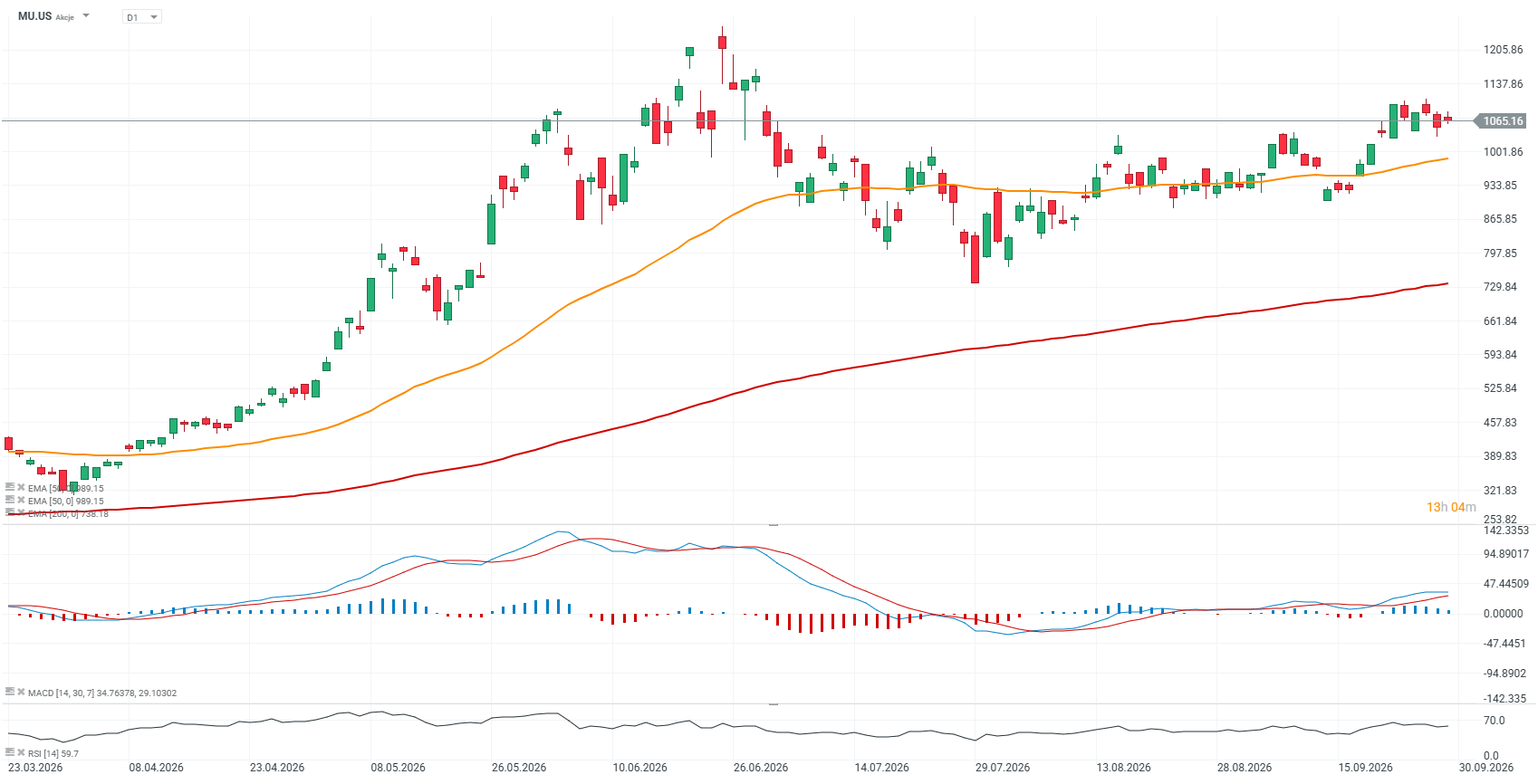
Source: xStation5


Meta Preview: Billions in AI spending, but when will the investments start paying off?


Tesla Preview: Will Robotaxis Save Earnings?

Supermicro Raises Forecast by $4 Billion as AI Server Demand Once Again Surprises the Market


SpaceX Results: Can Starlink Carry the AI Revolution?