



$600 is a transformation scenario, not a conventional growth case
Morgan Stanley’s bull case assumes much more than an increase in rocket launches or continued growth in Starlink subscribers. In practice, it envisions SpaceX evolving from a space and telecommunications company into a global infrastructure operator combining orbital transportation, satellite connectivity, and AI computing capacity.
Starship remains the most important piece of that equation. Morgan Stanley assumes the fully reusable system will eventually fly frequently and cheaply enough to materially reduce the cost of deploying computing infrastructure into orbit. Under the bullish scenario, the cost of building orbital computing capacity could fall to roughly half its current level.
This distinction matters from a valuation perspective. A successful Starship creates value on its own, but substantially greater optionality emerges if cheaper access to orbit enables entirely new markets. Morgan Stanley is therefore assuming not only the success of a product, but also the emergence of an economic ecosystem that barely exists today.
Starlink could eventually connect more than just people
The second pillar of the $600 scenario is a major expansion of Starlink’s addressable market. Over the longer term, the network could provide connectivity not only to households, businesses and mobile devices, but also to autonomous AI-powered machines. Morgan Stanley’s scenario assumes that by 2040, hundreds of millions — potentially even billions — of robots could be connected through Starlink, generating average monthly revenue per user of around $35.
If such a market develops, Starlink’s economics could look fundamentally different from what they do today. The satellite network would no longer be merely an alternative way of accessing the internet; it could become a global communications layer for autonomous devices.
At the same time, this is one of the most distant assumptions embedded in the valuation. Investors assigning value to this opportunity today must account not only for SpaceX’s technological execution risk, but also for uncertainty surrounding the pace of global automation and future competition in machine-to-machine connectivity.
Cursor is becoming an important part of the SpaceX valuation story
The roughly $60 billion acquisition of Cursor significantly expands SpaceX’s exposure to AI. The all-stock transaction is expected to close before the end of August. Cursor develops an AI platform that helps programmers write, edit, debug and analyze code, and the service is reportedly used by more than 50,000 companies and over 64% of Fortune 500 firms.
The strategic value of the transaction therefore extends beyond the product itself. SpaceX gains an established distribution channel into corporate customers, a substantial user base, and access to data generated through interactions between developers and AI models. The two companies have already been working together since April, including on training Grok 4.5 using Cursor data and integrating the model into the platform. Strategically, the acquisition could shorten the path between AI model development and commercial deployment.
Morgan Stanley expects extremely rapid growth from Cursor
The forecasts for the acquired business are aggressive. Morgan Stanley estimates Cursor could generate around $2.5 billion in revenue in 2026 and $13 billion in 2027, representing roughly 10% and 19% of projected SpaceX AI revenue, respectively. Annual recurring revenue is expected to reach approximately $8 billion by the end of this year and around $33 billion by 2030.
Under those assumptions, the $60 billion acquisition price begins to look very different. If Cursor actually approaches $33 billion in ARR, the current transaction value would represent less than two times that future recurring revenue base.
The main risk sits on the cost side. Rapid AI revenue growth can require equally aggressive spending on data centers, energy and computing accelerators. For SpaceX’s long-term valuation, Cursor’s ability to convert growth into durable cash flow may therefore matter just as much as the headline revenue numbers. Morgan Stanley currently estimates that the AI business accounts for roughly $12 per SpaceX share, implying a discount to some competing neocloud businesses.
Morgan Stanley has also previously argued that a share price around $100 would effectively imply that the market was assigning no value to SpaceX’s AI operations. That helps explain why valuation scenarios for the company are so unusually wide.
Rockets and Starlink are already functioning businesses backed by real infrastructure, customers and substantial barriers to entry. AI, orbital data centers and future connectivity for autonomous machines represent optionality. Much of the potential upside therefore does not come from simply scaling existing operations, but from SpaceX successfully creating several new revenue streams.
Wall Street is bullish, but the valuation range is enormous
Among the 32 analysts covering SpaceX, the average price target stands at roughly $227. The dispersion, however, is arguably more informative than the consensus itself. Raymond James sees $800, Morgan Stanley $300, J.P. Morgan $240, Deutsche Bank $235, Goldman Sachs $220, Wells Fargo $215, UBS $210 and Citi $200. Arete recently raised its target from $401 to $450 while maintaining a Buy rating.
At the other end of the spectrum, Piper Sandler has a $140 target and a Hold rating, CFRA sees $115 with a Sell rating, while Phillip Securities values the shares at $75. A $75–800 range is exceptionally wide even for a high-growth technology company. It suggests that the biggest disagreement among analysts is not necessarily over the value of SpaceX’s existing businesses, but over how much value should be assigned today to businesses that may emerge over the next decade or more.
Morningstar takes a considerably more conservative approach. Its estimates put the core Starlink and launch businesses at roughly $40 per share. Additional value comes from more speculative projects, while its “Moonshot” scenario reaches approximately $154 per share and is assigned only a 7% probability.
Morgan Stanley’s own $75 bear case is equally revealing. Within a single analytical framework, SpaceX’s potential value varies eightfold between the bearish and most optimistic scenarios. Such dispersion is typical of companies where a large proportion of terminal value depends on technologies and markets that have not yet reached full commercialization.
SpaceX is increasingly a portfolio of interconnected businesses
One useful way to analyze SpaceX is to separate it into four components. The first is the launch business — technologically the most mature and supported by an operational advantage that competitors cannot easily replicate. The second is Starlink, a globally scalable telecommunications infrastructure platform. The third is Starship, which is both a product in its own right and potentially a tool for reducing the cost base of SpaceX’s other businesses. The fourth is AI, encompassing Cursor, computing infrastructure and potentially orbital compute.
The most interesting part of the bull case lies in the interaction between these businesses. If Starship reduces the cost of deploying infrastructure, Starlink provides global connectivity, and Cursor supplies customers and distribution for AI, the individual assets could ultimately be worth more together than separately. In that scenario, SpaceX would not simply be a conglomerate of unrelated technologies, but a vertically integrated infrastructure platform.
That is also why $600 should not be interpreted as a straightforward price target derived from today’s fundamentals. It represents a scenario in which several highly ambitious projects succeed commercially at roughly the same time. Starship needs to radically reduce launch costs, Starlink needs to move beyond conventional internet connectivity, Cursor needs to sustain exceptional growth, and AI operations need to reach sufficient scale to justify tens or potentially hundreds of billions of dollars in additional value.
For shareholders, the most important signals will therefore not be Wall Street price-target increases themselves. More important will be evidence confirming or challenging the assumptions behind them: Starship’s development pace, Starlink economics, Cursor’s growth and margins, and the amount of capital required to build out SpaceX’s AI infrastructure.
SpaceX is ultimately an unusual case in which the market is pricing both existing competitive advantages and substantial long-term optionality. The more of that optionality turns into revenue and cash flow, the easier higher valuations become to justify fundamentally. But if the company’s most ambitious projects face delays or weaker economics than expected, the same mechanism works in reverse, because future businesses account for a large part of the gap between conservative valuations and the $600 bull case.
SpaceX chart (H1 interval)
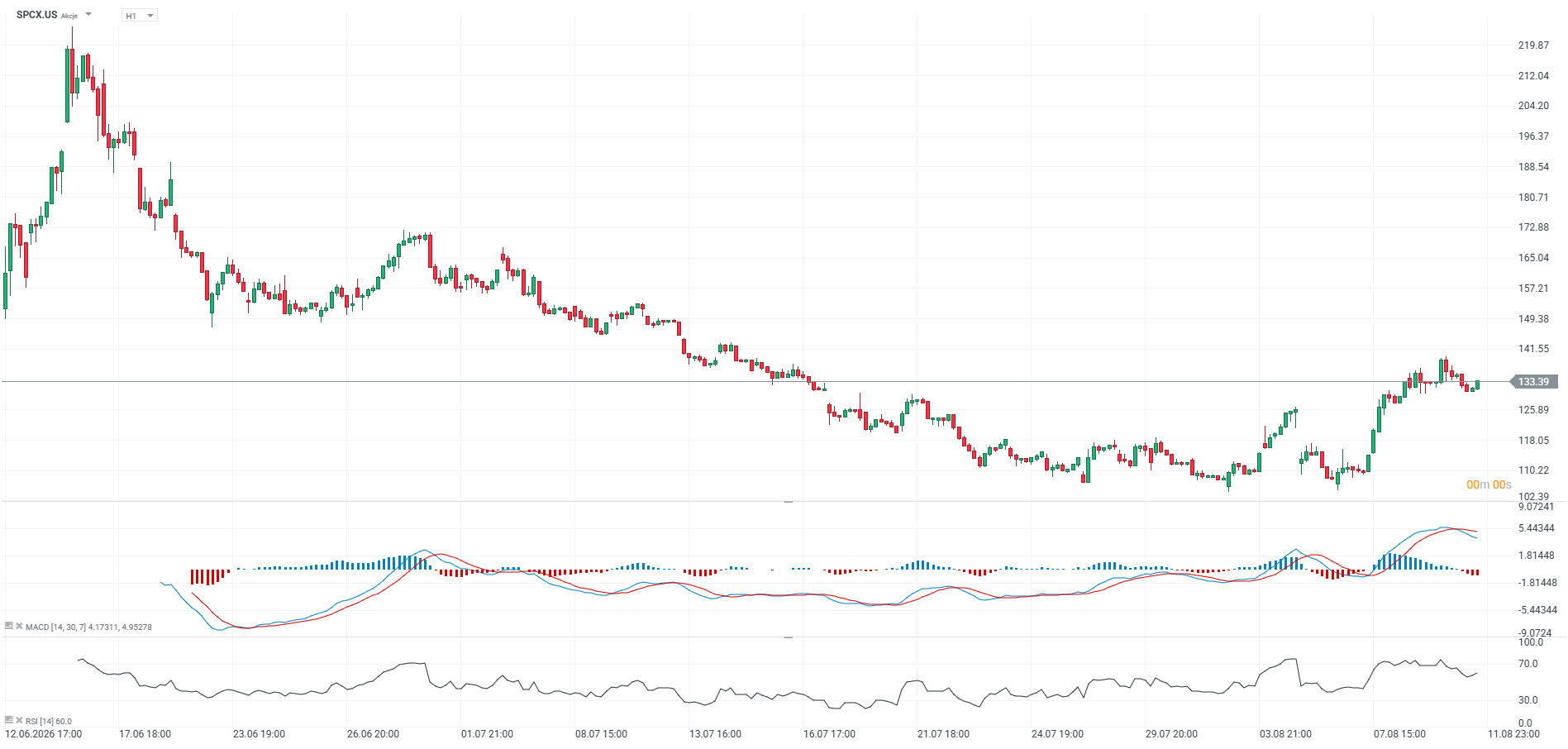 Source: xStation5
SpaceX – fundamentals reflect the scale of investment ahead of monetization
SpaceX remains in a phase of exceptionally intensive expansion, meaning its current fundamentals say more about the scale of investment than about its ultimate earnings potential. Revenue has grown at an approximately 15.4% CAGR over the past eight quarters, but an EBIT margin of -41.4% and ROE of -41.1% show that growth is still coming at the expense of near-term profitability. The balance sheet is particularly important: current liabilities stand at around $24.4 billion, while net debt is approximately $6.6 billion, highlighting the capital-intensive nature of the company’s current development phase. At the same time, a debt-to-equity ratio of 0.7x does not yet point to extreme financial leverage, although persistent operating losses make the company’s ability to fund future investments an important variable. The key fundamental test will therefore be whether SpaceX can translate the growing scale of Starlink, launch services and its newer ventures into sustained margin expansion and stronger cash flows. The current financial profile also helps explain the enormous dispersion in analyst valuations: the market is not valuing SpaceX primarily on today’s earnings, but on how much of today’s investment spending can eventually produce scalable, high-margin revenue.
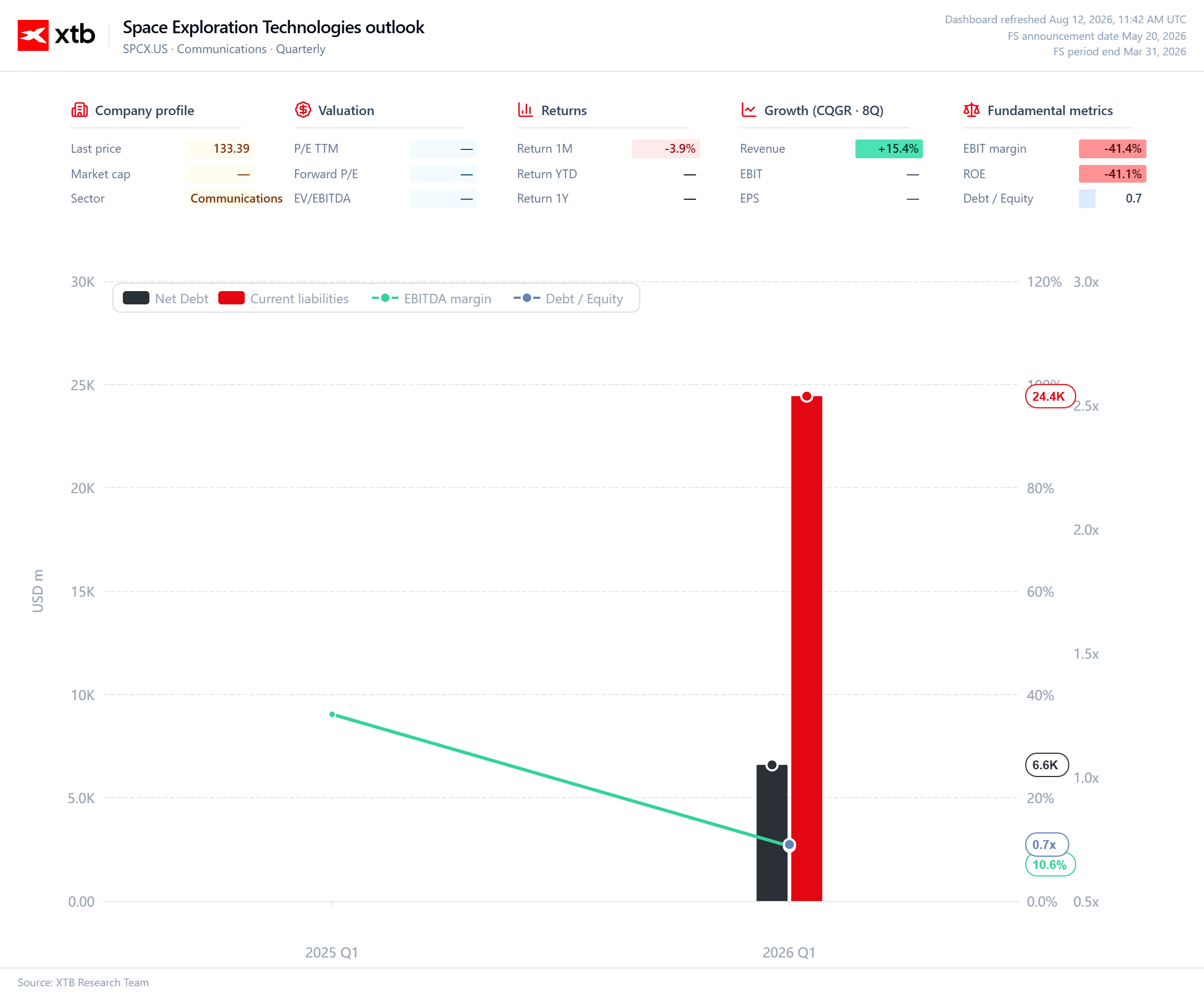
Source: xStation5



Market Wrap: ASML lifts tech sentiment, EU yields pull back


ASML disappoints on revenue but delivers stronger profits and raises guidance 🍳 What’s next for the AI sector?


Daily Summary: Earnings Season Kicks Off on Wall Street Amid Mixed Sentiment


SpaceX Wants to Fly Starship Almost Every Day. Musk’s Business Empire Is Betting on It