


NVIDIA is currently at a point that could prove to be one of the most significant moments for the company’s valuation in the coming quarters, particularly in the context of its relationship with the Chinese artificial intelligence market. According to emerging reports, the company has informed selected clients in China about plans to begin shipments of H200 graphics processors in mid-February 2026, just before the Chinese New Year period. Initial volumes are expected to come from existing inventory and range from 5,000 to 10,000 modules, which translates to approximately 40,000 to 80,000 individual GPU units. Although the H200 does not represent NVIDIA’s latest generation of solutions, it remains a key tool for training large language models and handling advanced workloads, especially in environments subject to export restrictions.
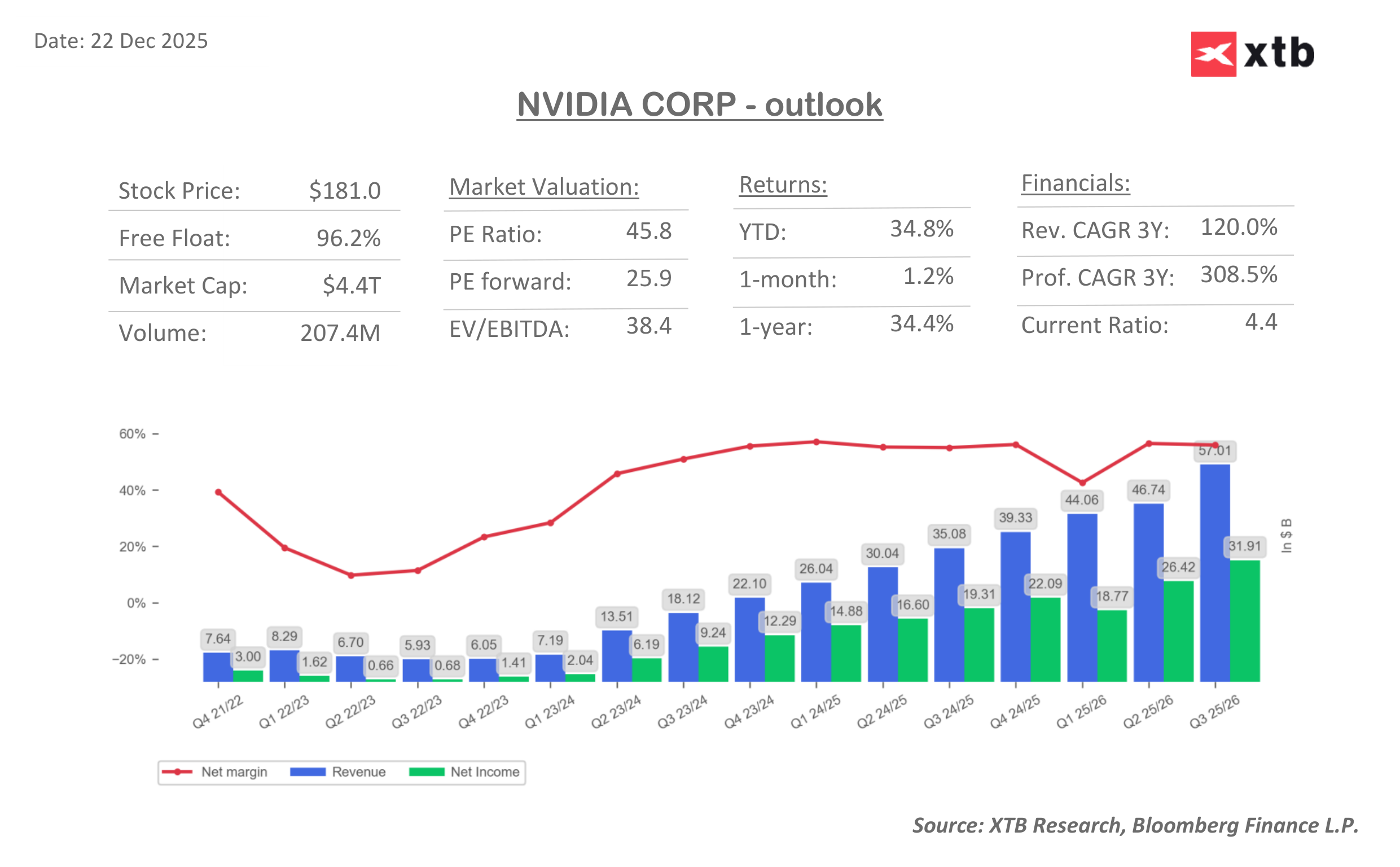
These plans are a direct result of a shift in the United States’ approach to exporting advanced technology following the new administration taking office in early 2025. The easing of restrictions on selected NVIDIA products opens the company’s access to one of the world’s largest AI markets. In China, demand for high-performance GPUs significantly exceeds the capabilities of local suppliers, whose solutions remain noticeably less competitive compared with NVIDIA’s hardware. As a result, for many local technology companies, H200 units represent the only viable path for further development of advanced AI systems.
Financial markets quickly priced in this information. In pre-market trading, NVIDIA shares were up more than 1.5 percent, consistent with the pattern observed during previous reports regarding potential export approvals to China.
China’s importance to NVIDIA’s long-term growth trajectory remains critical. Forecasts indicate that in 2026, the market could account for roughly 20 to 25 percent of global demand for AI processors, potentially translating into 15 to 20 billion USD in revenue. Major players such as ByteDance, Alibaba Cloud, and Tencent are actively seeking rapid regulatory approvals, as the continued development of their AI platforms relies on access to high-performance computing infrastructure. In many applications, local chips remain significantly less capable than NVIDIA’s solutions.
In a baseline scenario, the gradual opening of the Chinese market represents a key factor influencing NVIDIA’s valuation in the first half of 2026. Beyond shipments from existing inventory, scaling up production from the second quarter and securing new orders worth hundreds of millions of USD play an important role. Potential long-term contracts with major Chinese clients would likely prompt the market to revise revenue projections for the next fiscal year.
At the same time, the investment environment carries significant risks. Decision-making by Chinese regulators is still ongoing, and authorities aim to balance imports of advanced technology with support for domestic suppliers. Additional uncertainty stems from geopolitical tensions and concerns among some U.S. policymakers regarding potential non-civilian uses of advanced processors.
From a market perspective, information about potential H200 shipments to China is viewed as a highly relevant business factor and a signal of changes in the regulatory landscape surrounding the AI sector. The fact that NVIDIA communicated with Chinese clients and the easing of export restrictions has drawn investor attention to China’s importance in the company’s operational structure. As a result, the Chinese angle has once again become a key element in the market narrative around NVIDIA, particularly in the context of regulatory decisions and upcoming financial reports.


Daily summary 📈 Precious metals and stock indices rebound as Treasury yields fall


US Open: Nasdaq 100 extends losses 🚩 AI stocks under pressure, CoreWeave falls 8%



Market Wrap: Tech Sell-Off Hits Europe, Gold Shines Again


TSMC breaks records once again driven by the AI boom