



Vladimir Putin’s decision to place Nestlé’s (NESN.CH) Russian assets under temporary external administration serves as a stark reminder of the ongoing geopolitical risks facing Western corporations operating in Russia. This move, which also targets the French retail chains Auchan and Lemana Pro (formerly Leroy Merlin), triggered an immediate reaction from investors and a sharp drop in the Swiss food giant’s stock price.
Fundamental circumstances and the acquisition process
Under the new presidential decree, the Russian operations of the listed companies will come under the control of an entity called L.E.V. Management. Although the Kremlin, through Dmitry Peskov, is reassuring the public that this is merely “temporary external management,” history suggests a different scenario. The use of the 2023 legal framework is a standard mechanism that typically constitutes the first step toward de facto nationalization and the transfer of assets to investors linked to the government.
Assets belonging to giants such as Denmark’s Carlsberg, France’s Danone, and Finland’s Fortum have already met a similar fate. For Nestlé, which has so far continued to operate on a limited basis in Russia, this means an almost certain loss of control over the local supply chain, factories (producing, among other things, Nescafé coffee and KitKat bars), and revenue from that market.
The Broader Geopolitical Context
The Kremlin’s move against Nestlé is no accident and is part of a broader political game. Switzerland, despite its historical neutrality, adopted most of the European Union’s sanctions packages following the full-scale invasion of Ukraine in 2022. Moscow openly declares that it no longer considers Bern a neutral country, which removes the protective umbrella from Swiss corporations.
Moreover, the seizure of the assets of Auchan and Leroy Merlin—companies that, for more than two years of war, have exceptionally resisted pressure to leave the Russian market and weathered accusations of indirectly financing Russia’s military effort—shows that loyalty to the Russian market does not protect against expropriation.
For investors, today’s trading session and the technical slump in Nestlé’s stock price serve as a warning sign. The risk premium for companies that still hold physical assets or operate within the Russian Federation must be reassessed, as Moscow’s legal framework allows for the cost-free and immediate severing of Western capital from ownership. The market is now awaiting official estimates from Nestlé’s management regarding the exact impact of the loss of its Russian business on its balance sheet and annual revenue forecasts.
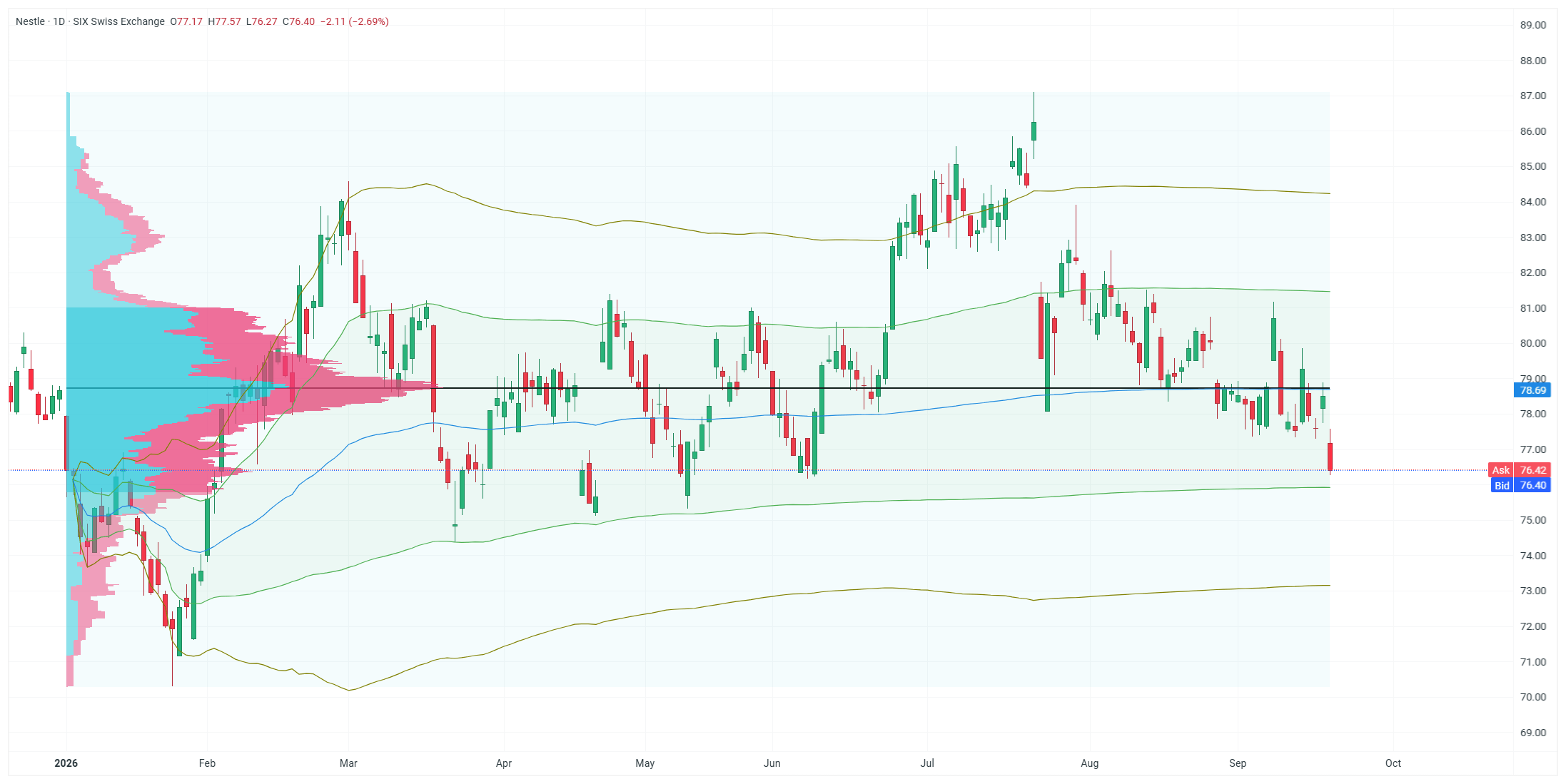
The break below the multi-month consolidation range, accompanied by a loss of the POC (78.69 CHF), occurred as news broke that L.E.V. Management had taken control of Russian assets, providing a pretext for the bulls to capitulate. Until the price returns above the 77.00–78.70 CHF range, technical indicators point to a supply-side advantage. Source: XTB



Is Starbucks eyeing Chipotle❓ The market reacts nervously to the FT's reports of a takeover🔥


Stock of the Week: Marvell Technology and the Race for AI Infrastructure’s Most Valuable Resource



Market Wrap: A 4% surge in oil prices weighs on indices (08.10.2026)


🚩 Caterpillar shares extend decline, down 30% from record high