



Crude oil prices rose sharply on Tuesday as overlapping supply disruptions from Saudi Arabia and Libya heightened concerns about global oil supplies. A barrel of Brent crude rose by 0.9% to $107.39, whilst US WTI crude gained 1.17%, reaching $103.51. The market reacted sharply to reports from Saudi Arabia, where the kingdom informed selected European refineries that it was cancelling some of its September oil shipments. Riyadh’s decision is a direct consequence of a drone attack which damaged pumping infrastructure and led to the complete shutdown of the key East-West pipeline.
The pipeline, with a capacity of 7 million barrels per day, has so far played a strategic role in bypassing the sea route through the risk-prone Strait of Hormuz. According to industry sources and estimates by the AP, repairs to the damaged pipeline infrastructure could take between three and five weeks. In response to the situation, Saudi Arabia has begun efforts to increase the volume of crude oil exports through the Strait of Hormuz. US Energy Secretary Chris Wright has announced that the US Navy is escorting numerous merchant ships through the maritime corridor near Oman, in order to support Saudi exports.
However, the increase in shipments from the Persian Gulf is facing significant logistical barriers, including limited availability of tankers and a sharp rise in freight rates. Charter rates for tankers from Saudi ports to China exceeded the $1 million mark at the end of last week. Supply pressures are also being exacerbated by the escalating crisis in Libya, where the state-owned National Oil Corporation (NOC) has suspended production at the Hamada and Al-Tahara oil fields. The closure of the Libyan fields is a direct result of protesters blocking pipelines, which has prompted the NOC to signal the possibility of invoking force majeure.
The situation on the oil market is further complicated by planned maintenance work in Kazakhstan and ongoing disruptions to Russian fuel production resulting from the war in Ukraine.
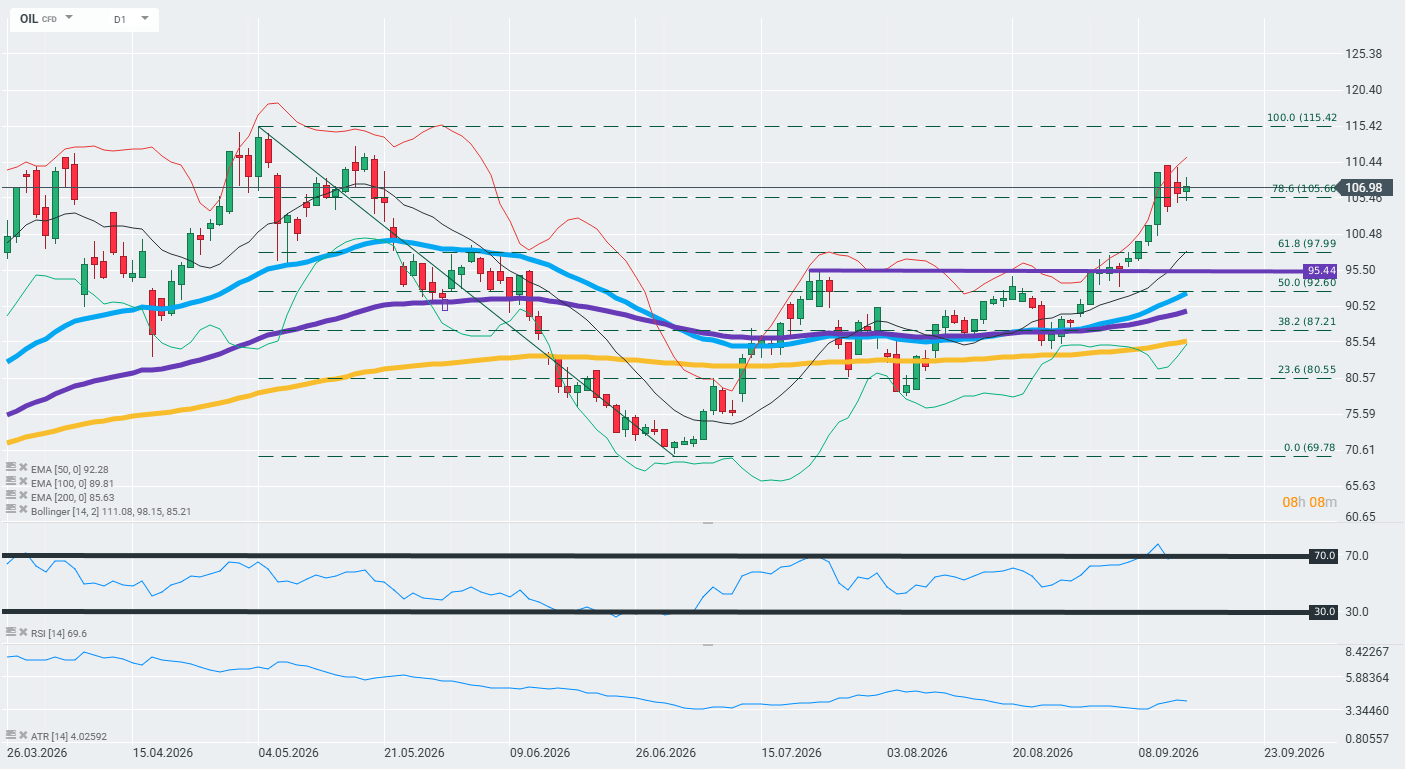
The OIL contract has been trading in the region of US$107 per barrel for nearly three days now. From a technical perspective, an analysis of the RSI indicator based on a 14-day moving average shows that the recent upward momentum has exceeded the textbook level of 70 points, which is often regarded as the overbought zone. Source: XTB



Gold Falls Below $4,000


Chart of the Day: USDJPY Caught in a Trap. Tokyo Intervention and a Hawkish BoJ Loom



Economic Calendar: Conference Board Consumer Confidence and US Data in focus

Morning Wrap: Wall Street Rises on Anthropic News, Asian Markets Surge