



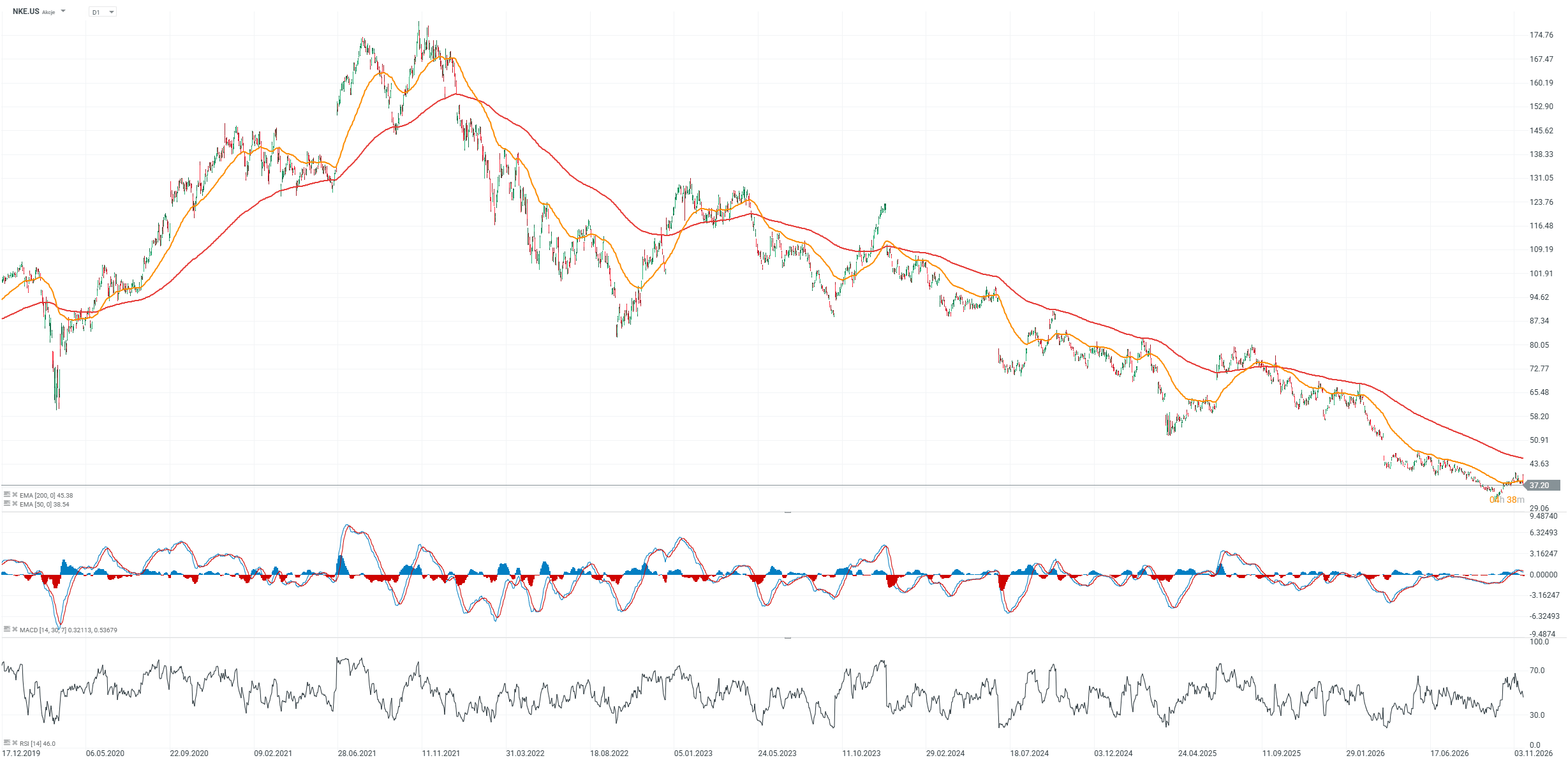
Shares of major companies that reported quarterly earnings and revenue before the U.S. market open are showing mixed performance in the second half of the trading session. Nike shares are down 2% and have fallen more than 10% from their intraday highs near $42 despite company business turnaround projection, completely erasing their earlier rebound. Home Depot is also trading lower, while Disney has given up almost all of its initial gains. What did the companies report?
Disney: Strong Results Driven by Streaming and Theme Parks
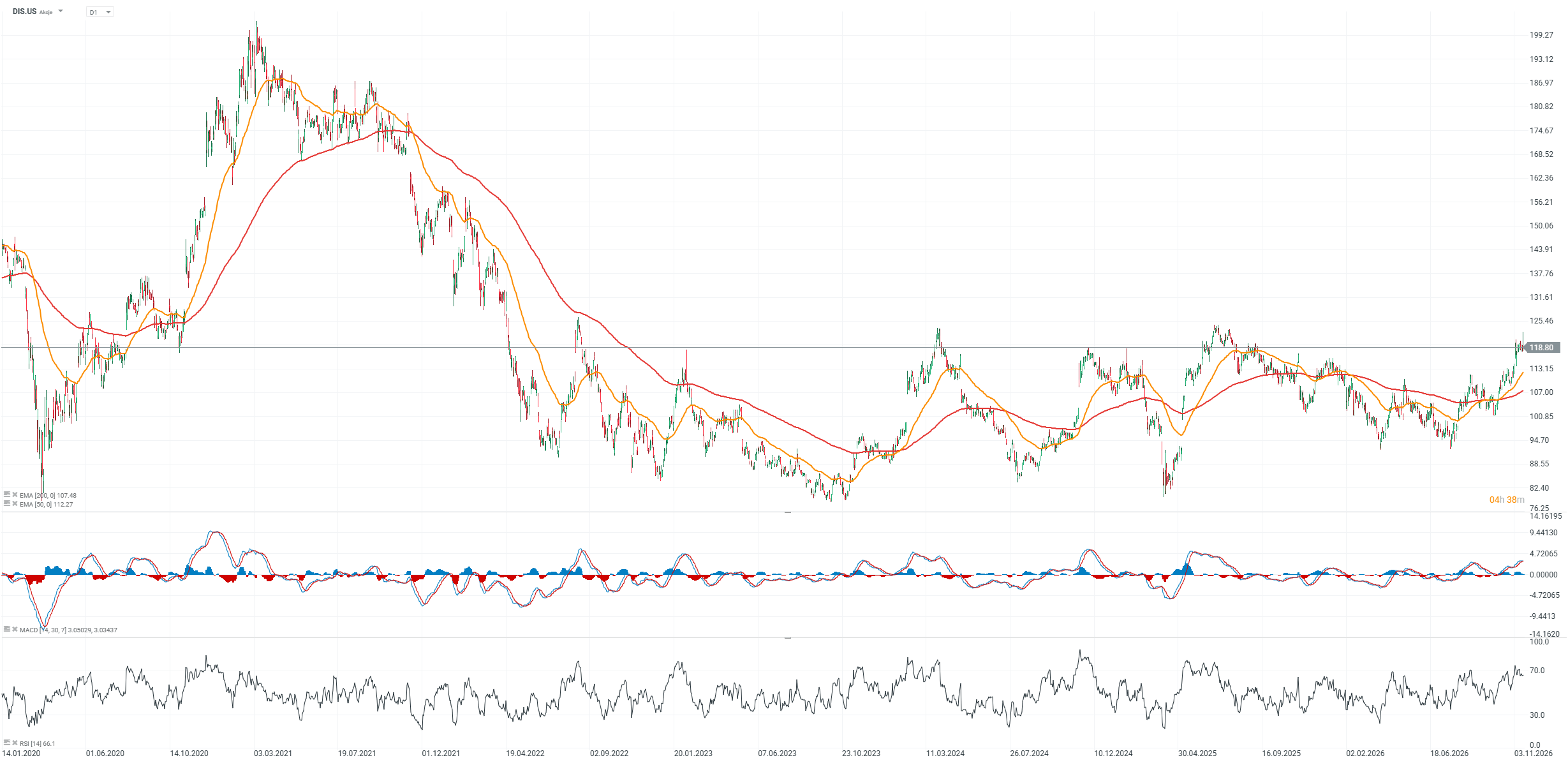
Disney closed FY2026 with results that significantly exceeded Wall Street expectations. Fourth-quarter revenue rose 16% year over year to $25.95 billion, while adjusted EPS reached $1.77, representing a 59% annual increase. The Experiences segment increased operating income by 20% to $2.25 billion, while operating income in the Sports segment surged 53% to $1.39 billion. Streaming profitability is also becoming increasingly important, with SVOD operating income rising to $824 million from $402 million a year earlier. However, the favorable impact of an additional 53rd week should be considered when assessing the reported growth rates.
The company reaffirmed its outlook for double-digit adjusted EPS growth in FY2027, alongside approximately 8% growth in segment operating income after excluding the impact of the additional week. Disney plans to increase content spending by 9% to $26 billion, allocating more resources to sports broadcasting rights and international productions, among other areas. Capital expenditures are expected to reach approximately $9 billion, while free cash flow is projected at around $11 billion. Management is also targeting $3 billion in cost savings by FY2029. For investors, the key question remains whether Disney can continue improving streaming profitability while increasing spending on content and expanding its theme park operations.
Disney – Q4 2026 Earnings Results
-
Adjusted EPS came in at $1.77 versus expectations of $1.66, while revenue reached $25.95 billion, exceeding the $25.18 billion consensus estimate.
-
Entertainment segment: Revenue of $11.89 billion versus expectations of $11.48 billion; operating income of $1.33 billion, in line with estimates.
-
Experiences segment: Revenue of $10.11 billion versus expectations of $9.89 billion; operating income of $2.25 billion versus the $2.21 billion consensus.
-
Sports segment: Revenue of $4.61 billion versus expectations of $4.45 billion; operating income of $1.39 billion versus the $1.38 billion consensus.
-
Total segment operating income reached $4.97 billion, compared with expectations of $4.88 billion. For FY2027, Disney expects double-digit adjusted EPS growth, approximately 8% growth in segment operating income (excluding the impact of the 53rd week), around $9 billion in capital expenditures and approximately $11 billion in free cash flow (FCF).
-
In the first quarter of FY2027, Disney expects total segment operating income of approximately $5.4 billion.
-
The company announced a dividend of $2 per share, payable in two installments of $1 each.
DIS.US Chart (D1 Timeframe)
 Source: XTB
Nike: The Company Prepares for a Multi-Year Business Turnaround
Nike unveiled its new "Full Stride Ahead" strategy at its Investor Day, aiming to restore sustainable revenue growth and profitability. However, the near-term outlook remains challenging: the company expects revenue to decline by approximately 7–9% in FY2027 (June 2026 to May 2027), with adjusted EPS ranging from $1.15 to $1.35. Operating margin is projected at just 6%, while fiscal years 2027–2028 will focus on investment and restructuring the business model. Nike expects its revenue decline to gradually moderate in 2028, followed by a return to market-level growth in FY2030 (June 2029 to May 2030).
By 2030, Nike aims to increase annual revenue by approximately $5 billion compared with current levels, improve its operating margin to 12–14%, and achieve adjusted EPS of $3.00–$3.50. Around $4 billion in incremental revenue is expected to come from Performance Sports, particularly running, training, football, basketball, and outdoor activities. The company also plans to distribute approximately $12 billion in dividends to shareholders through 2030. For investors, the key question is whether Nike can restore the strength of its Jordan and Converse brands and improve performance in China without putting further pressure on margins.
-
Revenue is expected to decline by 7–9% year over year in FY2027, with the contraction projected to moderate in FY2029 (June 2028 to May 2029).
-
Adjusted earnings per share (EPS) for FY2027 (June 2026 to May 2027) are expected to reach $1.15–$1.35, in line with previous guidance. By FY2031 (June 2030 to May 2031), Nike targets EPS of $3.00–$3.50, nearly three times the current projected level.
-
Fiscal years 2027–2028 will be a period of intensive investment aimed at returning Nike to a sustainable growth trajectory.
-
By FY2031, the company aims to generate approximately $5 billion in additional annual revenue and return a cumulative $12 billion to shareholders through dividends.
NKE.US Chart (D1 Timeframe)
 Source: XTB
Home Depot: Earnings Beat Expectations, but Demand Remains Moderate
Home Depot increased its Q3 2026 revenue by 4.9% year over year to $43.4 billion, while adjusted EPS rose 3.2% to $3.86. Comparable sales improved by 2.2%, exceeding analyst expectations. Nevertheless, comparable customer transactions declined by 0.5%, while the average transaction value increased by 3%. This suggests that sales growth was driven more by higher spending per transaction than by increased customer traffic. The figures point to a gradual stabilization in demand but do not yet confirm a strong recovery in the U.S. home improvement market.
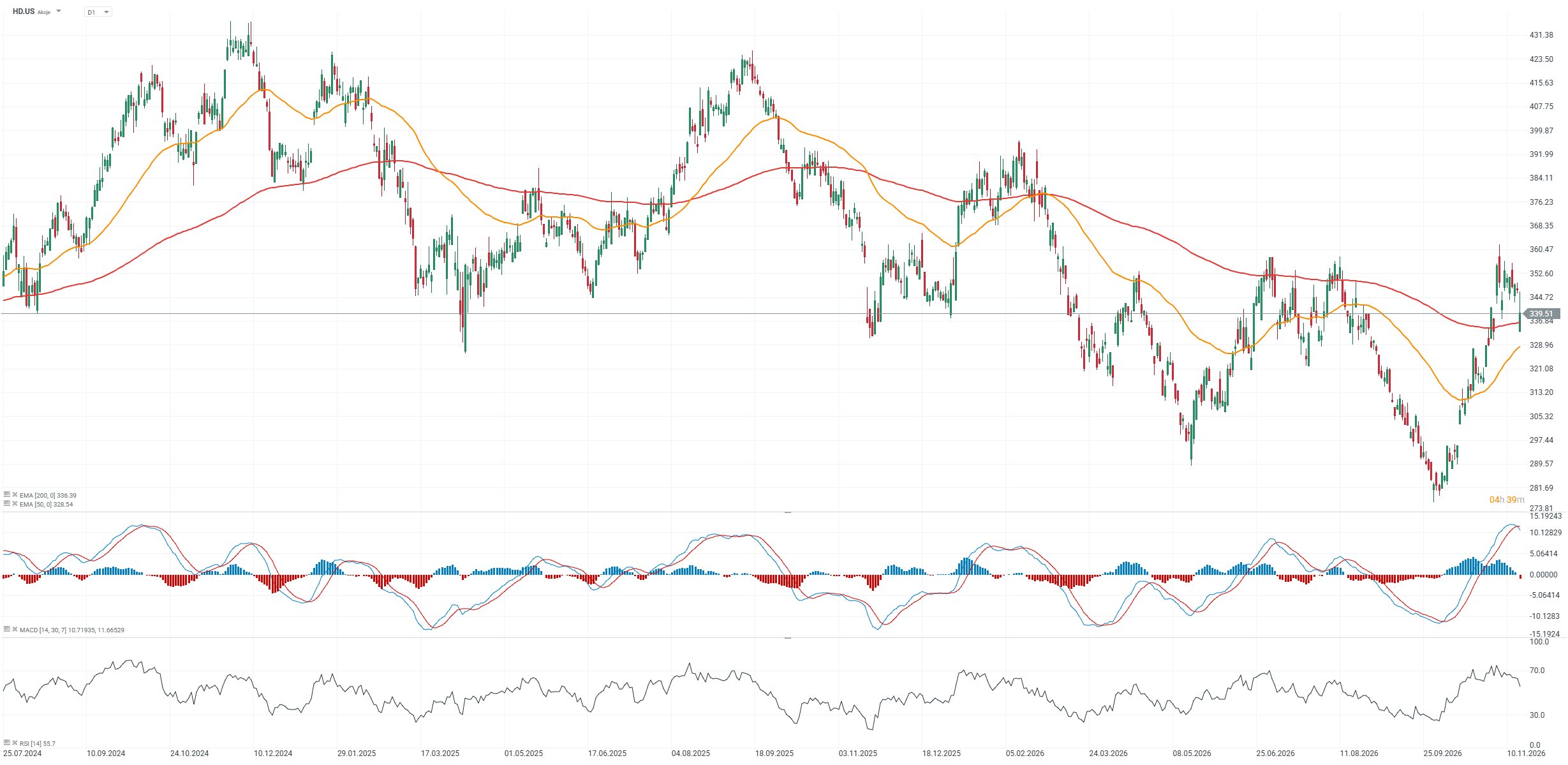
The company raised its full-year FY2026 revenue growth outlook to approximately 4.5%, while forecasting comparable sales growth of 1.4%. Adjusted operating margin is expected to reach around 12.8%, while adjusted EPS is projected to increase by 2% year over year. Investors are also focusing on management changes, with Richard McPhail taking over as CEO. Despite results exceeding consensus expectations, Home Depot shares fell approximately 3% following the release, suggesting that investors remain concerned about limited growth potential amid elevated financing costs and subdued home improvement activity.
-
Adjusted EPS came in at $3.86 versus expectations of $3.85, while revenue reached $43.4 billion, exceeding the $42.83 billion consensus estimate.
-
Comparable sales rose 2.2%, compared with expectations of 1.71%. U.S. comparable sales also increased by 2.2%, exceeding the forecast of 1.52%.
-
Merchandise inventories reached $27.6 billion, compared with expectations of $26.87 billion.
-
The company forecasts full-year revenue growth of approximately 4.5%, compared with its previous guidance range of 2.5–4.5%. Comparable sales are expected to increase by around 1.4%, versus the previous outlook of 0–2%.
HD.US Chart (D1 Timeframe)
 Source: XTB


US Open: Wall Street on Edge Ahead of Nvidia Earnings 🚩 Could Rising Oil Prices Weigh on Stocks?


Nvidia Preview: Strong Results, Uncertain Future


US OPEN: Tech selloff continues ahead of Nvidia earnings and Anthropic’s debut



Three Markets to Watch Next Week (13.11.2026)