


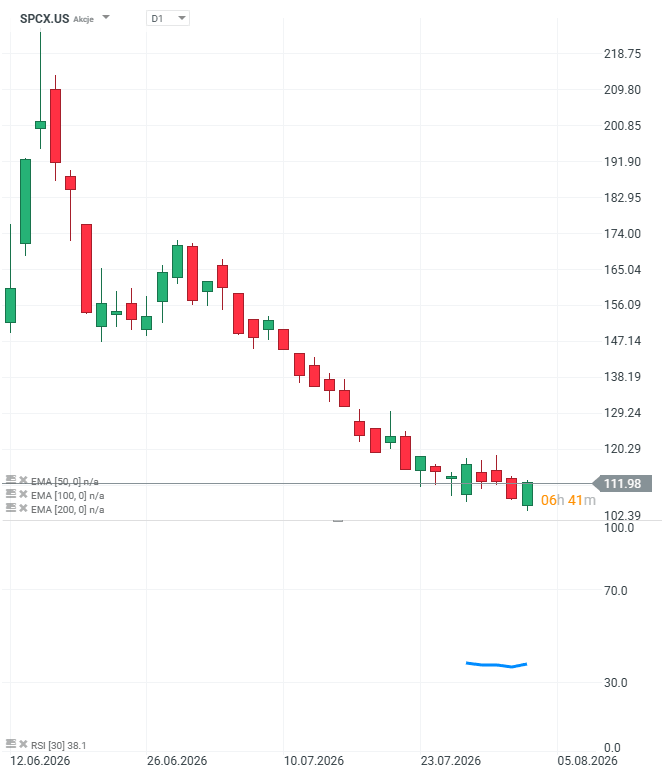
SpaceX’s stock market debut was one of the most anticipated events in the market, but the first few weeks of trading quickly demonstrated how difficult it can be to translate enormous technological ambitions into a stable market valuation. The IPO price was $135 per share. The stock subsequently climbed above the $200 mark before falling back to around $110.
Such significant volatility is not merely a reaction to current news. Above all, it shows that investors are trying to answer a fundamental question: how much of the current share price is supported by an established business, and how much reflects value assigned to projects that may deliver their greatest benefits only years from now?
The upcoming earnings report will be SpaceX’s first real test as a publicly traded company. It may not yet determine the company’s long term value, but it could show whether the current valuation remains justified following the sharp correction from its highs. The bar has been set extremely high, both by Elon Musk, who has spent years building a narrative around breakthrough technologies, and by investors who were willing to value the company far above its IPO price.
In SpaceX’s case, however, the financial results themselves may not be the most important factor. The market will be far more interested in how management describes the company’s growth trajectory, the scale of future investment, and the pace of development across its key projects. The first earnings report is expected to answer not only how much the company earned in the most recent quarter, but, more importantly, whether the business is growing quickly enough to justify the enormous expectations surrounding its future.
Key Expectations and Figures
-
IPO price: $135 per share
-
Post IPO peak: nearly $200
-
Current share price: approximately $110
-
Revenue: $6.81 billion
-
Net income: negative $2 billion
-
EPS: negative $0.23
-
Connectivity segment, Starlink: $3.95 billion
-
Gross margin: 54%
-
Capital expenditures, CapEx: $13.2 billion
Starlink Remains the Foundation of the Entire Story
In SpaceX’s long term growth narrative, the greatest excitement surrounds Starship, the development of space infrastructure, and artificial intelligence related projects. These are the initiatives that could potentially expand the company’s scale many times over in the future.
However, the company’s current value cannot be based solely on long term projects. Investors need a stable business that is already generating revenue, funding development, and supporting the company’s investment pace.
That role is currently played by Starlink. The satellite internet segment is one of SpaceX’s most proven and commercially advanced businesses. Rapid growth in the customer base, expanding coverage, and the development of services for consumers, enterprises, and public institutions could make Starlink the financial foundation of the entire group.
Over the next several years, Starlink could effectively serve as a cash generating engine for SpaceX’s other projects. If the business continues to scale rapidly, the revenue and cash flows it generates could fund less profitable initiatives whose potential is enormous but whose path to full commercialization remains long.
For this reason, investors will focus not only on Starlink’s revenue growth but also on customer acquisition, margin expansion, and the segment’s ability to generate cash. Strong growth at Starlink could demonstrate that SpaceX already has a real, scalable business capable of supporting its most ambitious projects. Weaker figures, by contrast, would increase concerns that the company’s valuation is still based primarily on future promises.
Starship Remains the Greatest Opportunity and the Largest Source of Uncertainty
Starship could fundamentally transform the scale of SpaceX’s operations. The success of the program could reduce the cost of launching payloads into orbit, increase mission frequency, and open the door to new commercial and strategic applications. A significant portion of the company’s long term valuation is built around Starship.
The challenge is that the project’s potential is much easier to estimate than its timeline. Any delay could push back the point at which Starship reaches full operational capability and commercialization, while also increasing the amount of capital required to fund the program.
For that reason, management’s commentary on the next stages of Starship’s development will likely be more important than the company’s second quarter financial results. Investors will be looking for updates on technical progress, planned tests, the pace at which operational capabilities are expanding, and the outlook for the rocket’s commercial use.
If Elon Musk presents a specific and credible timeline, it could strengthen confidence in the company’s long term growth story. If communication remains vague or cautious, the market may begin pricing in a greater risk of delays.
AI Could Be a Major Opportunity, but for Now It Requires Capital
Artificial intelligence related projects are becoming one of the most important elements of SpaceX’s long term strategy. The combination of satellite infrastructure, vast data resources, advanced computing systems, and collaboration with Elon Musk’s other companies could eventually create new sources of revenue.
At the current stage, however, AI remains primarily an area of investment. Developing the necessary infrastructure requires enormous spending on data centers, computing hardware, and energy. Before these projects begin generating meaningful revenue, they may increase costs and weigh on cash flows for an extended period.
This creates a clear tension within SpaceX’s investment story. On the one hand, AI could significantly expand the company’s long term potential. On the other hand, it requires funding that may limit free cash flow for many quarters to come.
This is precisely why investors will expect specific information regarding the scale of investment, the development timeline, and potential monetization. Simply stating that SpaceX intends to participate in the AI race will not be enough. The market will want to know how much capital is required and when the first measurable benefits could emerge.
Record CapEx Will Test Investor Patience
According to Wall Street expectations, SpaceX’s capital expenditures could reach approximately $13.2 billion in the second quarter. For the full year 2026, CapEx is expected to approach $46 billion, before rising to nearly $87 billion in 2027.
Such rapid growth in spending demonstrates the scale of the company’s ambitions. SpaceX is investing simultaneously in Starlink’s expansion, the Starship program, technological infrastructure, and artificial intelligence related projects. Each of these areas could eventually become a major business, but all of them require substantial capital.
The market will therefore have to assess whether these high expenditures represent an investment in future competitive advantages or whether they are beginning to create excessive financial pressure. For mature technology companies, high CapEx can be accepted if rising expenditures quickly translate into higher revenue. SpaceX, however, is in a different position. A significant portion of its investments is directed toward projects whose full monetization may not occur for several years.
Consensus estimates also point to negative free cash flow of approximately $1.9 billion in the second quarter. Negative FCF alone does not necessarily represent a negative signal. For a company developing projects that are so capital intensive, the more important issue will be whether investors receive a credible roadmap connecting current spending with future revenue.
Financing Remains an Important Part of the Story
SpaceX raised nearly $86 billion through its IPO and, just a few weeks later, increased its financing by approximately $25 billion in debt. The scale of the capital raised shows that investors are willing to fund the company’s ambitious plans. At the same time, it raises questions about the pace of future capital requirements.
If capital expenditures increase in line with current forecasts, the market may begin to analyze not only the company’s current results but also the timing of its next capital raise and the potential valuation of future share offerings.
The first earnings report could therefore provide information not only about the outlook for the second half of 2026. Management’s commentary may also help investors assess how long the company’s current financing will remain sufficient and whether SpaceX will require additional large scale sources of capital.
The Lock Up Expiration Could Increase Volatility Regardless of the Results
Several days after the earnings report is released, the gradual unlocking of additional shares subject to the lock up period will begin. This does not mean that all of these shares will immediately enter the market, but it increases the potential supply of shares and could raise short term volatility.
This is important because the stock’s reaction to the results may be shaped not only by financial data and Elon Musk’s commentary. Even a very strong earnings report could be partially overshadowed by concerns about the increasing number of shares available for trading. On the other hand, the gradual nature of the unlock means that the market will have time to absorb the additional supply.
It is also worth remembering that the ability to sell does not create an obligation to sell. Some employees and early investors may choose to take profits or diversify their portfolios, while others may retain their positions. As a result, the impact of the share unlock on the stock price will depend on the actual scale of selling and the current level of demand for the shares.
Elon Musk May Matter More Than the Numbers Themselves
SpaceX’s first quarterly earnings report will also be the company’s first major test of communication with the public market. Investors know Elon Musk as a leader capable of building highly ambitious visions and attracting capital to projects that extend beyond the traditional boundaries of technology.
This time, however, vision alone may not be enough. Following the sharp rise and subsequent selloff in the stock, shareholders will expect more concrete information. Key areas will include the development of Starlink, the Starship timeline, the scale of AI investment, the availability of semiconductor chips, and the outlook for future revenue.
Musk’s commentary could have a greater impact on the share price than a small earnings beat or a modest disappointment relative to consensus expectations. The market will primarily assess management’s level of confidence and the credibility of the growth path presented.
Three Possible Scenarios
Positive Scenario
The positive scenario assumes strong growth at Starlink, specific updates on the continued development of Starship, and a convincing strategy for monetizing artificial intelligence related projects. If management demonstrates that high CapEx is a response to growing demand and is contributing to the creation of new revenue streams, the market may view the recent correction as an opportunity to revalue the company.
Neutral Scenario
The neutral scenario assumes results broadly in line with expectations, continued strong growth at Starlink, and a general reaffirmation of long term plans. Such a report could stabilize investor sentiment but might not be enough to trigger a significant rebound in the share price. At the current valuation, investors may expect more specific information regarding future growth.
Negative Scenario
The negative scenario includes weaker momentum at Starlink, delays in Starship’s development, further increases in CapEx, and the absence of a clear path toward monetizing AI projects. In this case, the market could conclude that even a share price of around $110 still reflects an overly ambitious growth scenario.
The First Earnings Report Will Test the Credibility of the Entire Story
SpaceX remains one of the most ambitious technology companies in the world. It possesses genuine competitive advantages, an established Starlink business, the enormous potential of Starship, and the opportunity to develop new sources of growth in AI. At the same time, a large portion of the company’s valuation is based on projects whose full scale and profitability remain distant.
The first quarterly earnings report will therefore be more than a standard financial release. It will be the first test of whether the market is receiving enough evidence to continue valuing SpaceX as one of the most important growth companies of the future.
The key questions are:
-
Is Starlink still growing quickly enough?
-
Can the segment generate the cash needed to fund SpaceX’s other projects?
-
What does the Starship development timeline look like?
-
How large will future AI investments be?
-
When could AI related projects begin generating revenue?
-
Is rising CapEx still justified?
-
How long can SpaceX continue funding its expansion while generating negative free cash flow?
-
Does the current valuation still reflect an overly ambitious growth scenario?
-
How will the market react to the increase in the number of shares available for trading?
Key Takeaways
SpaceX is entering its first quarterly earnings report following a highly volatile period. The stock rose from its $135 IPO price to $200 before falling back to around $110. The current valuation suggests that the market has begun to assess more critically the pace at which ambitious projects can be translated into tangible financial results.
Starlink remains the company’s most important foundation. Rapid growth in the segment could confirm that SpaceX already possesses a scalable business capable of funding less profitable but potentially more promising projects.
Starship remains the company’s greatest long term opportunity but also one of its main sources of uncertainty. Commentary regarding the development timeline could have a greater impact than the second quarter financial results themselves.
AI increases the company’s long term potential but also requires enormous investment. Consensus estimates point to approximately $46 billion in CapEx in 2026 and around $87 billion in 2027, alongside expected negative free cash flow in the upcoming quarter.
High spending may be accepted if SpaceX demonstrates that it is leading to rising revenue, continued growth at Starlink, and the creation of new sources of expansion. However, if investment increases faster than the company’s real ability to monetize its projects, the market may once again question the valuation.
SpaceX’s first earnings report will therefore not be merely an assessment of the most recent quarter. Above all, it will test whether the company can convince investors that a significant portion of its future value already rests on tangible foundations rather than on promises alone.



Three markets to watch next week (23.10.2026)



Daily Summary: Oil at five-month highs, indices under pressure (23.10.2026)

US Open: Further declines on Wall Street, Brent above 111 USD, AI correction continues (14.10.2026)



Morning Wrap: AI profitability concerns spark market Sell-Off