


Broadcom once again demonstrated that the boom in artificial intelligence infrastructure can be a powerful source of growth for the company. In the third fiscal quarter of 2026, revenue reached $29.6 billion, up 86% year over year, while revenue from AI infrastructure semiconductors surged 221% to $16.7 billion. The results clearly exceeded market expectations.
Despite this, investors reacted negatively. The reason was relatively straightforward: revenue guidance for the following quarter came in at approximately $34.8 billion, while consensus expectations were slightly above $35 billion. With the bar set so high, even a small miss against expectations was enough for the market to focus on the next three months.
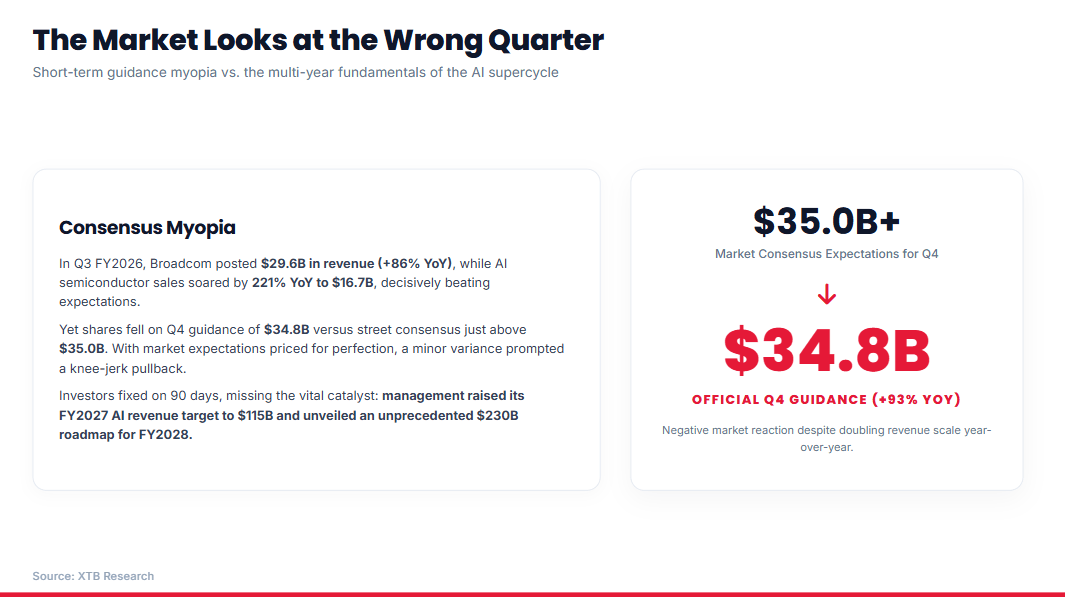
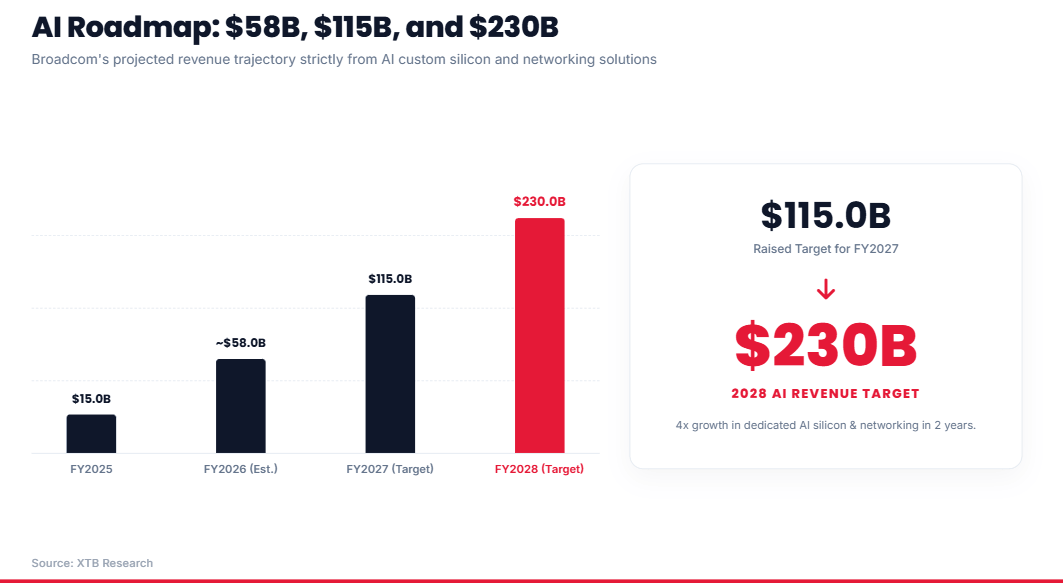
However, in Broadcom’s case, the much more interesting perspective extends beyond a single quarter. The company raised its forecast for AI semiconductor revenue in 2027 to approximately $115 billion, while also presenting an even more ambitious outlook for 2028, when this business is expected to reach approximately $230 billion.
This trajectory is now the key to evaluating Broadcom. The company is no longer simply a supplier of specialized components for data centers; it is increasingly becoming one of the major beneficiaries of rising spending on AI infrastructure. The scale of the projected revenue highlights how much importance management places on its custom AI chips, networking technologies, and solutions developed for its largest customers.
Against this backdrop, the latest report should be analyzed not only through the lens of next-quarter guidance, but above all through the quality of the current business, its ability to generate cash, and the visibility of growth over the coming years. That is where the most important part of the Broadcom story lies.
Business Model: What Broadcom Really Is
Broadcom is now a much broader company than its name alone might suggest. It is no longer simply a semiconductor manufacturer. The company combines advanced chip technologies with infrastructure software, providing solutions used in data centers, networks, and enterprises.
Broadcom reports its operations across two main segments: Semiconductor Solutions and Infrastructure Software. The first includes the design of chips and components used in data centers, networking, broadband systems, wireless communications, and storage systems. Artificial intelligence solutions have become a particularly important area. Broadcom designs, among other things, custom chips for the world’s largest technology companies, as well as networking technologies responsible for the rapid movement of data between different components of the infrastructure.
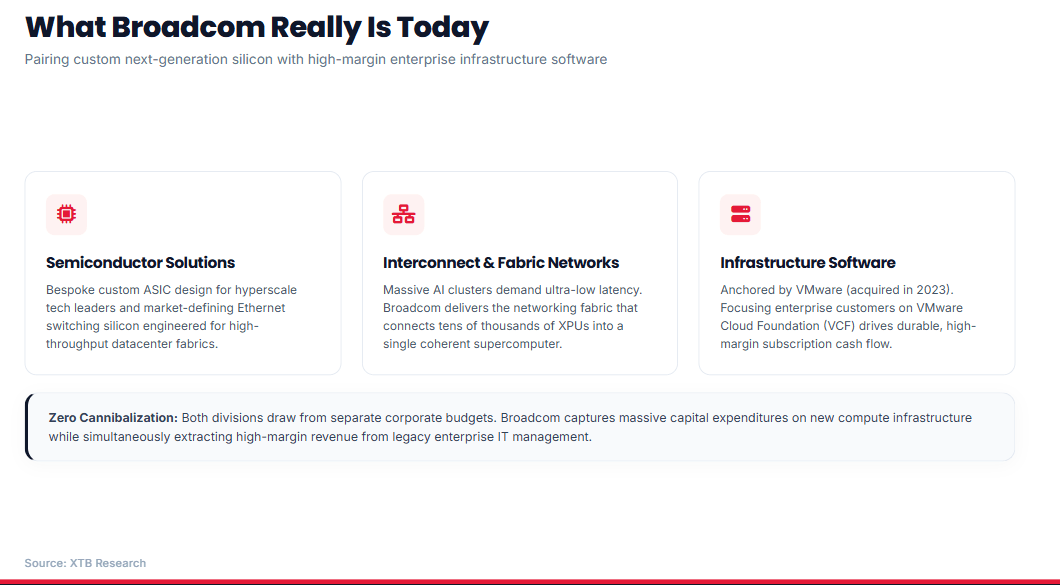
This is important because the development of AI does not end with building increasingly powerful computing chips. As AI clusters become larger, communication between thousands of individual components becomes increasingly important. Broadcom operates directly in this area, providing the technologies required to connect the entire infrastructure into a single, high-performance system.
The second pillar of the business is Infrastructure Software, which includes software used by enterprises to manage IT infrastructure, cloud environments, and mission-critical IT systems. The most important component of this segment is VMware, which Broadcom acquired in 2023. Following the transaction, the company focused VMware’s operations primarily on VMware Cloud Foundation and enterprise customers.
What is particularly interesting is that the two segments do not compete for the same customers or the same type of spending. Broadcom can benefit from two different trends at the same time. On the one hand, spending on building new computing infrastructure is increasing, while on the other, enterprises increasingly need software that allows them to manage both existing and newly built infrastructure.
That is why Broadcom should not be viewed as a traditional semiconductor manufacturer, but rather as a technology provider deeply embedded in the digital infrastructure stack. Some of its products determine how data is processed and transmitted, while the other part of the business determines how the infrastructure itself is managed.
This structure is key to understanding Broadcom’s current story. The company has one business that primarily benefits from the boom in new computing capacity and another, more mature segment focused on infrastructure software. In the following sections, it is therefore worth looking separately at how these two areas translate into financial results, cash flows, and future growth potential.
Latest Results: Excellent Performance and Disappointing Guidance
Broadcom’s third fiscal quarter of 2026 was another record period for the company. Revenue increased 86% year over year, while profitability and cash flow improved significantly.
Key figures:
-
Revenue: $29.59 billion, up 86% year over year
-
GAAP operating income: $15.96 billion, up 171% year over year
-
GAAP net income: $13.09 billion, up 216% year over year
-
GAAP earnings per share: $2.68, up 215% year over year
-
Cash flow from operations: $14.20 billion, up 98% year over year
-
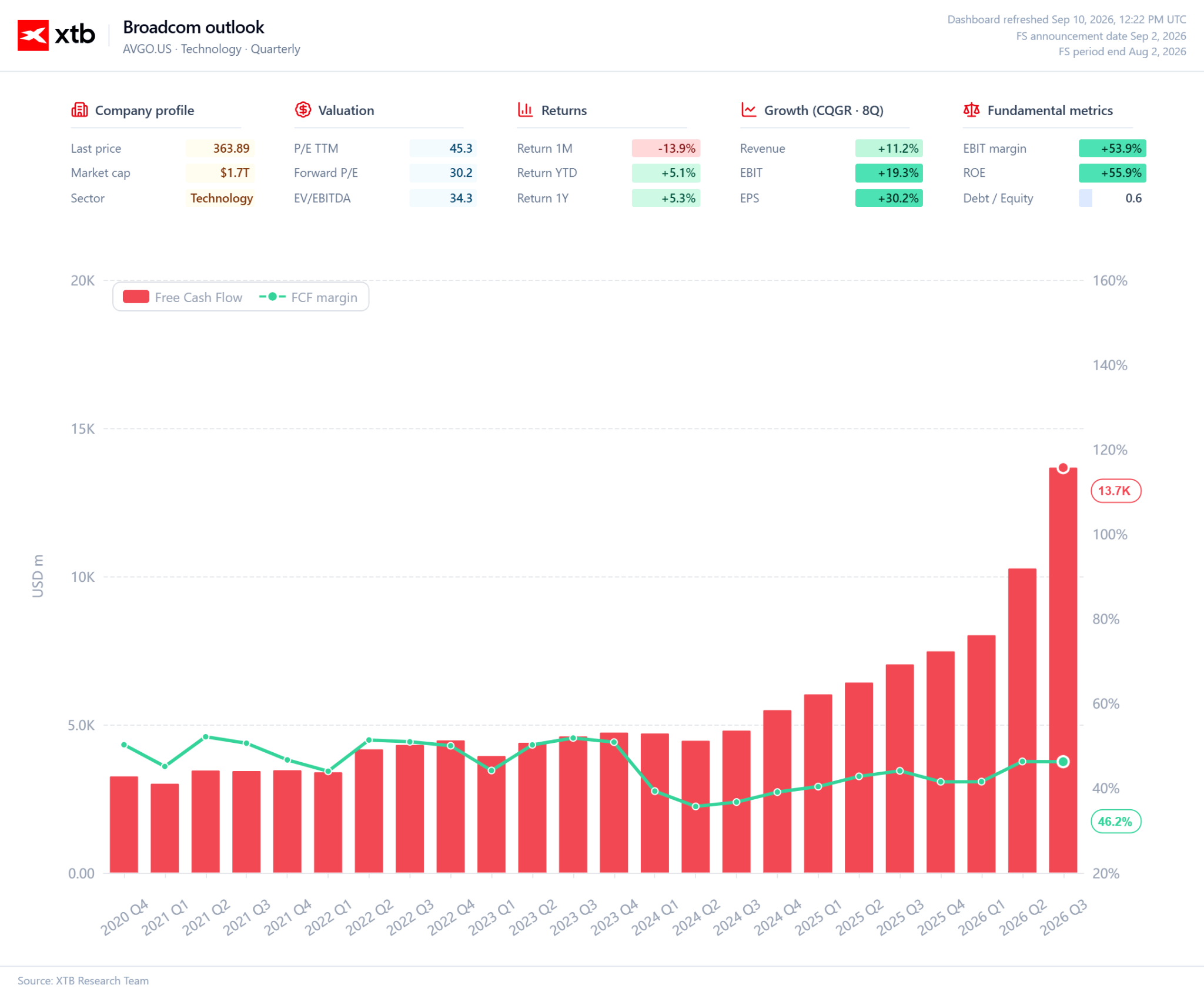
Free cash flow: $13.67 billion, up 95% year over year, equivalent to 46% of revenue
The Semiconductor Solutions segment was the primary driver of these results. Revenue from this part of the business increased 127% to $20.84 billion. The AI-related business grew even faster. Revenue from AI semiconductors reached $16.7 billion, representing a 221% year-over-year increase and a 54% increase from the previous quarter.
By comparison, Infrastructure Software revenue increased 29% to $8.75 billion. This shows that Broadcom’s current surge in results is primarily being driven by rapidly increasing demand for AI infrastructure, while the software business remains the more stable pillar of the overall group.
Cash flow is also worth highlighting. Broadcom generated $14.2 billion in cash from operations during the quarter, and after deducting $0.5 billion in capital expenditures, it was left with $13.7 billion in free cash flow. This demonstrates that the growth in revenue is not merely an accounting phenomenon. The company is highly effective at converting rising sales into actual cash. At the end of the quarter, it had $24 billion in cash and cash equivalents.
The issue for investors emerged only in the outlook for the next quarter. Broadcom expects approximately $34.8 billion in revenue in the fourth fiscal quarter, which would still represent 93% year-over-year growth. The company also expects its non-GAAP operating margin to remain at approximately 66%.
At first glance, it is therefore difficult to describe the guidance as weak. The market, however, was expecting even more. Elevated expectations meant that the $34.8 billion forecast was interpreted as disappointing, despite implying continued extremely rapid business growth. Broadcom’s share price fell because investors began comparing the forecast not with the previous year, but with an exceptionally high consensus estimate and their own expectations.
Importantly, at the same time, the company raised its expectations for its long-term AI business. For the next fiscal year, Broadcom expects approximately $115 billion in AI semiconductor revenue, while its forecast for 2028 stands at approximately $230 billion. In my view, these figures are far more important to the company’s long-term story than a relatively small miss against expectations for a single quarter.
As a result, Broadcom’s latest report highlights an interesting disconnect. Operationally, the company is experiencing one of the strongest periods in its history, yet the market reacted negatively to a relatively minor disappointment in short-term guidance. It is a good example of just how high the bar has been set for companies that are among the biggest beneficiaries of the AI infrastructure boom.
Financials: A Business That Converts Growth Into Cash
When it comes to Broadcom, revenue growth alone does not tell the whole story. What is much more interesting is what the company does with every additional dollar of sales. And this is where Broadcom’s business model looks particularly attractive. Rapid revenue growth is accompanied by very high profitability and exceptionally strong cash generation.
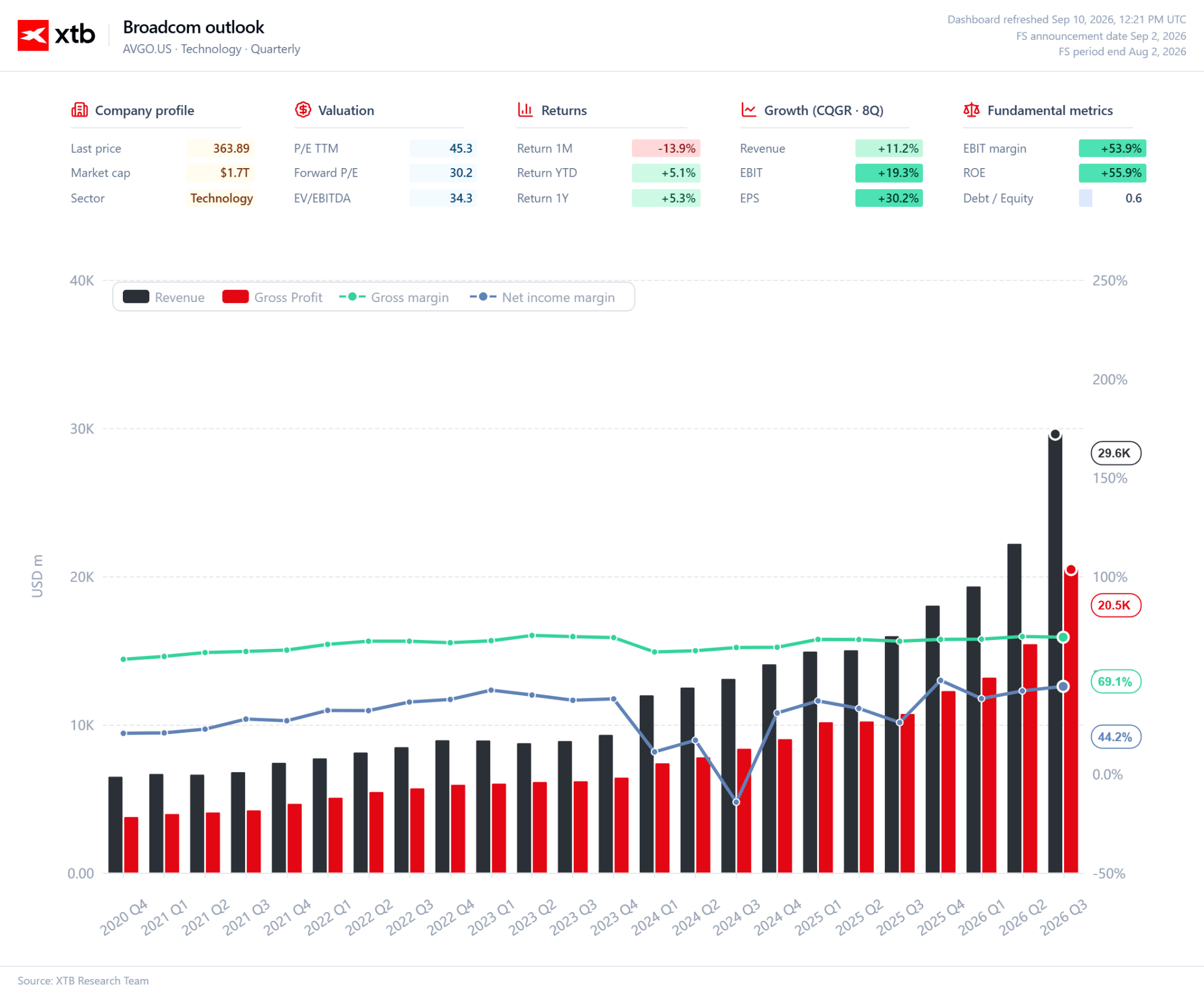
This is best illustrated by cash flow. In fiscal 2025, Broadcom generated $27.5 billion in cash from operations, compared with just under $20 billion a year earlier. Free cash flow reached approximately $26.9 billion.
This is important because Broadcom is not a business that needs to allocate a huge portion of its revenue to building factories or its own manufacturing capacity. The company focuses primarily on technology design, while a significant portion of its manufacturing is carried out by external partners. As a result, a large part of the growth in sales can flow directly into cash flow.
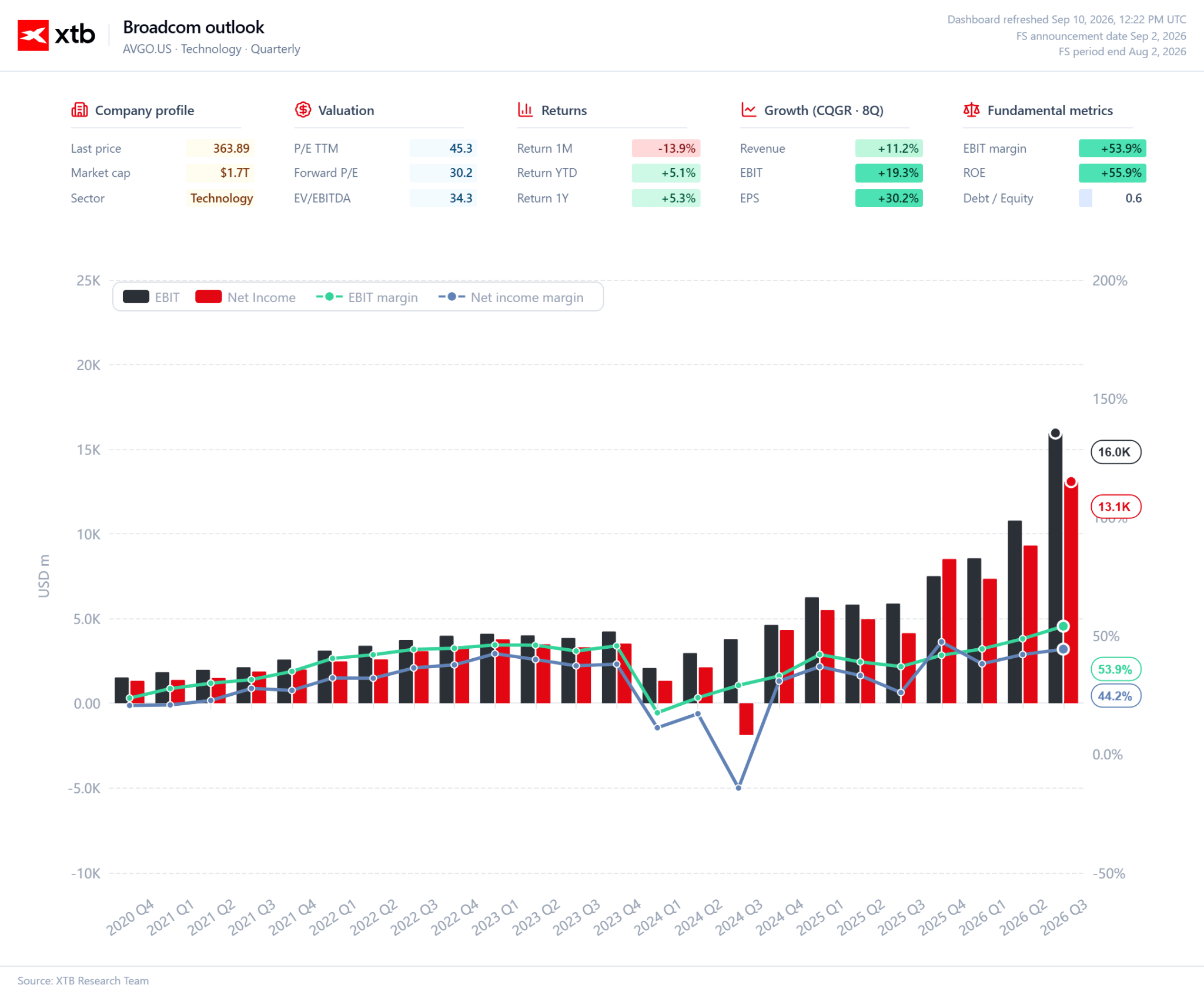
This is even more evident in the latest results. In the third quarter, the company generated $14.2 billion in operating cash flow and $13.7 billion in free cash flow. With revenue of $29.6 billion, this means Broadcom converted nearly half of its quarterly sales into FCF. That is an exceptionally high level of cash conversion for a technology business.
The second part of the equation is margins. Broadcom has spent years building its business around products with high technological value, while the acquisition of VMware further increased the contribution of highly profitable software to the group. As a result, the company is able to maintain very high profitability even as it rapidly expands the scale of its operations. Management expects non-GAAP operating margin to be approximately 66% in the fourth fiscal quarter of 2026, highlighting the scale of this advantage.
That does not mean, however, that Broadcom’s balance sheet is without its burdens. The largest item is debt related to the VMware acquisition. The transaction was partially financed with debt, and at the end of 2025 Broadcom had approximately $67.1 billion of fixed-rate debt outstanding. At the same time, the company is now generating so much cash that its debt does not appear to be an issue that materially constrains its operations. In 2025, Broadcom allocated, among other things, $11.1 billion to dividends while also repaying debt.
This is why the most important question regarding Broadcom’s finances today is not whether the company can rapidly increase revenue. The latest results clearly show that it can. The much more important question is whether the same high quality of its financial profile will remain intact as the AI business reaches a much larger scale.
For now, the answer appears favorable. Broadcom is increasing sales, improving earnings, generating enormous amounts of cash, and at the same time has the ability to continue reducing its debt. If the announced expansion of the AI business is indeed delivered over the coming years, the company’s current financial structure gives it a very strong position to continue investing, servicing its debt, and returning capital to shareholders.
Broadcom Roadmap: $58 Billion, $115 Billion and $230 Billion
The most important part of the Broadcom story today is not the results of the next quarter, but how quickly its AI-related business can grow over the coming years. According to the assumptions presented by the company, revenue from AI chips and other AI-related solutions could reach approximately $58 billion in 2026, approximately $115 billion in 2027, and approximately $230 billion in 2028.
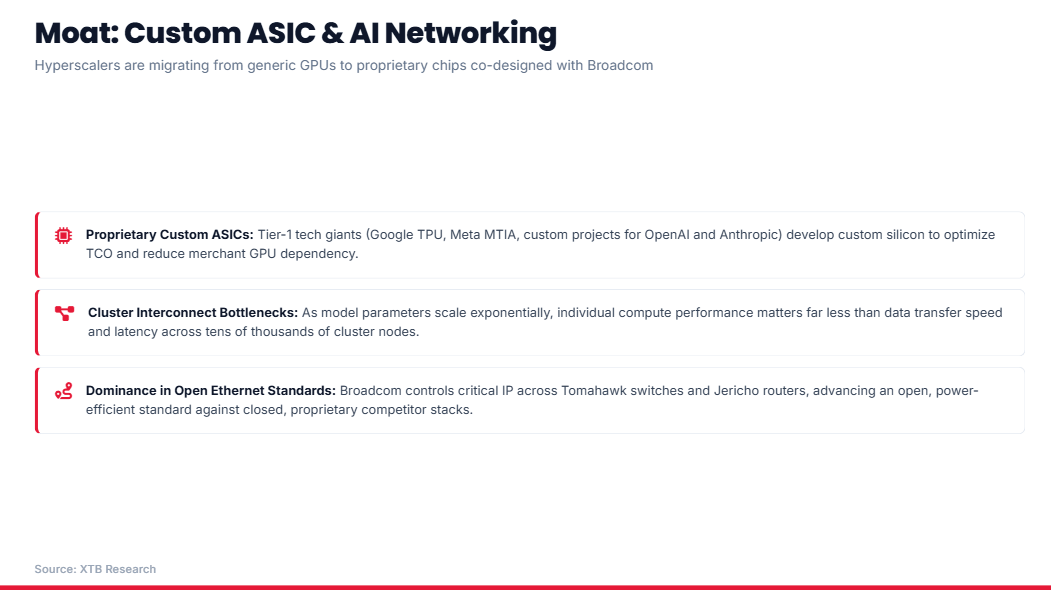
The scale of this forecast is impressive, but its source is quite specific. Broadcom designs custom processors and chips for the largest technology companies, which are increasingly looking to develop their own solutions for running artificial intelligence workloads. Among its key customers are Google, Anthropic, OpenAI, and Meta.
Broadcom is also benefiting from another important trend: the development of networks connecting thousands of processors operating inside data centers. As AI systems become larger, what matters is not only the computing power of an individual chip, but also the speed at which data can move between all the different components of the infrastructure. This is another area in which Broadcom has a very strong position.
The scale of the current growth is clearly visible in the latest results. In the third quarter, revenue from AI solutions amounted to $16.7 billion, representing a 221% year-over-year increase. In the following quarter, the company expects this figure to reach approximately $21.7 billion.
Even more important is the visibility into the coming years. Broadcom says it has secured sufficient supply to meet its increased expectations for 2027. The company has also pointed to specific projects from its largest customers, involving more than 10 GW of capacity for Anthropic, more than 5 GW for OpenAI, and approximately 3 GW for Meta.
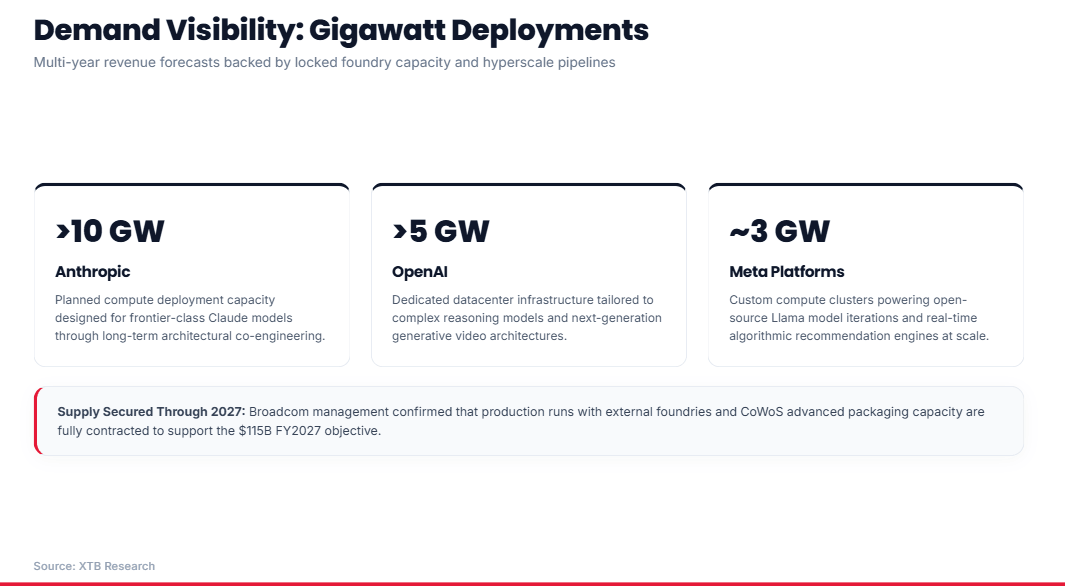
This does not, of course, mean that each of these investments will automatically translate into Broadcom revenue. However, it does illustrate the scale of the infrastructure currently being planned by the world’s largest technology companies.
And this is precisely where the most important part of the story lies. Broadcom is not benefiting solely from the growing number of processors being sold. The company also provides chips designed for specific customers, networking components, and technologies required to connect entire data centers into a single system.
That is why the $115 billion forecast for 2027 and $230 billion forecast for 2028 are so important. At the same time, these are highly ambitious targets. Achieving them will require sustained high levels of AI spending by the largest technology companies, continued growth in demand for computing power, and Broadcom maintaining its position among the key suppliers of this infrastructure.
For now, however, the company has increasingly strong visibility into this demand. This suggests that the latest results should not necessarily be viewed as the peak of the current cycle, but rather as the starting point for a much larger business. The question is how long this growth can continue and what factors could bring it to a halt.
Key Takeaways
Broadcom is currently experiencing one of the strongest periods in its history. The company is benefiting from massive spending on artificial intelligence while also maintaining a second, more mature pillar in the form of infrastructure software.
The latest quarter demonstrated the scale of this growth. Revenue increased 86%, AI-related revenue rose 221%, and free cash flow reached $13.7 billion. Importantly, Broadcom has demonstrated an ability to translate rising sales into exceptionally strong cash generation.
The biggest question, however, is whether the current pace of growth can be sustained for years to come. The company’s forecasts call for approximately $115 billion in AI revenue in 2027 and approximately $230 billion in 2028. This represents enormous potential, but also sets an extremely high bar.
The key risks include dependence on spending by the largest technology companies, customer concentration, supply-chain constraints, and increasing competition. High expectations also mean that even a relatively small disappointment can trigger a strong market reaction, as we saw following the latest results.
Broadcom therefore remains, above all, a story about the continued scaling of AI infrastructure. The company already has a very strong business, enormous cash generation, and increasingly clear visibility into future projects. The key question now is whether its ambitious roadmap for 2027 and 2028 will ultimately translate into actual results.
Source: xStation5



Three markets to watch next week (23.10.2026)



Daily Summary: Oil at five-month highs, indices under pressure (23.10.2026)

US Open: Further declines on Wall Street, Brent above 111 USD, AI correction continues (14.10.2026)



Morning Wrap: AI profitability concerns spark market Sell-Off