


Texas Instruments posted results clearly better than expectations and delivered a strong outlook for the next quarter. Investors, however, did not react very enthusiastically. The semiconductor maker’s shares fell by about 5% at the market open.
If not the pace and scale of growth, what is putting pressure on the valuation?
Key figures
- Revenue in Q2 2026 totaled USD 5.46 billion, up 23% year over year.
- EPS came in at USD 2.14, nearly 9% above the prior consensus.
- Gross margin rose to 61.4%, while operating margin reached 42.3%.
- Operating profit increased 48% year over year, almost twice as fast as revenue.
This points to rising operating leverage as factory utilization increases and demand for analog integrated circuits rebounds.
The recovery covered most of the key end markets:
- Sales to industrial customers rose by about 30% year over year.
- The data center segment doubled revenue.
- Automotive grew at a pace of, only and as much as, the low teens percent range.
The results therefore confirm that the improvement is not limited solely to the AI investment boom.
Outlook
- Another positive signal is the guidance for the third quarter. Texas Instruments’ management expects around USD 6 billion in revenue and USD 2.50 in earnings per share.
- That implies levels roughly 5% and 12% above the market’s previous expectations, respectively.
What went wrong?
Texas Instruments went into the earnings release after the stock had risen nearly 70% since the start of the year. With such a high valuation, investors expected not only a beat but also a rapid improvement in free cash flow. Meanwhile, stronger demand may encourage the company to maintain high spending on new fabs.
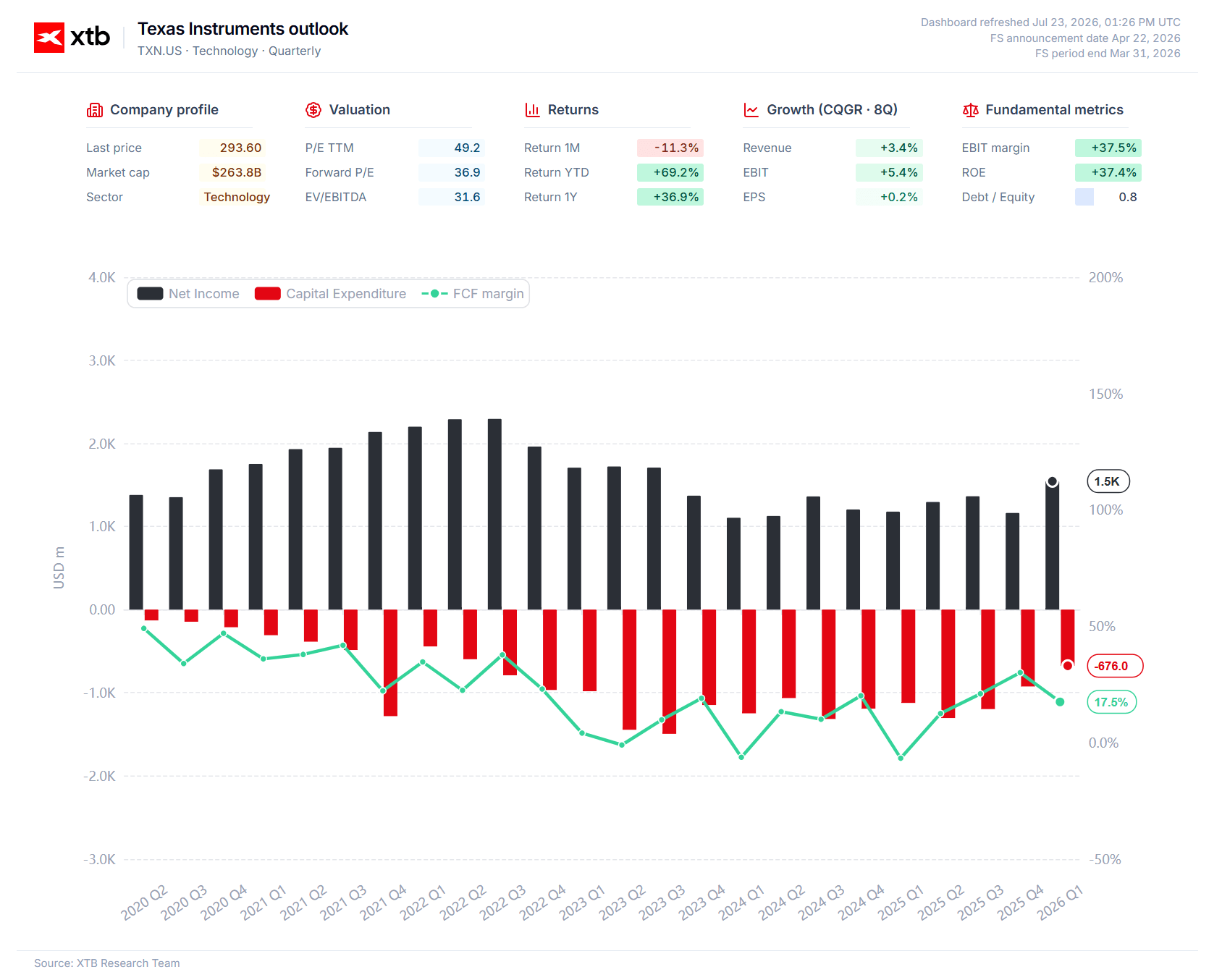
Reported free cash flow over the last 12 months was about USD 6.53 billion, but it included roughly USD 1.61 billion of benefits related to the CHIPS Act. Excluding those, FCF falls to about USD 4.92 billion, or “only” 25.3% of revenue.
The results strengthen the case for a broad rebound in the analog semiconductor market, but the market is not ready to pay that much for a company without cash.
Texas Instruments remains operationally strong, but after this year’s share price rally, the market needs further proof that improved results will also translate into a sustained increase in cash flows.



Daily Summary: Rising inflation weighs on markets, semiconductors suffer most (14.10.2026)


US Open: CPI reading weighs on American indices (14.10.2026)

POET: A “meme stock” in photonics, is there still hope?


US Open: Earnings season kicks off on a high note (13.10.2026)