

- The ECB is widely expected to keep interest rates on pause during its meeting.
- Rising French bond yields and widening spreads create a difficult policy dilemma for the central bank.
- Christine Lagarde will step down as ECB President on 07.02.2027, focusing market attention on her successor.

- The ECB is widely expected to keep interest rates on pause during its meeting.
- Rising French bond yields and widening spreads create a difficult policy dilemma for the central bank.
- Christine Lagarde will step down as ECB President on 07.02.2027, focusing market attention on her successor.
Today's ECB meeting presents Christine Lagarde with a choice in which every option works to the disadvantage of the single currency. Perhaps this also offers hope for the euro. Things are so bad that any positive signal will be able to improve the situation, at least temporarily. However, from a longer-term perspective, there are no prospects for improvement.
The market is almost 100% pricing in a pause, but the direction of the euro will be decided not by the rate decision itself, but by how the central bank reacts to the growing problem in the French debt market.
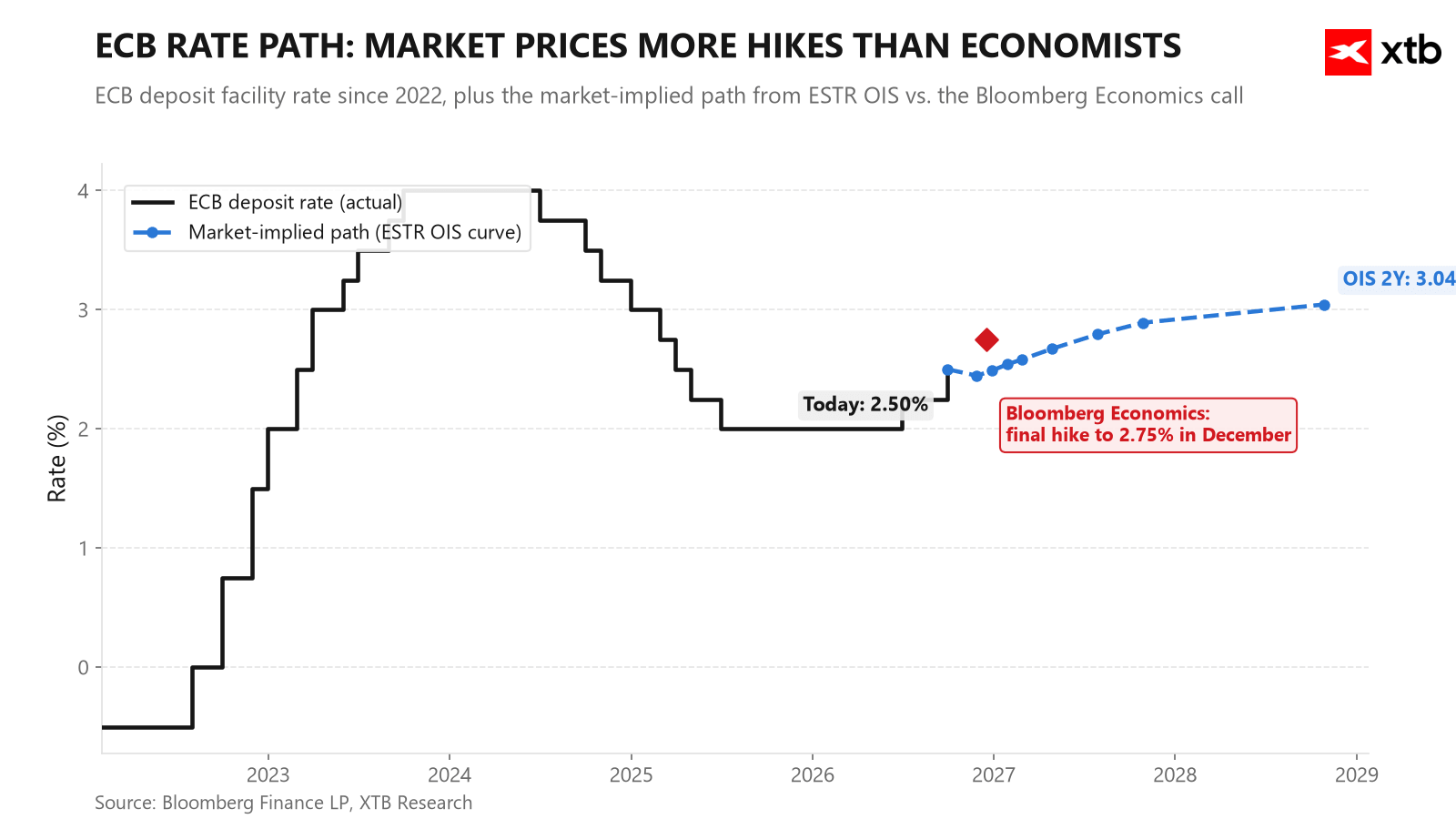
Today's decision: pause almost certain, December almost certain
The ECB is at a rather difficult juncture. Inflation is rising, terms of trade are deteriorating markedly, and looking from the perspective of rising energy prices, it would be helpful not to add further tightening when the bond market is already doing it for them. Yields are rising, which in itself tightens financial conditions. According to the Bloomberg Economics model, the term premium has risen by about 40 basis points since July, which could subtract around 0.2 percentage points from Eurozone GDP. Without new macroeconomic projections and given high uncertainty regarding commodity prices before December, the ECB will likely avoid firm commitments.
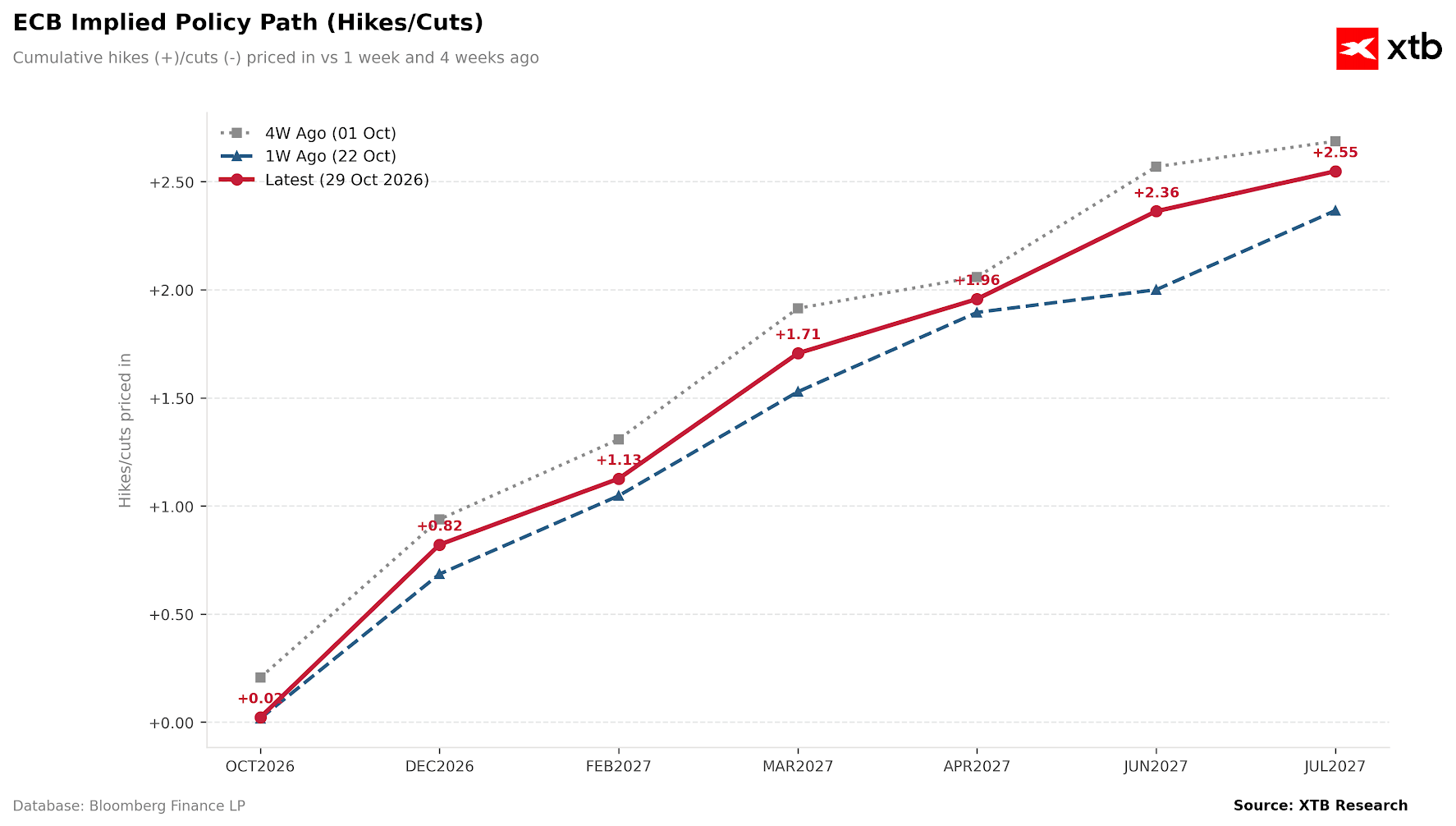 December is a completely different story. Bloomberg Economics maintains a scenario of one more hike, to 2.75%, slightly into restrictive territory. Oil and gas have risen since the September meeting to the point where they are approaching the ECB analysts' negative scenario, and the inflation forecast for 2026 (3.1%) is already higher than the bank's own September projection (3.0%). The key question for December is whether the energy shock will begin to spill over into core inflation. For now, there are few signals of such a spillover.
Why is this a no-win trap for the euro?
The real test of today's press conference will not be the rhetoric on interest rates, but how Lagarde addresses the French problem of rising bond yields amid a lack of buyers for French debt. The problem for France is that most of this debt is sold abroad.
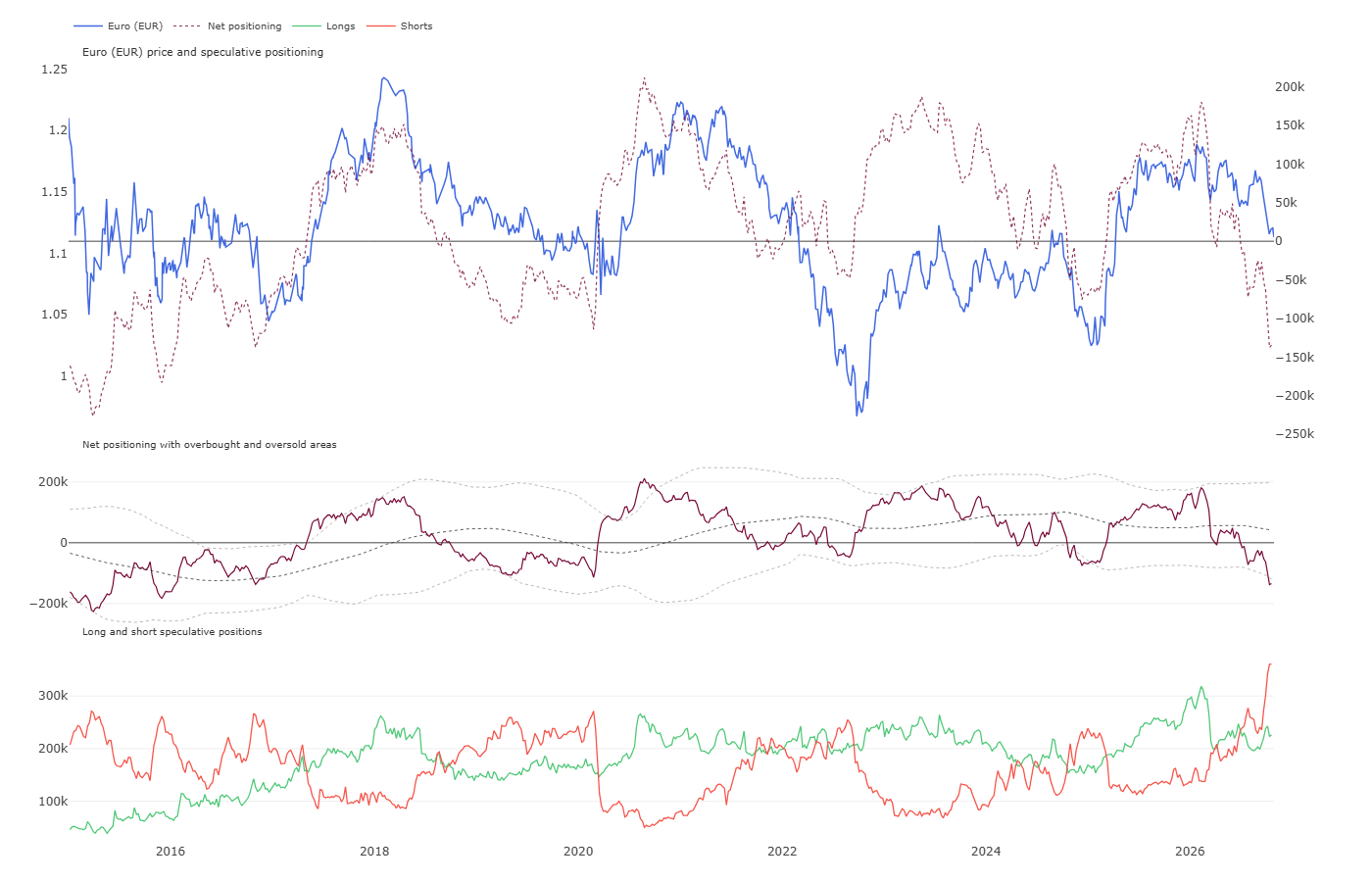 The euro is currently the most oversold by speculators (net) since 2017. The number of short positions is, in turn, the highest in history. Source: CFTC, XTB
The OAT-Bund spread has widened by more than 60 basis points since the September meeting, and the market is looking for a signal as to how ready the ECB is to react. As European analysts' comments point out, regardless of what Lagarde says, the euro will not find support. What, then, should be expected?
- Scenario one and baseline. Lagarde dismisses the need for intervention for now and suggests that French stress will not limit further tightening. OAT spreads then have room for further widening, carrying the risk of a contagion effect to other markets. Such a scenario would hit the euro through the systemic risk channel.
- Scenario two. Lagarde signals that French stress is impacting the policy path. This is a dovish interpretation: higher bond yields are already tightening financial conditions on their own, so the ECB has less work to do. This, in turn, weighs on EURUSD through the interest rate differential channel.
Both directions lead to the same conclusion: either the ECB tolerates growing stress in France, or that stress begins to constrain monetary policy. In neither of these scenarios does the euro gain clear support from today's meeting. There remains the question regarding formal intervention alongside further tightening in the form of rate hikes. Is there any chance of that at all?
Formal intervention still unlikely
Activating the TPI instrument, which protects monetary policy transmission, has a very high threshold to meet, and current levels are still clearly below the thresholds threatening broader financial stability or those seen during previous episodes of tension in Italy. Intermediate solutions are more likely at this stage: pausing quantitative tightening (QT) or a separate liquidity support mechanism, rather than bond purchases targeted directly at France.
France: OAT yield already higher than Italy's
The French debt market remains the largest source of tension in the Eurozone. The 10-year OAT yield stands at 4.90%, surpassing Italy (4.51%) for the first time in history, and the spread over Germany is already around 155 basis points.
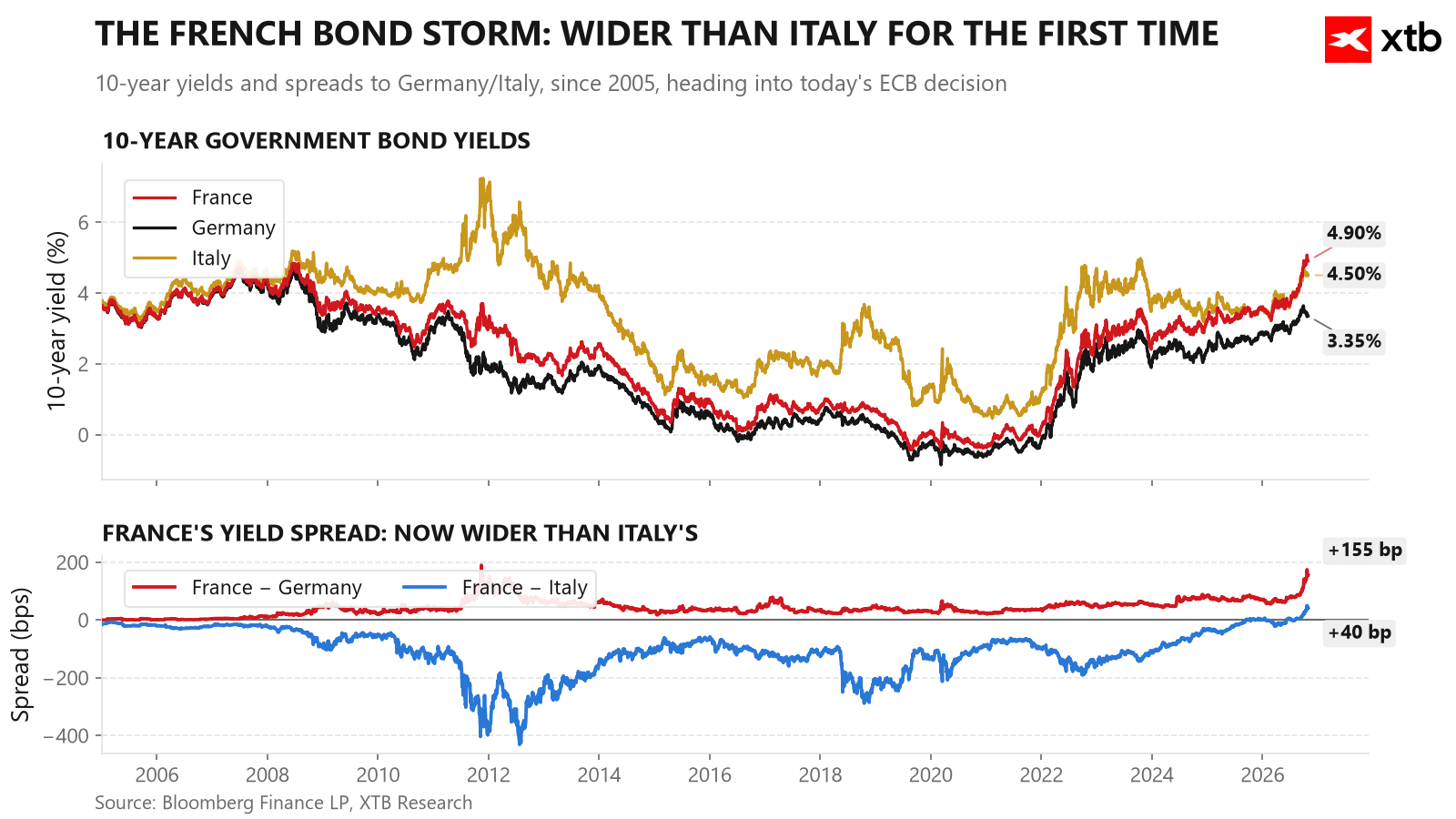
An interesting, rarely discussed element of the puzzle is the TARGET2 system. Banque de France is already one of the largest net debtors in the system, with an obligation reaching EUR 181 billion (about 6% of GDP), but it finances itself through this channel at the ECB deposit rate rather than at the market yield of French debt. Bloomberg Economics estimates that this saves the French treasury EUR 5–11 billion annually, and every additional 100 basis points of spread widening adds about EUR 2 billion per year to this benefit. However, this is a double-edged sword: rising TARGET2 liabilities can be interpreted as capital flight from France, similar to Italy and Spain in 2011–2012, aggravating political tensions with creditor countries, mainly Germany. A key test will come on November 2, when September TARGET2 data is published, the first to cover the current sell-off wave.
The issue of Lagarde's successor
As reported by Bloomberg, Christine Lagarde has officially announced that she will step down as ECB President on February 7, 2027, ahead of the end of her term in October 2027. Her departure will coincide with taking on the role of head of the World Economic Forum, focusing market attention on the selection of her successor.
This has crucial practical importance for pricing French risk. The most frequently mentioned candidates to succeed her are Klaas Knot (Netherlands, more hawkish, supported by Germany) and Pablo Hernández de Cos (Spain, more dovish, likely supported by France due to greater willingness to intervene in the bond market). If pressure on French debt persists until the leadership change at the ECB, this choice will decide how far the central bank goes in supporting Paris.
What next for EURUSD?
Today's decision in itself should not surprise the market. The real risk is how Lagarde handles questions about France. A tough scenario carries the risk of a continued sell-off in French debt and a contagion effect, while a soft scenario signals less work for the ECB and a narrower interest rate disparity relative to the Fed. Both paths favor further euro weakness rather than its strengthening, and the real catalyst for a change in direction may turn out to be the publication of TARGET2 data on November 2 or the disclosure of succession plans for Lagarde.
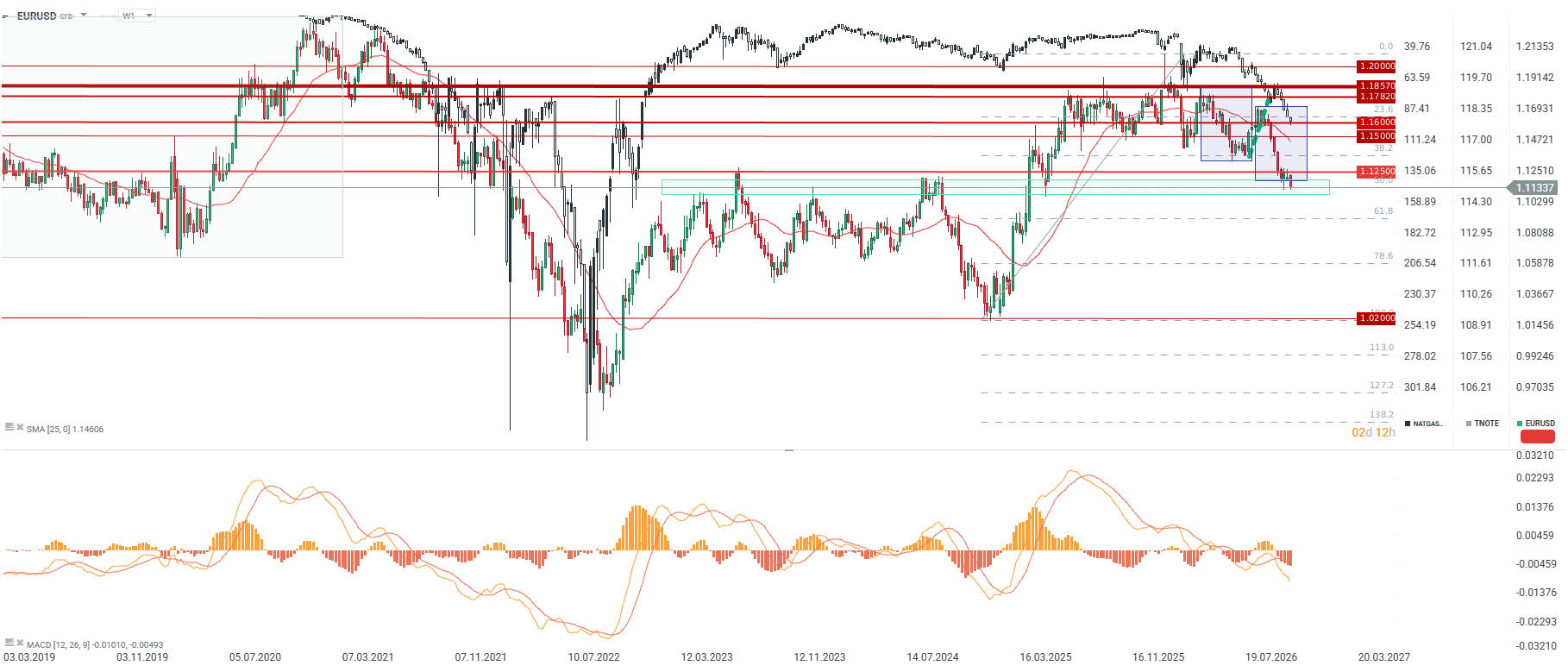 EURUSD remains under the influence of rising energy prices. When European gas prices last reached 100 EUR/MWh in 2022, EURUSD was below 1.10, but was already in an upward mode. On the other hand, the first time this situation occurred was in 2021. EURUSD was at 1.16 then, but for the pair, it was only the beginning before deeper declines. If EURUSD does not rebound to 1.1175 by the end of this week, everything indicates that key support will be broken, which could push the pair down to at least 1.09, where the 61.8 retracement of the last upward wave is currently located.


Warsh changes the game, Fed catches its breath [Post-FOMC Comment]

Daily Summary: Oracle drives the market higher, dollar weakens following Fed meeting (28.10.2026)

Time for a pause – what will determine the strength of the dollar? [Pre-FOMC Report]


BREAKING: Bank of Canada hikes for the first time in 3 years but signals caution on further moves