


U.S. President Donald Trump has backed restrictions on diesel exports from the United States, while Treasury Secretary Scott Bessent confirmed that the administration is examining both a full and a partial ban. No decision has yet been made, but Trump said it should come quickly. This marks a significant shift in the administration’s stance, as it had previously been skeptical about restricting fuel exports. If approved, such a move could represent a major blow to global diesel supply.
The reason is straightforward: diesel prices in the U.S. have reached levels that are beginning to matter not only for drivers, but for the broader economy. According to the EIA, the average retail price of diesel stood at $6.52 per gallon on September 21, compared with $5.96 just two weeks earlier. AAA reported a record average of around $6.53 per gallon on September 22. At first glance, an export ban therefore looks like a simple solution: if more diesel stays in the U.S., domestic supply should increase and prices should fall. But the refined-products market is far more complicated.
An export ban may only appear to lower prices
The most immediate effect would indeed probably be supportive for the U.S. market. Barrels of diesel that currently go to Mexico, Latin America, Europe and other destinations would have to be sold domestically. The increase in local supply would put downward pressure on wholesale prices and, over time, potentially on prices paid by distributors and at fuel stations.
The potential scale of the impact is far from marginal. The United States is one of the world’s largest exporters of refined petroleum products. In 2025, exports of major transportation fuels averaged around 2.4 million barrels per day, with distillates, of which diesel is the most important component, accounting for more than half of that volume. In April 2026, distillate exports climbed to as much as 1.6 million barrels per day, the highest level since 2017.
Redirecting even part of these volumes to the domestic market could therefore quickly lower spot prices on the U.S. Gulf Coast, the center of the country’s refining and export industry. The problem is that lower prices on the Gulf Coast would not automatically translate into equally large declines in diesel prices in Iowa, New York or California. Refined products still have to move physically through pipelines, terminals, rail networks and storage infrastructure, while regional logistical constraints mean that the U.S. fuel market is not fully uniform.
The biggest problem: the U.S. does not produce diesel independently of gasoline and jet fuel
A refinery is not a factory that can simply decide one day to produce only diesel. A single barrel of crude oil yields a basket of products, including gasoline, diesel, jet fuel, LPG and other components. In June 2026, around 43.8% of U.S. refinery output consisted of gasoline, approximately 29.6% of distillates and 12.4% of jet fuel. On the Gulf Coast, distillates accounted for around 31.5%.
This is crucial for understanding the risk. If an export ban were to cause a sharp drop in Gulf Coast diesel prices, refinery economics would also begin to deteriorate. Refiners do not look at the price of one product in isolation. They assess the value of the entire fuel basket relative to the cost of crude oil.
In an extreme scenario, export restrictions could therefore create a paradox: initially, they would increase diesel supply in the U.S. and push prices lower, but at the same time they would weaken refining margins. If some plants responded by cutting throughput, meaning the volume of crude oil processed, production of diesel, gasoline and jet fuel could begin to decline. This is why Trump acknowledged that restrictions on diesel exports could also affect the gasoline market, while the administration is analyzing the consequences for the entire refining system.
The real problem today lies in refining margins, not just crude oil prices
The current diesel market is unusual because the rise in prices is not being driven solely by expensive crude oil. The EIA points out that diesel prices are currently being supported by both high crude prices and very elevated crack spreads, meaning the difference between the price of a refined product and the cost of the crude oil required to produce it. Crack spreads are among the most important market measures of refinery profitability.
Global supplies of refined products have been constrained by geopolitical disruptions and outages affecting part of global refining capacity. According to Axios, around 7–8% of global refining capacity is currently offline, while restrictions affecting Russia and broader disruptions to fuel flows are adding further pressure to the diesel market.
This means crude oil can stabilize or even decline while diesel remains extremely expensive. For consumers, the price of Brent or WTI is only one part of the equation. Between crude oil and the price paid at the pump lie refining, logistics, wholesale distribution, taxes and retail margins.
The world could lose around 1.5 million barrels per day of U.S. distillate exports
From the perspective of the global market, a full export ban would be a much more serious event than from the perspective of the United States itself. The U.S. currently acts as a kind of “swing supplier” of refined products. When shortages emerge elsewhere, competitive Gulf Coast refineries can increase exports and redirect fuel toward markets where prices are highest.
In the spring of 2026, when disruptions around the Strait of Hormuz boosted global demand for U.S. fuels, total U.S. exports of crude oil and petroleum products reached a record 13.6 million barrels per day. Distillate exports alone averaged around 1.6 million barrels per day in April.
Removing a substantial part of this supply from the global market would mean that importers would have to compete for diesel from alternative sources. The most exposed economies would be those heavily dependent on U.S. diesel. Poland imports only relatively small volumes of diesel from the United States. Mexico, by contrast, is one of the key destinations for U.S. fuels. In June alone, more than 7.6 million barrels of distillates were shipped there from the Gulf Coast, equivalent to around 256,000 barrels per day.
The result could be higher refined-product prices across Latin America and other import-dependent markets, as well as stronger competition for supplies from Europe, the Middle East and Asia.
Why could the ban eventually feed back into higher prices in the U.S.?
This is the central paradox of the proposal. In the first stage, the mechanism is simple: more diesel remains in the U.S., domestic inventories rise and wholesale prices fall. But only up to a point.
In the next stage, the situation becomes more complicated. The U.S. restricts exports, global diesel supply declines, international refined-product prices rise and crack spreads outside the U.S. widen. That, in turn, alters global trade flows as well as the prices of feedstocks and blending components.
At the same time, U.S. refiners lose the ability to sell part of their output into the most profitable overseas markets. If domestic prices are artificially pushed below global levels, the incentive to maximize production may weaken. This is precisely why some analysts cited by Axios argue that an export ban could temporarily reduce prices in the United States, while simultaneously raising them abroad and eventually feeding higher costs back into the U.S. economy.
Diesel is particularly important for inflation. Could refiners face a problem?
The economic importance of diesel is much greater than its direct share of household spending might suggest. Heavy trucking, large parts of agriculture, construction machinery, logistics and parts of industry all rely heavily on diesel. Higher diesel prices increase the cost of transporting food, raw materials and virtually every good moving through supply chains.
That is why diesel is one of the fuels whose price increases can relatively quickly feed into core inflation through higher transportation and production costs. With prices now above $6.50 per gallon, pressure on farmers, hauliers and logistics companies is therefore much greater than it was a year ago. According to AAA data, the current average diesel price is almost $2.83 per gallon higher than a year earlier. This helps explain why the administration is considering a measure that until recently appeared unlikely.
From a financial-market perspective, it is important to separate crude producers from refiners. For oil producers, the impact would be indirect. Refinery demand for crude could fall only if weaker margins eventually led to lower throughput.
For refinery operators, however, the consequences would be direct. Companies with assets on the Gulf Coast currently benefit from the ability to arbitrage between domestic and foreign markets. Exports allow them to sell diesel wherever its value is highest. A ban would restrict that flexibility.
The initial market reaction would therefore likely be a narrowing of U.S. diesel crack spreads relative to overseas benchmarks. At the same time, crack spreads in Europe or Latin America could widen. This helps explain opposition from the refining industry. The American Petroleum Institute argues that the market needs more supply and greater flexibility rather than export restrictions, as such measures could deepen existing problems. This is the position of an industry lobby and should be distinguished from an independent assessment of the regulation’s effects.
A full ban and a partial restriction are two completely different scenarios
The key variable for the market now will be the design of any potential regulation. A full ban would be a highly aggressive measure and could trigger a sharp restructuring of global fuel flows. Partial restrictions, a licensing system or temporary export limits would give the administration more control over domestic inventories while still allowing refiners to serve key overseas customers.
This is why Bessent confirmed that the administration is assessing both full and partial options and examining how restrictions would affect U.S. refining capacity. For the fuel market, this distinction is critical. Cutting exports by a few hundred thousand barrels per day could primarily act as a mechanism for rebuilding domestic inventories. A complete withdrawal of U.S. diesel from the global market, however, would amount to an internationally significant supply shock.
The diesel market is entering a difficult phase
The idea of restricting exports primarily shows just how tight the global refined-products market has become. The United States has substantial refining capacity and is a major diesel exporter, but it does not operate in isolation from the rest of the world. U.S. refiners buy crude oil, produce several fuels at the same time and direct them toward markets where the price structure offers the highest returns.
An export ban could therefore quickly increase domestic diesel availability and push U.S. wholesale prices lower, particularly on the Gulf Coast. That does not mean an equally large decline would automatically appear at the pump across the entire country. Over a longer horizon, the key issue would be how refiners respond. If lower domestic diesel prices led to a meaningful decline in margins and refinery throughput, the initial increase in supply could eventually be partially reversed.
That is why the market will now focus on three things more than on the headline itself: the scale of the restrictions, how long they would remain in force, and whether the administration allows refiners to continue exporting part of their output. These factors will determine whether the regulation remains a short-term tool for lowering U.S. prices or becomes another source of disruption in an already exceptionally tight global fuel market.
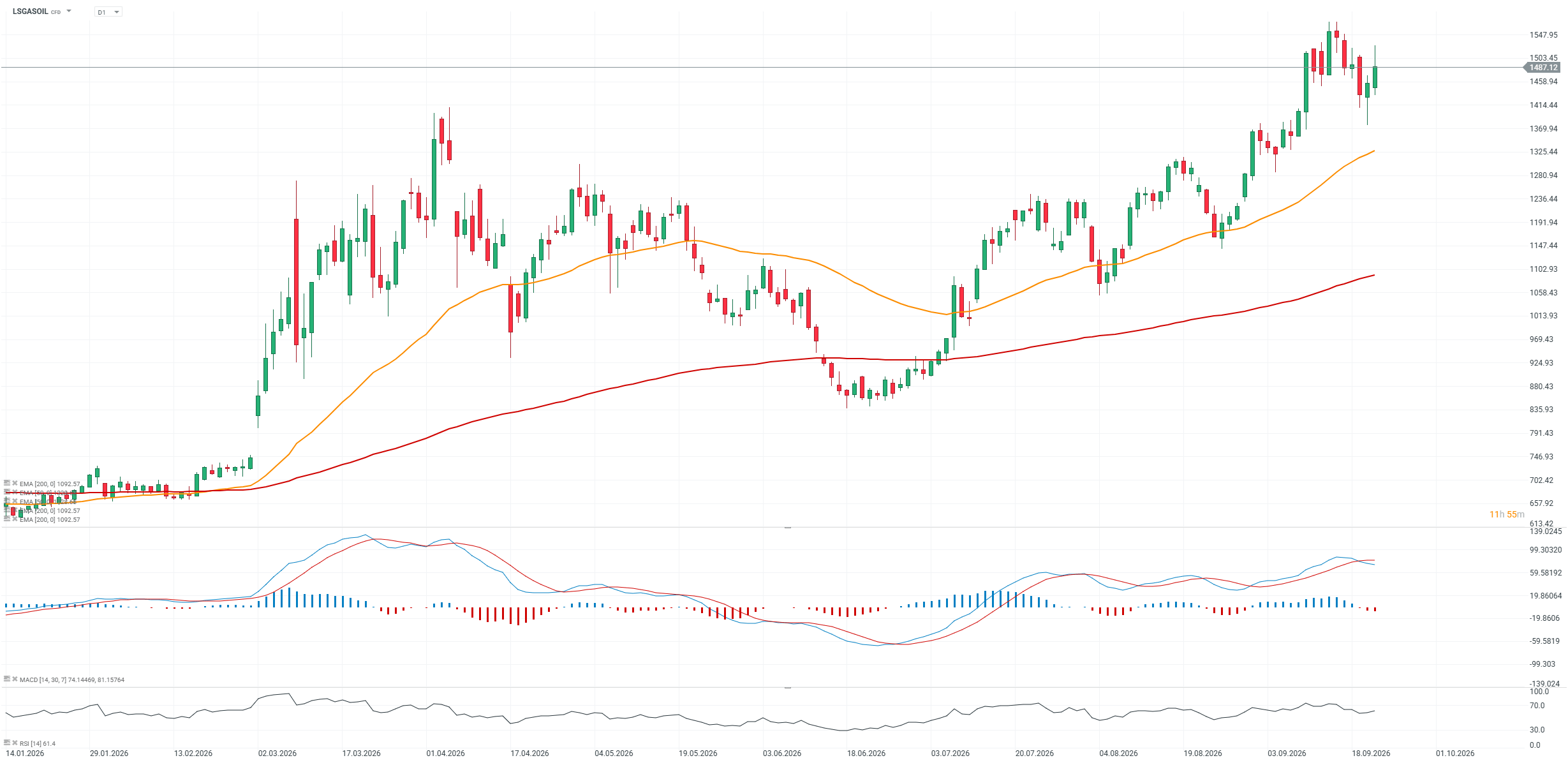
LSAGASOIL diesel futures chart (D1 timeframe)
We can see that diesel futures have declined less than Brent crude prices and remain close to historical highs. News of a potential U.S. export ban has provided additional support for the bulls.
 Source: xStation5



Daily Summary: Earnings Season Kicks Off on Wall Street Amid Mixed Sentiment



Market Wrap: European Stocks Rise as Banks Beat Earnings Expectations



Morning Wrap: Tech Crash in Asia and Hawkish Central Banks in the Shadow of an Oil Shock (13.10.2026)



Daily Summary: Investors Concerns Rise Ahead of Earnings Season