



- As recently as June 30, the market expected Q3 earnings growth of 26.6% y/y. Since then, estimates have been revised higher, and four sectors now have stronger earnings expectations than they did at the end of June.
- In terms of guidance, positive updates continue to outweigh negative ones: 72 S&P 500 companies have issued positive EPS guidance for Q3, while 42 companies have issued negative guidance.
- The S&P 500’s forward 12-month P/E ratio currently stands at 19.1. This is below the five-year average of 19.8, but slightly above the 10-year average of exactly 19.0.
- The earnings season is only just beginning. So far, two S&P 500 companies have reported Q3 results, and both delivered EPS above expectations as well as revenue above consensus.
Q3 earnings season looks stronger than previously expected
The final weeks of the third quarter brought a clear improvement in expectations for S&P 500 corporate earnings. Analysts have raised their Q3 2026 earnings forecasts, and the scale of the revisions has been unusually positive. Since June 30, EPS estimates have increased by an average of 1.4%, whereas over the previous 20 quarters they typically declined by around 2.5%. The 10-year average also points to a 2.2% decline in earnings estimates during the quarter.
Corporate guidance is another important signal. Of the 111 S&P 500 companies that have issued EPS guidance for Q3, 72 provided positive guidance and 42 issued negative guidance. The number of positive outlooks is above both the five-year average of 43 and the 10-year average of 41. The share of companies issuing positive guidance stands at 63%, compared with a five-year average of 57% and a 10-year average of 51%.
As a result, consensus estimates now point to S&P 500 earnings growth of 28.7% y/y in Q3, up from 26.6% expected on June 30. If this forecast is confirmed, it would mark the third consecutive quarter of earnings growth above 25% and the eighth consecutive quarter of double-digit EPS growth. All 11 sectors are expected to report year-over-year earnings growth, with five projected to deliver double-digit increases. The strongest earnings growth is expected in Energy, Information Technology, Communication Services and Materials.
Analysts have also raised their revenue forecasts. S&P 500 companies are now expected to report Q3 revenue growth of 11.9% y/y, compared with 10.9% expected at the end of June. If achieved, this would mark the third consecutive quarter of double-digit revenue growth. All 11 sectors are expected to post year-over-year revenue growth, led by Information Technology, Energy and Communication Services.
Expectations also remain elevated for the coming periods. Analysts forecast earnings growth of 26.3% for Q4 and 31.6% y/y for full-year 2026. At the same time, the S&P 500 forward P/E ratio stands at 19.1, below the five-year average of 19.8 and the 20.4 level recorded at the end of Q2, but slightly above the 10-year average of 19.0. Two S&P 500 companies are scheduled to report Q3 results in the coming week.
Energy: higher oil prices sharply lift earnings expectations
The Energy sector has recorded the largest increase in estimated dollar-level earnings among all 11 S&P 500 sectors since the end of June. Forecasts have risen by 14.8%, from $47.0 billion to $54.0 billion. One of the main drivers has been a 47% increase in oil prices since June 30, from $69.50 to $102.50 per barrel.
- As a result, expected Q3 earnings growth for the sector has increased from 79.3% to 105.7% y/y. The Energy sector itself has gained 22.6% over the same period, the strongest performance among all sectors in the index.
- Average EPS estimates have been revised higher for 8 of the 21 Energy companies, representing 38% of the sector. In three cases, the increase exceeded 10%: Marathon Petroleum’s consensus estimate rose from $10.43 to $21.16, Valero Energy’s from $9.66 to $17.58, and Phillips 66’s from $6.38 to $10.32.
- These companies, together with Exxon Mobil, where the EPS estimate increased from $3.36 to $3.65, and Chevron, where it rose from $4.34 to $4.65, accounted for the largest part of the increase in expected sector earnings.
Information Technology: earnings estimates rise across most of the sector
Information Technology ranks second in terms of improvement in expected earnings since the start of the quarter. Aggregate forecasts have increased by 3.9%, from $246.5 billion to $256.0 billion, while expected Q3 earnings growth has risen from 56.9% to 63.0% y/y. Since the end of June, the sector has gained around 2%.
- The revisions have been broad-based: EPS estimates were raised for 58 of the 73 companies in the sector, or 79%, while 25 companies saw increases of more than 10%. Among the largest revisions were Super Micro Computer, where the estimate rose from $0.86 to $1.04, Dell Technologies from $4.21 to $6.56, Intel from $0.28 to $0.39, Teradyne from $1.50 to $2.08, and Nvidia from $2.35 to $2.47.
- Dell, Cisco Systems, where the EPS estimate increased from $1.16 to $1.32, and Intel made the largest contributions to the increase in expected sector earnings in dollar terms.
Financials: JPMorgan and Goldman Sachs support higher earnings forecasts
The Financials sector recorded the third-largest increase in projected earnings among S&P 500 sectors. Since June 30, aggregate estimates have risen by 2.2%, from $121.3 billion to $124.0 billion, while expected Q3 earnings growth has increased from 1.3% to 3.5% y/y. At the same time, the sector has gained 5.7% since the end of June, the second-best performance among the 11 sectors.
- EPS estimates were raised for 42 of the 76 Financials companies, or around 55% of the sector. In three cases, the revision exceeded 10%: Goldman Sachs’ consensus estimate increased from $14.09 to $16.42, Robinhood Markets from $0.46 to $0.52, and Allstate from $5.84 to $6.54.
- JPMorgan Chase, where the EPS estimate rose from $5.49 to $5.62, and Goldman Sachs made the largest contributions to the increase in expected sector earnings in dollar terms.
Materials: Dow and Newmont weigh most heavily on forecasts
The Materials sector has recorded the largest decline in projected earnings among all 11 S&P 500 sectors. Since the end of June, aggregate consensus estimates have fallen by 8.1%, from $18.1 billion to $16.6 billion, while expected Q3 earnings growth has declined from 42.4% to 30.9% y/y. The sector itself has lost around 1.3% since June 30.
EPS estimates were cut for 19 of the 25 companies in the sector, or 76%. In five cases, the reduction exceeded 10%: Mosaic from $0.56 to $0.10, Dow from $0.72 to $0.20, International Paper from $0.53 to $0.32, Coreva from -$0.28 to -$0.39, and Newmont from $2.50 to $2.18. Dow and Newmont had the largest negative impact on expected sector earnings.
Consumer Staples: Walmart weighs on expectations
Projected earnings for the Consumer Staples sector have declined by 3.5% since the end of June, from $38.6 billion to $37.2 billion. As a result, expected Q3 earnings growth has fallen from 6.2% to 2.5% y/y. Over the same period, the sector has gained around 0.6%.
- EPS estimates were lowered for 25 of the 34 companies in the sector, or 74%. In nine cases, the reduction exceeded 10%, including Dollar Tree from $1.37 to $0.93, Tyson Foods from $0.83 to $0.68, Mondelez International from $0.72 to $0.68, and Walmart from $0.64 to $0.57.
- Walmart made the largest contribution to the decline in expected sector earnings.
Health Care: lower forecasts across a large part of the sector
The Health Care sector has recorded the third-largest decline in projected earnings within the S&P 500. Aggregate consensus estimates have fallen by 2.5%, from $80.5 billion to $78.4 billion, while expected Q3 earnings growth has declined from 8.7% to 6.0% y/y. Despite this, the sector itself has gained around 4.5% since the end of June, the third-best performance in the index.
- EPS estimates were lowered for 59 of the 69 companies in the sector, or 86%. In 38 cases, the cuts exceeded 10%. The largest reductions included Humana from $0.94 to $0.20, Incyte from $3.95 to $2.83, Biogen from $1.51 to $2.03, Pfizer from $0.85 to $0.76, Cencora from $9.91 to $8.25, and Johnson & Johnson from $3.02 to $2.90.
- Pfizer and Biogen made the largest negative contributions to expected sector earnings.
US500 chart (D1 interval)
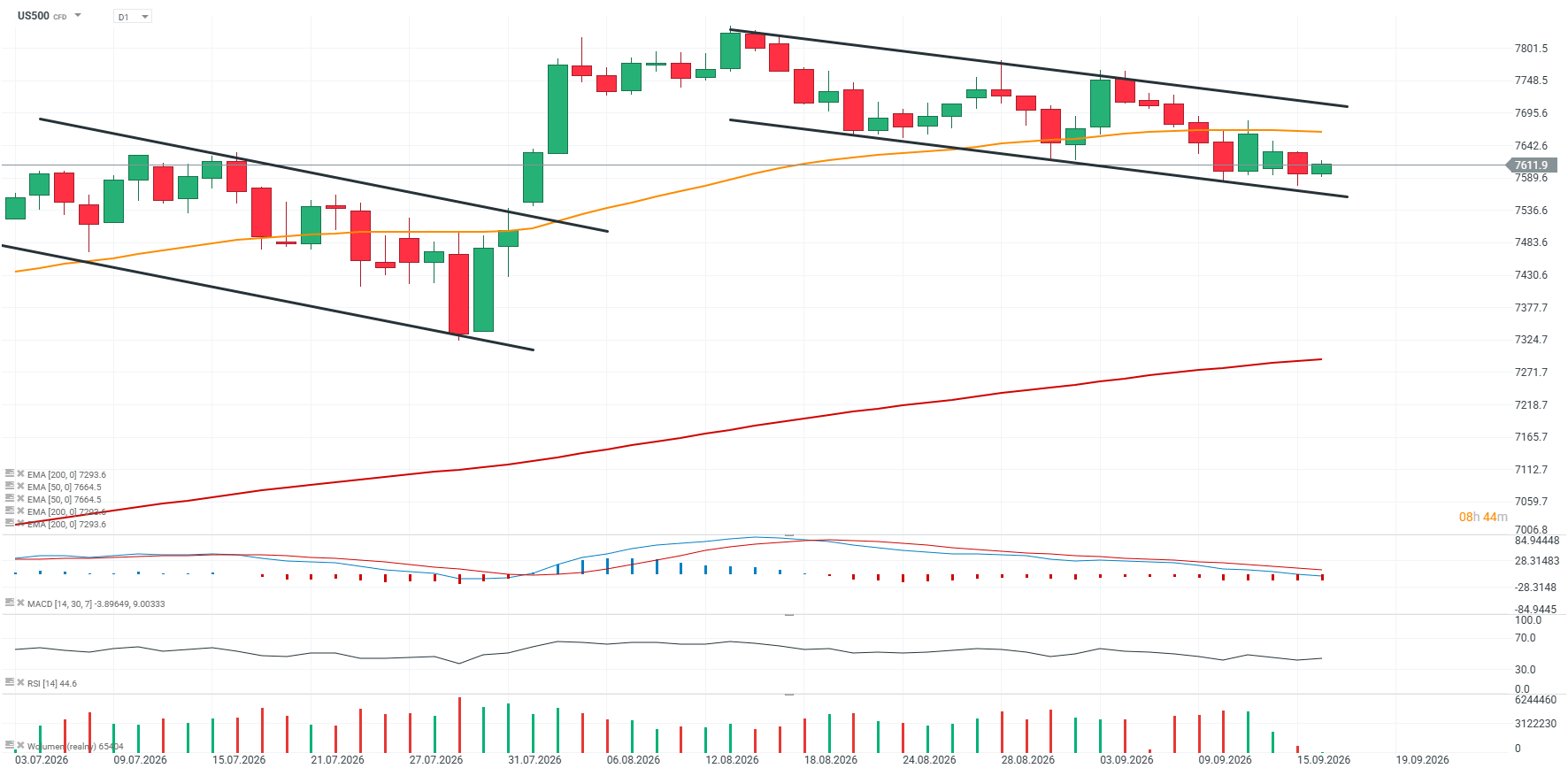
Source: xStation5



Daily Summary: Wall Street Rises Ahead of Tomorrow's Fed Meeting💡



The US100 gets back on track and gains 1%📈



Market Wrap: Renewed confidence in AI drives stock market recovery (27.10.2026)



Economic Calendar: Conference Board Consumer Confidence and US Data in focus