


Inflation in the United Kingdom accelerated for the first time in five months, reaching 3.4% y/y in December, compared to 3.2% in November, slightly above economists' forecasts (3.3%). The rise in prices was mainly driven by an increase in tobacco excise duty and higher airfares. Services inflation, a key indicator for the Bank of England, rose to 4.5% from 4.4%, but weaker than expected. The Bank of England predicts that inflation will approach its 2% target in the spring, supported by government measures, including freezing rail fares and reducing energy bills. Despite this, the central bank is approaching the end of its cycle of interest rate cuts, monitoring the labour market for signs of a slowdown. The pound lost slightly in value after the data was released, but is currently hovering around USD 1.3440, and expectations for future rate cuts remain largely unchanged.
In December, tobacco prices rose by 3% month-on-month due to the postponement of tax increases, and airfare prices jumped by 28.6% m/m, leading to the highest inflation rate in transport since 2022. Food prices rose by 4.5% y/y, mainly due to bread and cereals, with declines recorded in categories such as recreation, games and sports equipment. At the same time, the data indicate a decline in cost pressures in industry – factory gate prices remained unchanged, while raw material and fuel prices fell. Bloomberg economists estimate that December's inflation rise will not change the Bank of England's policy, as the overall disinflationary trend continues. The labour market shows signs of weakening, with the lowest wage growth since 2020 and unemployment at 5.1%. signs of weakness, with the lowest wage growth since 2020 and unemployment at 5.1%, although the number of job vacancies rose slightly. In November, GDP surprised with a positive result of +0.3% m/m, suggesting some resilience in the economy.
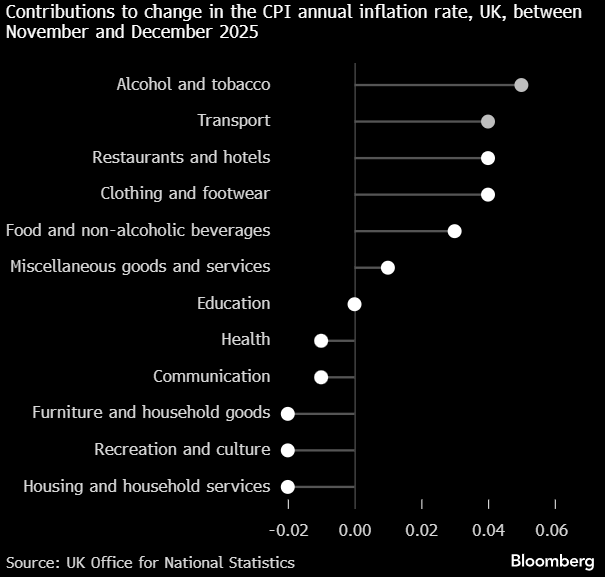
Chart showing contributions to CPI inflation in the United Kingdom. Source: ONS, Bloomberg Financial Lp
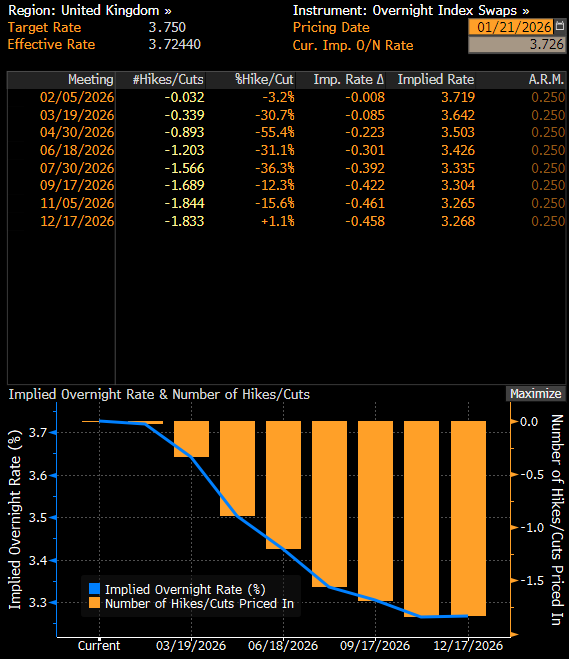
The futures market currently indicates that the Bank of England will decide on one interest rate cut in 2026 (fully priced in) with an 83% chance of a second such move at the end of the year. Source: Bloomberg Financial Lp


Daily Summary: Trump and OpenAI keep the market on a roller coaster💡



U.S. attacks on Iran suspended 💥


Market Wrap: A 4% surge in oil prices weighs on indices (08.10.2026)
EURUSD falls below 1.12 amid hawkish Fed's Waller remarks