

- The USDA forecasts U.S. wheat production in 2026 at just 1.53 billion bushels, down 23% from a year earlier and the lowest level since 1970.
- The U.S. supply balance is tightening significantly – the average yield is expected to fall to 47.8 bushels per acre from 53.3 bushels in 2025, making the market increasingly sensitive to further weather-related disruptions.
- Supply risks are also being amplified by the situation in the Black Sea region. Potential disruptions to Russian or Ukrainian exports could redirect part of global demand toward alternative suppliers and increase the risk premium on CBOT.
- U.S. export demand remains the biggest question mark. Lower production provides stronger fundamental support for prices, but a more sustained rally would likely require an improvement in overseas demand for U.S. wheat.

- The USDA forecasts U.S. wheat production in 2026 at just 1.53 billion bushels, down 23% from a year earlier and the lowest level since 1970.
- The U.S. supply balance is tightening significantly – the average yield is expected to fall to 47.8 bushels per acre from 53.3 bushels in 2025, making the market increasingly sensitive to further weather-related disruptions.
- Supply risks are also being amplified by the situation in the Black Sea region. Potential disruptions to Russian or Ukrainian exports could redirect part of global demand toward alternative suppliers and increase the risk premium on CBOT.
- U.S. export demand remains the biggest question mark. Lower production provides stronger fundamental support for prices, but a more sustained rally would likely require an improvement in overseas demand for U.S. wheat.
CBOT wheat (WHEAT) is surging nearly 4% today. Until recently, the main headwinds were weak export demand and competition from other major producers, but the market’s attention is increasingly shifting toward supply. The USDA now forecasts U.S. wheat production in 2026 at just 1.53 billion bushels, down 23% from last year and the lowest level since 1970. Winter wheat production alone is expected at around 990 million bushels, representing a 29% year-on-year decline. This is an important change for the market, as a smaller domestic supply cushion makes futures increasingly sensitive to additional weather problems or disruptions in other major exporting regions.
- Total U.S. wheat production is forecast at 1.53 billion bushels, down 23% from 2025.
- The winter wheat crop is expected at around 990 million bushels, 29% lower than a year ago.
- Weather problems and export disruptions in the Black Sea region are adding to the vulnerability of the global wheat balance.
- Export demand remains the biggest constraint for the U.S. market – without a meaningful recovery in overseas buying, lower production alone may not be enough to establish a sustained bullish trend.
The U.S. balance is getting increasingly tight
The most important story is currently unfolding on the supply side. The USDA's latest forecast puts the average U.S. wheat yield at 47.8 bushels per acre, compared with 53.3 bushels in 2025. For winter wheat, the yield is expected at around 47 bushels per acre, 7.9 bushels below last year's level.
For the market, however, the combination of weaker yields and limited planted acreage matters more than the percentage decline itself. The U.S. is entering the next season with a significantly smaller production cushion, leaving prices more exposed to any deterioration in weather conditions.
This is particularly visible in hard red winter wheat, where drought across the Southern Plains has already taken a toll on production. If autumn planting once again takes place with poor soil moisture, the market could begin pricing in a weather premium much earlier than usual.
The Black Sea is adding a risk premium again
The second factor is the situation surrounding Ukraine and Black Sea export routes. Recent disruptions to transport infrastructure have reminded investors that a substantial share of global grain trade passes through a region exposed to military risks. Global wheat prices rose 5.8% in July, with the FAO pointing to both adverse weather conditions and disruptions to Black Sea trade as contributing factors.
For CBOT, however, geopolitical headlines alone are not what ultimately matters. The key question is whether these disruptions actually reduce the volume of grain available to importers. If exports from the region continue to flow relatively smoothly, the risk premium could disappear quickly. But if the availability of Russian or Ukrainian wheat declines, part of global demand will have to shift toward alternative suppliers.
Demand remains the weaker side of the market
This is where the biggest question mark remains. Lower U.S. production improves the fundamental setup for wheat, but a sustained price rally ultimately requires buyers in the physical market as well.
A strong U.S. dollar does not help American exporters, while the U.S. continues to compete for orders with Russia, Europe, Australia and Argentina. Export sales data could therefore become just as important over the coming weeks as further production estimates.
The situation could change relatively quickly if weaker U.S. supply coincides with crop problems among other major exporters. The USDA had already been expecting global wheat production in 2026/27 to decline from the previous season's record level, alongside lower global ending stocks.
Could corn provide additional support?
Corn is also worth watching because the two markets are partially connected through feed demand and competition for acreage. The USDA's latest report lowered its U.S. corn yield forecast from 183 to 180.7 bushels per acre, a larger reduction than the market had anticipated. Corn futures reacted positively to the revision.
That removes one potential headwind for wheat. An exceptionally large supply of cheap corn could reduce the use of wheat in animal feed and weigh on the broader grain complex. A weaker outlook for corn yields makes that argument somewhat less powerful.
The current setup for wheat is therefore considerably more supportive than it was several months ago, but exports remain the key confirmation to watch. U.S. production is at its lowest level in more than half a century, the global balance is tightening, while weather and Black Sea risks are increasing supply uncertainty. If stronger demand for U.S. wheat joins that combination, the market would have a much firmer fundamental foundation for further gains.
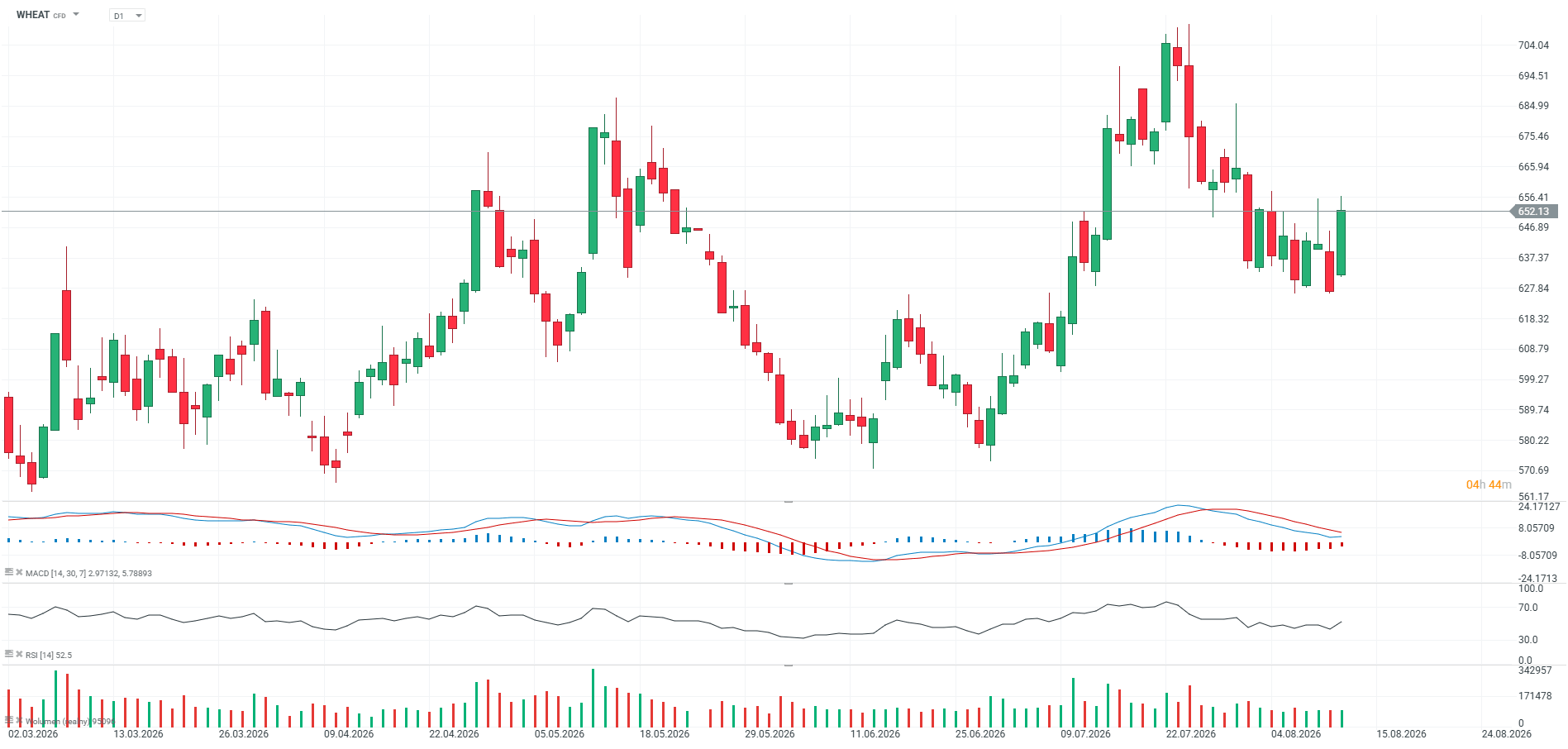
Wheat futures chart (WHEAT, D1 interval)
 Source: xStation5
CoT for Wheat: Funds Remain Bearish, but Are Slowly Changing Their Stance
The latest CoT report for Chicago wheat shows a clear shift in positioning. Managed Money remains net short, but funds significantly reduced their bets on further price declines over the past week. At the same time, producers and other commercial participants increased their short-side hedging.
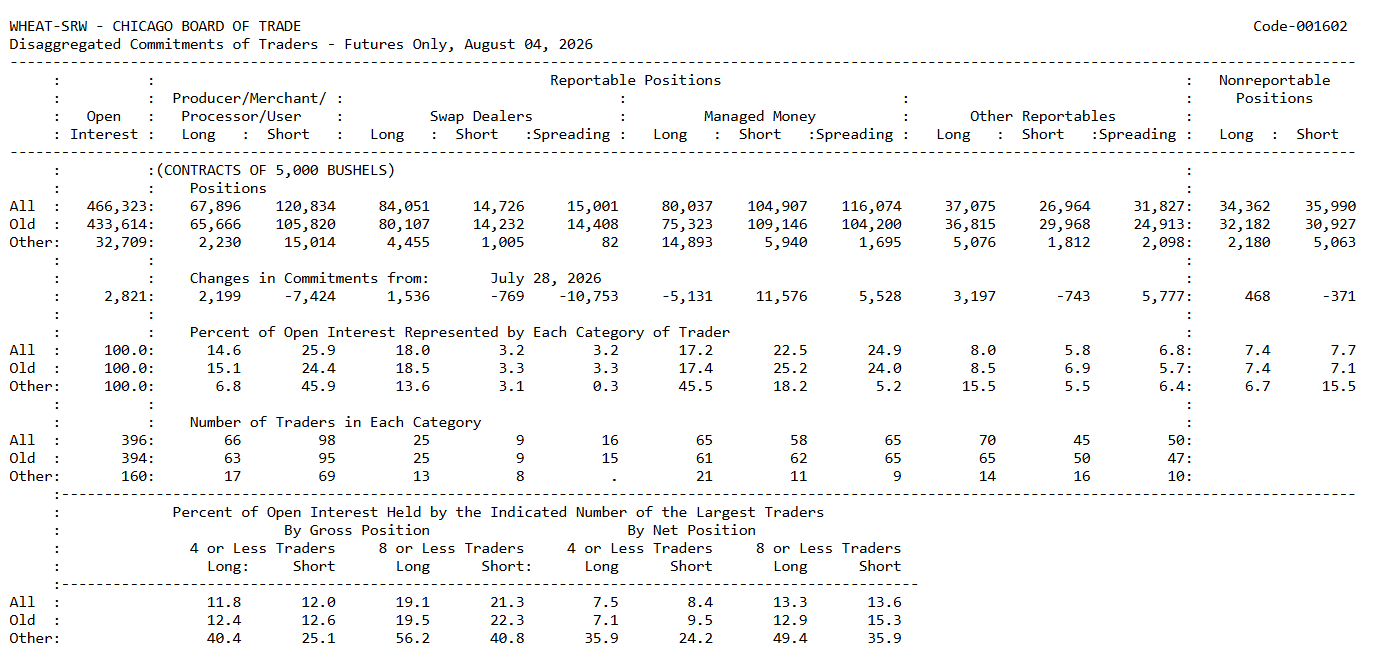
- Managed Money, representing large speculators, holds 80,037 long contracts and 104,907 shorts, resulting in a net position of approximately -24,900 contracts.
- A week earlier, the net position stood at around -33,800 contracts. Funds therefore reduced their net short exposure by almost 9,000 contracts in just one week.
- Importantly, this was not purely short covering. Managed Money added around 4,700 long contracts while simultaneously closing more than 4,200 shorts.
- Commercials – producers, hedgers and other participants directly involved in the physical wheat market – hold approximately 67,900 longs and 120,800 shorts, leaving them net short by around 52,900 contracts. Over the week, they increased their short positions by more than 7,400 contracts.
Managed Money vs Commercials
The most interesting signal comes from fund positioning. Managed Money is still positioned for lower wheat prices on a net basis, but conviction in that scenario is clearly weakening. The simultaneous increase in longs and reduction in shorts suggests something more than mechanical short covering, although it is still too early to call this a full shift toward bullish positioning.
Commercials are moving in the opposite direction, with their net short position increasing from around -44,800 to -52,900 contracts. This does not necessarily represent a bearish signal. Producers primarily use futures to hedge the price of physical grain, so as prices rise, they may naturally increase hedges against future sales.
What matters particularly for the market is that Managed Money still holds almost 105,000 short contracts, equivalent to 22.5% of open interest. This leaves considerable room for further short covering if fundamentals – including lower U.S. production, weather risks or disruptions in the Black Sea region – continue to support prices.
The current CoT setup can therefore be viewed as moderately constructive for wheat: funds remain bearish, but noticeably less so than before. The coming weeks should show whether this is simply a reduction in short exposure or the beginning of a more lasting shift in speculative positioning.
Source: CFTC



Daily Summary: Earnings Season Kicks Off on Wall Street Amid Mixed Sentiment



Market Wrap: European Stocks Rise as Banks Beat Earnings Expectations


🚩 US100 loses 0.7%



Morning Wrap: Tech Crash in Asia and Hawkish Central Banks in the Shadow of an Oil Shock (13.10.2026)