
Understand how the oil market works, what affects prices, and how investors gain exposure through financial instruments.
Understand how the oil market works, what affects prices, and how investors gain exposure through financial instruments.


Key takeaways
- Oil investing usually means gaining exposure to crude oil prices through financial instruments such as oil stocks, ETFs, or CFDs rather than purchasing physical oil itself.
- Oil prices are influenced by multiple factors at the same time, including global economic growth, OPEC production decisions, geopolitical tensions, US dollar strength, and changes in supply and demand expectations.
- Oil-related investments can experience high volatility, which means prices may rise or fall sharply over relatively short periods and may require active monitoring by investors.
What Is Oil as an Investment and Why Do Investors Buy It?
Oil investment usually means gaining exposure to crude oil prices through financial instruments rather than physically buying or storing barrels. Retail investors typically invest in oil through brokerage platforms using ETF, stocks, or other market-linked instruments connected to changes in crude oil prices. In practice, investors participate in the financial side of the oil market rather than trading physical deliveries of the commodity itself. This is one reason why oil is often included in broader discussions about how to invest in commodities, especially among investors looking beyond traditional stocks and bonds.
Oil remains one of the world’s most important commodities because it plays a central role in transportation, manufacturing, logistics, and energy production. Crude oil is used in fuels, plastics, chemicals, and industrial materials that support global economic activity. When financial media refers to “the price of oil”, it usually means one of two main benchmarks: Brent crude or WTI (West Texas Intermediate). Brent is commonly viewed as the international benchmark, while WTI is more closely associated with the US market.
Investors approach oil for different reasons depending on market conditions and portfolio strategy. Some use oil-related assets for diversification because commodity prices do not always move in line with equities or bonds. Others view oil as a way to gain exposure to global economic growth, since rising industrial activity and transportation demand often increase energy consumption. Oil is also sometimes discussed in inflation-related market discussions because higher energy prices can influence production costs and consumer prices across the economy.
|
|
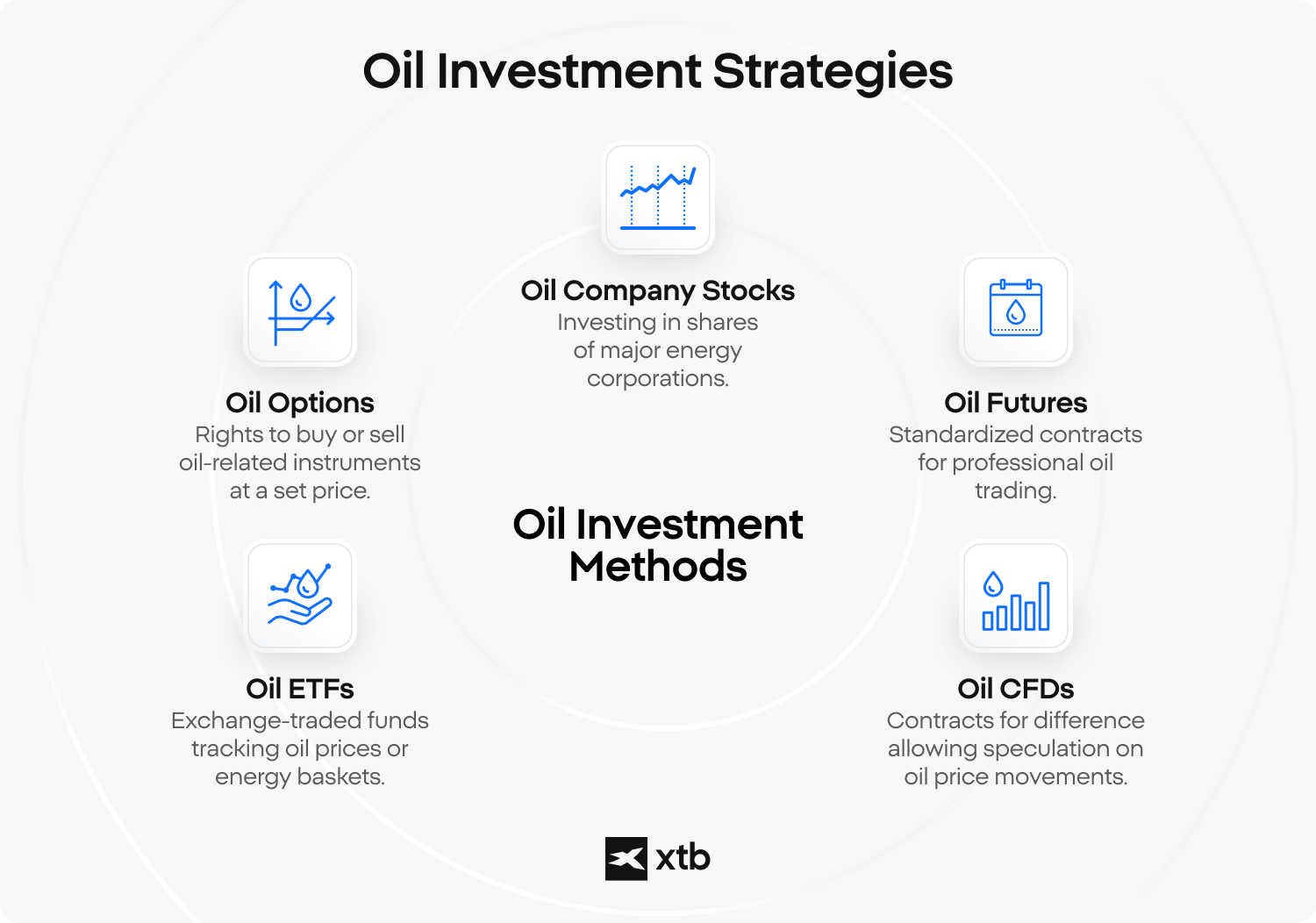
5 Popular Oil Investment Methods
Several oil-related investment methods are usually commonly available to investors.
- Oil company stocks such as ExxonMobil, Chevron, or Shell provide exposure to energy businesses rather than crude oil directly. Their share prices may depend on oil prices, management, production costs, debt, and dividend policy.
- Oil ETFs are exchange-traded funds that track oil prices or baskets of energy-related companies. They are generally more diversified than single oil stocks because exposure is spread across multiple assets.
- Oil CFDs are contracts for difference that allow traders to speculate on rising or falling oil prices without owning the underlying asset. They allow both long and short positions, but involve significant risk.
- Oil futures are standardized contracts used mainly by professional traders and institutions. They are usually complex for beginners because of leverage, expiration dates, and volatility.
- Oil options give the right, but not the obligation, to buy or sell oil-related futures or instruments at a set price. They can be used for speculation or hedging, but are complex and may involve substantial risk.
Some investors compare oil with assets such as gold, although the two commodities behave differently and are influenced by different market forces. Historically mixed correlation between oil, equities and precious metals makes the oil an important component of Wall Street professionals wanting to reduce portfolio risk and improve diversification, following Bridgewater’s Ray Dalio rules, and building portfolios with uncorrelated assets.
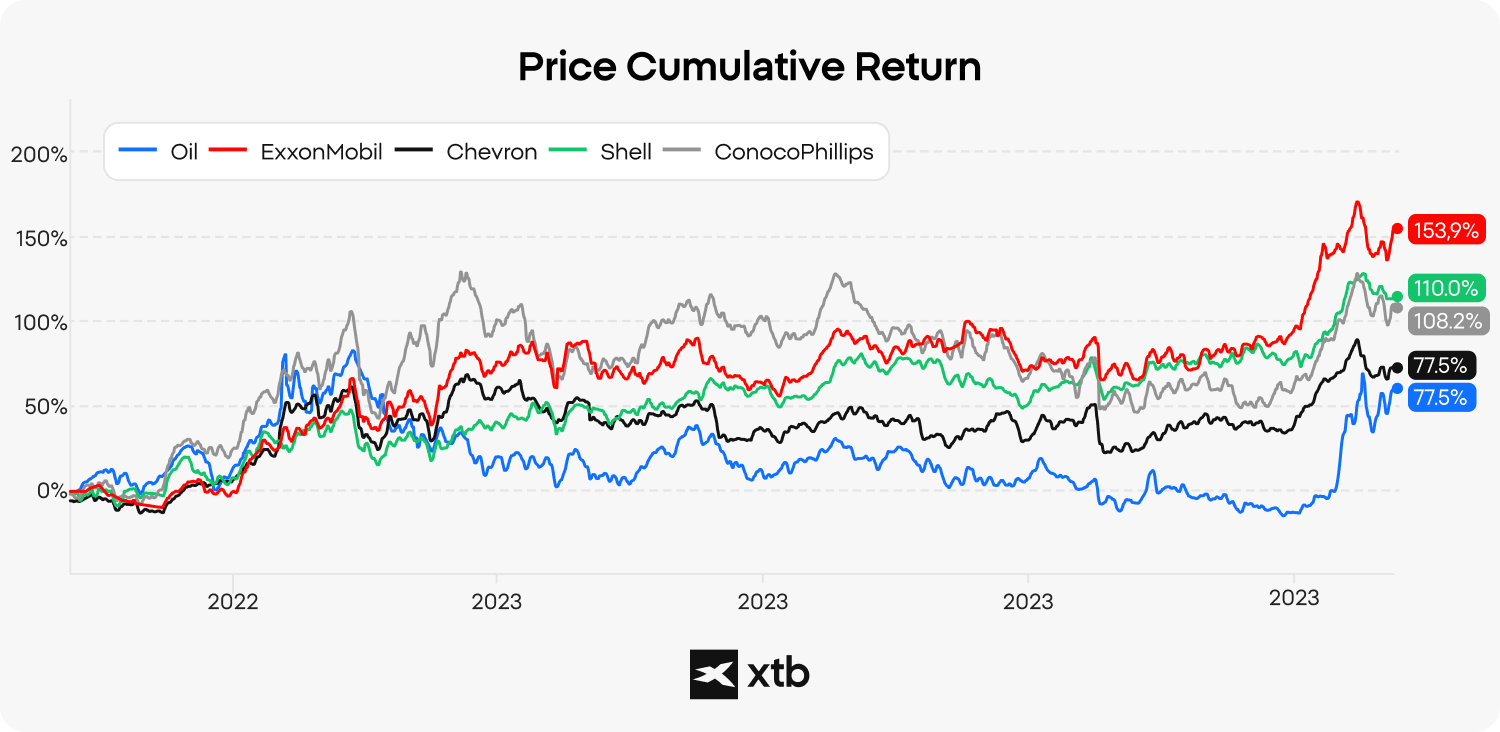
As the chart below shows, since May 2021 oil stocks such as ExxonMobil, Chevron, Shell or ConocoPhillips surged to much higher levels than oil price itself. Remember, past performance is not an indicator of future results.
What Moves the Price of Oil?
Oil prices are mainly driven by the balance between global supply and demand. When the economy grows, factories produce more goods, transport activity increases, and businesses usually need more energy. This can support higher demand for crude oil and put upward pressure on prices. When growth slows, demand expectations often weaken, which may weigh on the oil market.
Supply is shaped by major producers such as OPEC countries, the United States, and Russia. OPEC production decisions can move the global market because they affect expectations about how much oil may be available. Geopolitical events can also cause sudden price changes, especially when conflicts, sanctions, or embargoes create uncertainty around production or transport routes. Even weekly inventory data from the US Energy Information Administration (EIA) can trigger sharp short-term price moves when stockpile changes surprise the market.
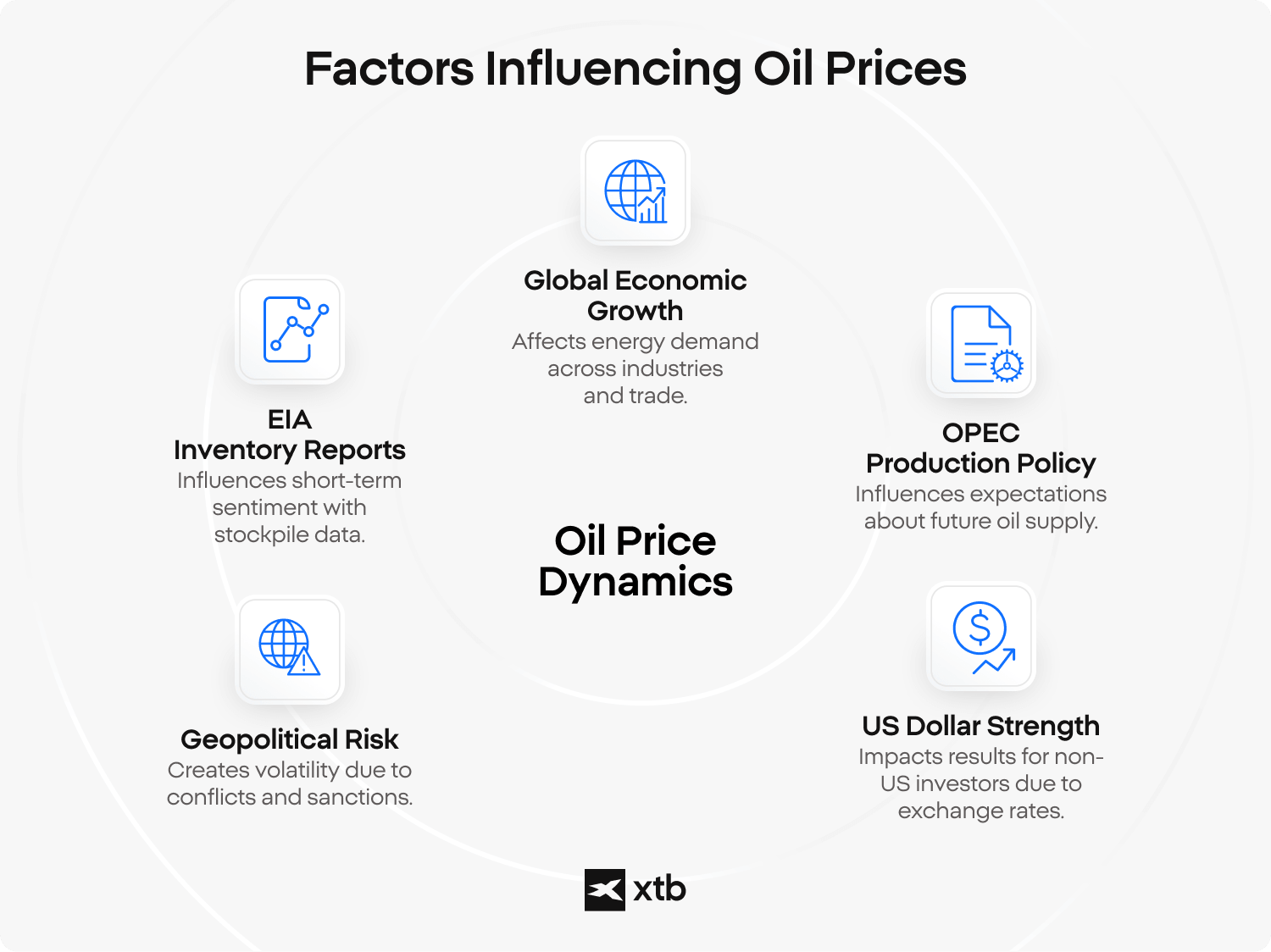
Several factors often influence oil prices at the same time:
- Global economic growth affects expected demand for energy across industry, transport, and trade.
- OPEC production policy can change expectations about future supply and market balance.
- Geopolitical risk may create sudden volatility when conflicts, sanctions, or embargoes threaten oil flows.
- US dollar strength matters because oil is priced globally in US dollars, so exchange rates can affect results for non-US investors.
- EIA inventory reports can influence short-term sentiment when weekly oil stockpile data differs from market expectations.
What Are the Risks of Investing in Oil?
Oil is one of the more volatile asset classes, with prices often changing sharply over short periods. Brent crude can react quickly to economic data, geopolitical events, and supply disruptions especially across the largest oil producers. In 2020, prices collapsed as COVID-19 lockdowns reduced travel, industrial activity, and fuel demand. This showed how strongly oil can respond to sudden shifts in the global economy and why several risks may affect oil-related investments at once:
- Geopolitical risk plays a major role because conflicts, sanctions, embargoes, or OPEC production decisions can rapidly change supply expectations and trigger sudden price movements.
- Currency risk matters for investors outside the United States because oil is priced globally in US dollars. This means exchange rates such as EUR/USD can influence the final investment result independently of oil price movements themselves.
- Concentration risk becomes important when investing in individual oil companies rather than the broader market. The performance of a single company may be affected by management decisions, debt levels, production costs, or operational problems in addition to oil prices.
- Leverage risk is especially relevant for CFD trading because leveraged products can magnify losses, and in some cases losses may exceed the initial deposit.
Oil also requires a different mindset than more passive long-term investments. The market is heavily influenced by economic conditions, political developments, and shifts in global energy demand, which means prices may remain unstable even during periods of broader market optimism. For that reason, oil-related investments often require regular monitoring and a clear understanding of how external events can influence the market environment. So, how to invest in oil stocks? First of all, try to understand the company business, always do your own research and invest cautiously.
|
|
Is Investing in Oil Right for You?
Oil may be considered by investors who understand that commodity markets can be highly volatile and influenced by global economic and political developments. In many cases, oil is treated as a complement to a broader portfolio rather than as a standalone investment strategy. Some investors use oil-related assets to diversify beyond traditional stocks and bonds, particularly when looking for exposure to global economic activity or the energy sector.
At the same time, oil is rarely viewed as a typical “first investment” because prices can change rapidly and may require regular monitoring. Oil-related instruments can react strongly to geopolitical events, economic slowdowns, supply disruptions, or currency movements, which may make the market difficult to navigate for inexperienced investors. Learning how to invest in crude oil is not simple, as the future remains unknown.
Before considering exposure to oil, it may be useful to ask a few practical questions: Do you understand what drives oil prices? Are you comfortable with large price swings? Does this type of volatility fit your investment horizon and risk tolerance?
|
|

FAQ
FAQ
For many beginners, oil ETFs are often viewed as one of the simpler ways to access the oil market because they provide diversified exposure through a single instrument. Unlike individual oil company stocks, ETFs may reduce company-specific risk by tracking a broader basket of assets or oil-related contracts. However, different ETFs follow different strategies, so their performance may not always match changes in crude oil prices exactly.
Yes, oil prices can move rapidly because the market reacts to economic data, geopolitical developments, production decisions, and supply disruptions at the same time. Events such as wars, sanctions, refinery outages, or unexpected changes in demand expectations can influence prices within hours. Oil is therefore generally considered more volatile than many traditional long-term investment assets.
No, these are related but different forms of exposure. Buying oil company shares means investing in a business whose performance depends not only on oil prices, but also on factors such as management decisions, debt levels, production costs, and dividend policy. Oil prices may rise while a specific company still underperforms because of operational or financial challenges.
Brent and WTI are two major global oil benchmarks used in different regions of the market. Although both represent crude oil, their prices can diverge because of regional supply conditions, transportation factors, and differences in market expectations. In financial media, “oil prices” usually refer to one of these benchmark standards.
Not necessarily. Oil prices can rise during periods of inflation because energy costs influence many parts of the economy, but the relationship is not constant. Economic slowdowns, weak demand, or oversupply can still pressure oil prices even when inflation remains elevated. This means oil should not be viewed as a guaranteed inflation hedge.
Oil is traded globally in US dollars, which means currency exchange rates can affect investment results for people outside the United States. For example, even if oil prices remain stable, changes in the USD/PLN exchange rate may still influence the final return for a Polish investor. Currency movements therefore add an additional layer of risk.
Oil-related investments are generally less passive than broad market index investing because the sector is heavily influenced by economic cycles, geopolitics, and supply conditions. Prices can react quickly to external events, which means investors often monitor the market more actively than they would with more diversified long-term assets.