
A beginner learns what stock investing is and the exact steps to start - from opening a brokerage account to buying their first shares - so they can begin investing with a clear plan and realistic view of risk.
A beginner learns what stock investing is and the exact steps to start - from opening a brokerage account to buying their first shares - so they can begin investing with a clear plan and realistic view of risk.


Stock investing means buying shares of public companies through a brokerage account to hold for a long-term horizon. Today, anyone learning how to invest in stocks can start buying fractional rightswith as little as $10. While the process requires only a few online steps, the stock market involves real financial risks that require a clear strategy.
Key takeaways for this subject include:
- Stock investing defined: You buy ownership stakes in public companies to potentially benefit from share-price growth and dividends.
- Five steps to begin: Set your goals, choose and open an account, fund it, and select suitable investments.
- Stocks vs. funds: Fractional rights allow beginners to start with limited capital, while index funds offer broader diversification than individual stocks.
- Risk reduction: A long-term investment horizon and a diversified portfolio can reduce company-specific risk and lessen the impact of short-term market volatility.
What does it actually mean to invest in stocks?
Investing in stocks means buying shares in publicly traded companies to participate in their value growth and dividend payouts over a multi-year horizon. Long-term investing in stocks differs fundamentally from active trading; you hold assets for years to build wealth rather than seeking short-term price fluctuations. If you are interested in short-term strategies, you must learn how to trade stocks using a different approach.
Stock investing generates returns through two primary mechanisms: capital appreciation when the share price rises, and dividends, which are periodic cash payouts from company profits. Compared to holding cash, which loses purchasing power to inflation, the stock market has historically offered higher potential returns - as of 31 July 2026 the S&P 500 averaged roughly 10% annually since the launch in 4 March 1957 (source: S&P historical data) - though with significantly higher volatility, including drawdowns that have exceeded 50% in past crises.
Investors should also be aware that, over the past 70 years, the S&P 500 has rarely delivered a calendar-year return close to its long-term annual average. In stronger years, returns often exceed the average by a significant margin, while weaker years can produce substantial losses.
How do you start investing in stocks step by step?
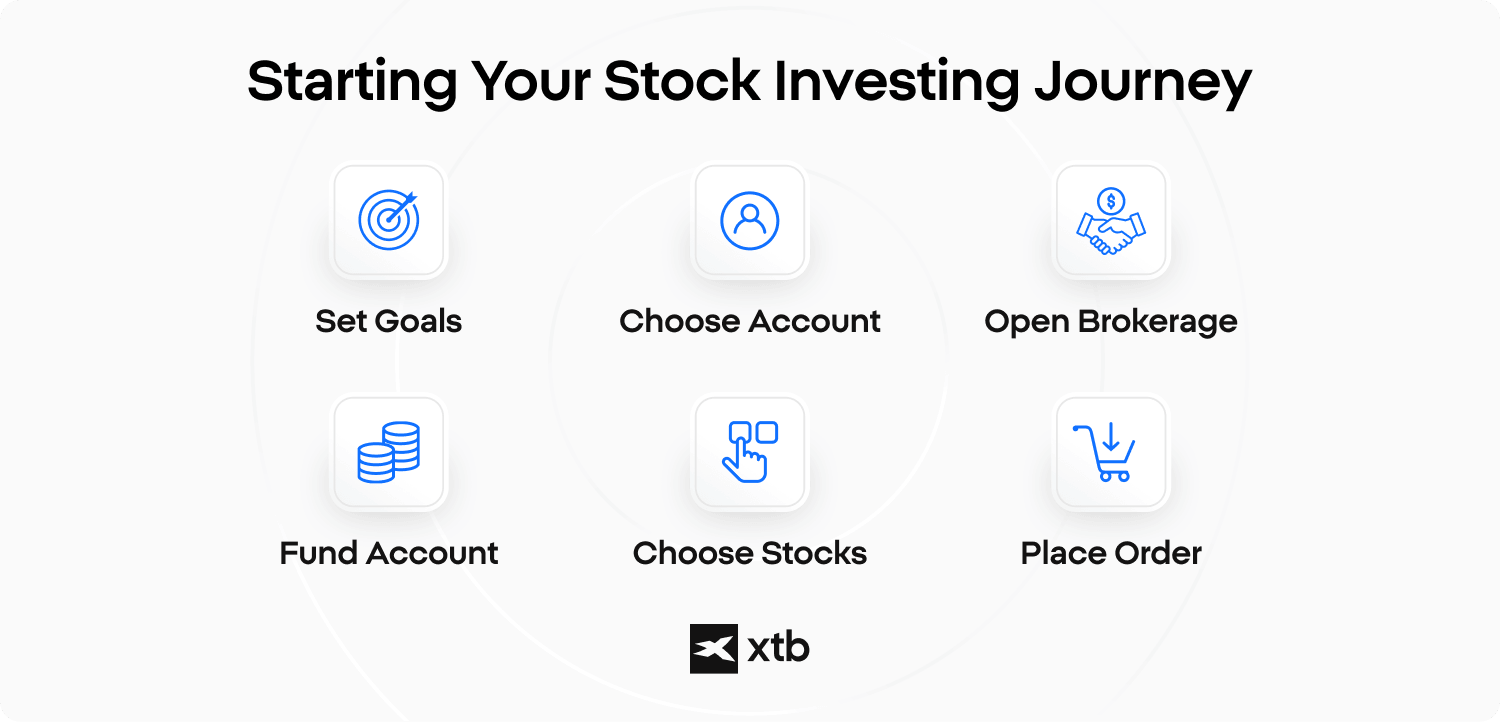
Starting your stock investing journey requires defining your financial goal, selecting the appropriate account type, opening a brokerage account online, depositing funds, and placing your first order. Following a structured approach helps investing for beginners feel manageable and secure.
Step 1: Set your investment goals
Establishing clear goals and a time horizon dictates your risk tolerance and asset choices. Investing for a retirement decades away allows for different strategies than saving for a house down payment needed in five years.
Step 2: Choose the right type of account
Investors choose between standard taxable accounts and tax-advantaged retirement accounts [per market: name the local vehicles, e.g. PEA for FR, ISA/SIPP or UK, IKE/IKZE for PL], which offer tax benefits in exchange for limits on when you can withdraw.
Standard accounts offer flexibility with withdrawals, while retirement accounts provide tax benefits but impose strict limits on when you can access your money.
Step 3: Open a brokerage account
A brokerage account acts as your gateway to the stock market, allowing you to buy and sell securities online. The process of opening a brokerage account is entirely digital, requires standard identity verification, and takes only a few minutes. While some investors use direct stock purchase plans without a broker, a standard brokerage account provides the widest access to different assets.
Step 4: Fund your account
You must deposit cash into your brokerage account before you can purchase shares. Most platforms support standard bank transfers or immediate payment methods to fund the balance securely.
Step 5: Choose your stocks or funds
Selecting the right instruments depends on your strategy: individual stocks give you direct control over specific companies, while diversified funds (index funds, mutual funds, ETFs) spread risk across many companies in one transaction. Beginners often start with a broad ETF for instant diversification.
Step 6: Place your first order
Executing a trade requires selecting the asset ticker, entering the investment amount, and choosing an order type. Market orders buy the asset immediately at the current price, while limit orders execute only when the price reaches your specified target.
What costs should stock investors consider?
Investment costs may seem small, but they can erode returns over time, particularly for investors who contribute regularly. Before opening a brokerage account, compare the total cost of investing rather than focusing on just one advertised feature.
The most important costs include:
- Stock and ETF commissions: Many reputable brokers now offer zero-commission investing in stocks and ETFs, which may help long-term investors keep more of their returns.
- Currency conversion fees: These can apply when buying foreign stocks and may significantly increase the total cost of each transaction.
- Bid-ask spreads: Even commission-free trades involve a spread, which represents the difference between the buying and selling price.
- Account or inactivity fees: Some brokers charge maintenance or inactivity fees, while others do not.
- Taxes: Dividends and capital gains may be taxable depending on your country of residence and the type of investment account you use.
How much money do you need to start investing in stocks?
You might wonder how to invest with little money - fractional rights allow you to buy portions of expensive assets for as little as $10, by accumulating fiduciary rights, meaning you can start investing with very small amounts of capital.
Many beginners ask if $100 is enough to invest in stocks. With a $100 deposit, you can build a diversified portfolio by purchasing fractional rights of multiple large companies or broad market index funds. Even a $10 investment is worth it to learn the mechanics of the brokerage platform and experience market fluctuations firsthand.
Add a short compounding projection for regular contributions, e.g.: investing $100 a month at a 7% average annual return might grow to roughly $17,000 after 10 years and roughly $52,000 after 20 years - most of the growth comes from staying invested, not from the size of each deposit. Past performance never guarantees future results, and returns are not linear.
Generating $1,000 a month in passive income from the stock market requires substantial capital and realistic expectations. Assuming an average annual dividend yield of 4%, you would need a portfolio worth approximately $300,000 to generate $12,000 annually. Investing small amounts is about long-term wealth building, not immediate monthly income.
These are illustrative and simplified calculations that do not account for additional fees.
Individual Stocks vs. Stock Funds: What Should Beginners Choose?
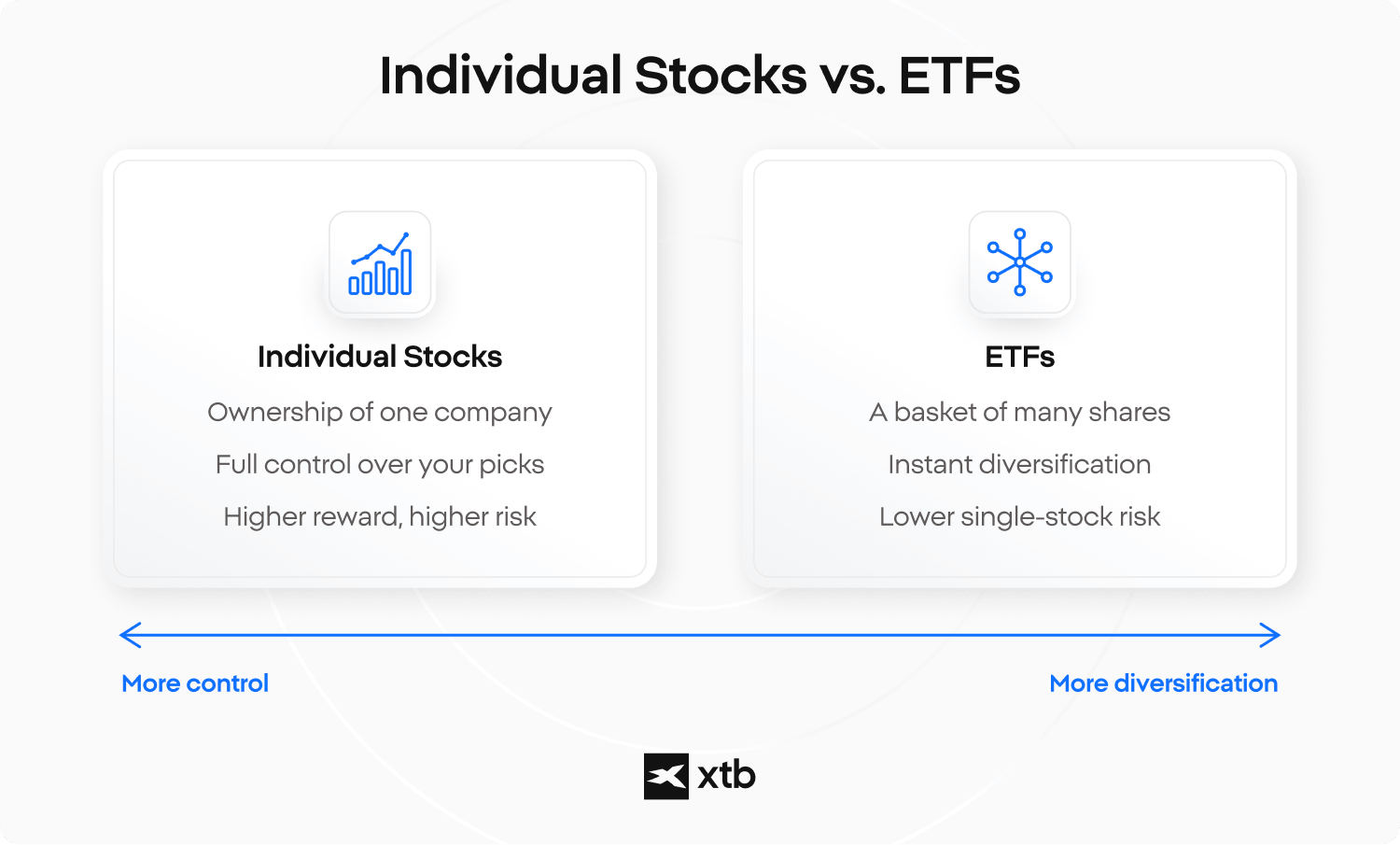
Beginners typically choose between individual stocks for direct control over specific companies or stock funds, like mutual funds and ETFs, for immediate diversification. Understanding what an ETF is helps clarify this crucial decision.
Buying individual shares gives you ownership in a specific company, meaning your returns rely entirely on that single business's performance. This approach offers higher potential rewards but carries concentrated risk if the company underperforms.
Stock funds pool money from many investors to buy a wide basket of shares. Index funds passively track a specific market benchmark, like the S&P 500, offering low costs and broad exposure. Mutual funds are often actively managed by professionals aiming to beat the market. An ETF trades directly on the stock exchange like regular shares, providing instant diversification across hundreds of companies in a single transaction.
How do you choose your first stocks as a beginner?
Choosing your first stocks should focus on understanding the underlying business and its valuation rather than trying to predict tomorrow's price. Many new investors make the mistake of buying companies simply because they are popular on social media or have recently delivered spectacular returns. Experienced investors instead begin by asking whether they understand how the business generates revenue and whether it has the financial strength to grow over time.
Rather than searching for the "next Amazon," beginners often benefit from studying established companies with long operating histories, consistent earnings, and sustainable competitive advantages. If analysing individual businesses feels overwhelming, broad-market ETFs remain a practical alternative that provides instant diversification while you continue learning.
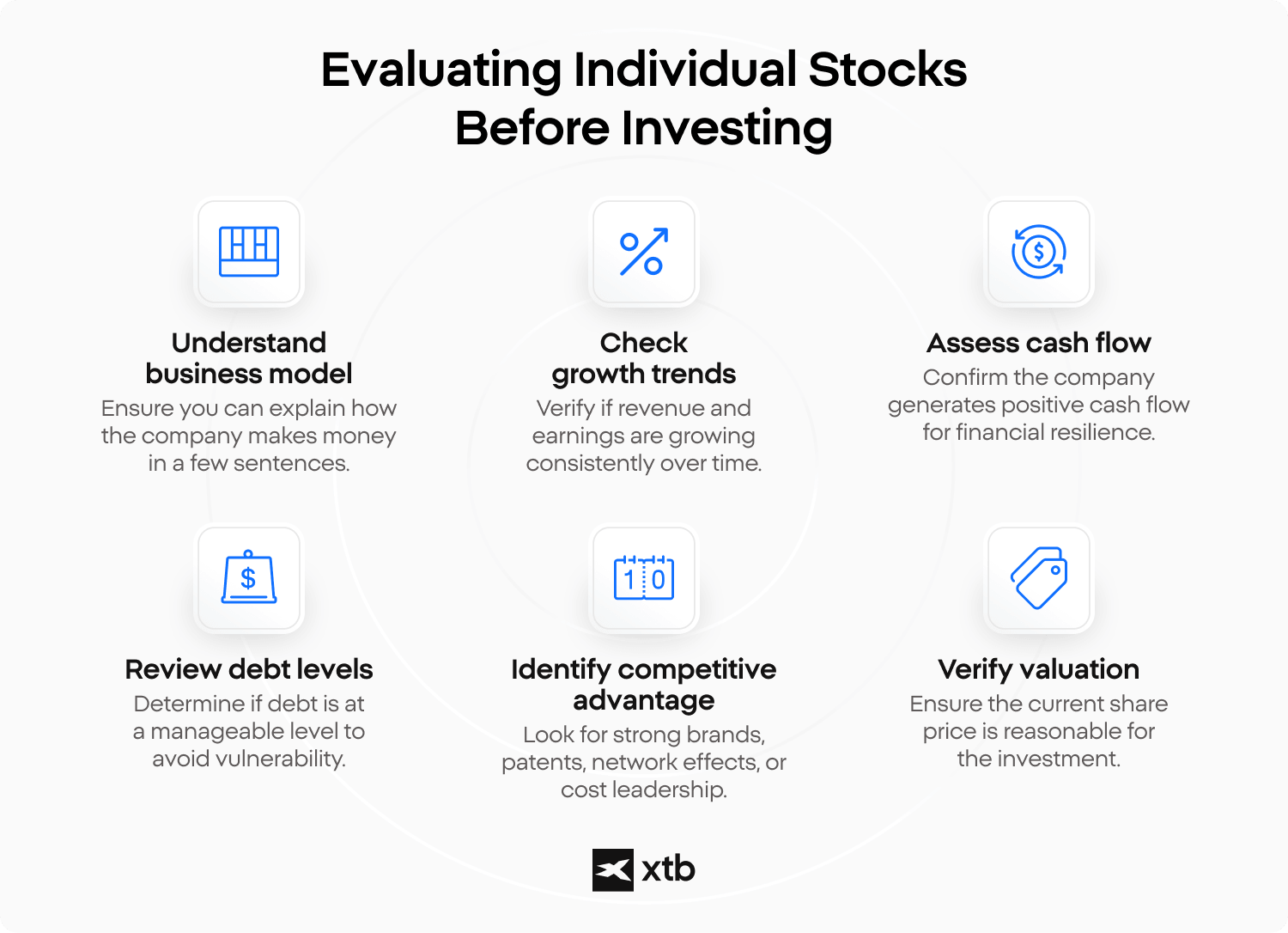
Before buying any individual stock, consider the following questions:
- Do you understand the company's business model? If you cannot explain how it makes money in a few sentences, it may be too early to invest.
- Is revenue and earnings growing over time? Consistent long-term growth can indicate a healthy business, although past performance never guarantees future results.
- Does the company generate positive cash flow? Businesses that consistently produce cash are generally more financially resilient during economic slowdowns.
- Is debt at a manageable level? Excessive borrowing can make companies more vulnerable when interest rates rise or profits decline.
- Does the company have a competitive advantage? Strong brands, patents, network effects, or cost leadership may help a business defend its market position for years.
- Is the current valuation reasonable? Even an excellent company can become a poor investment if investors pay an excessively high price for its shares.
Professional investors such as Warren Buffett have repeatedly argued that buying a stock should be viewed as buying part of a business rather than purchasing a ticker symbol. Focusing on business quality, financial strength, and long-term fundamentals often leads to more disciplined investment decisions than reacting to daily headlines or short-term market excitement.
How do you reduce risk when investing in stocks?
You reduce risk in stock investing by applying broad diversification, maintaining a long-term horizon of at least 5 years, and using dollar-cost averaging to enter the market gradually. You cannot eliminate stock market risk, but you can manage your exposure.
Diversification means spreading your capital across different sectors, company sizes, and geographical regions to ensure one failing asset does not destroy your portfolio. A well-diversified portfolio might hold shares of at least 20 to 30 companies or allocate up to 40% to foreign stocks.
Dollar-cost averaging involves investing a fixed dollar amount at regular intervals, regardless of the current stock market price. This strategy prevents you from investing all your capital at a market peak and naturally buys more shares when prices are low. Combined with a realistic assessment of your risk tolerance, these methods help you stay invested during market downturns instead of panic selling.
Building a stock portfolio ultimately requires patience, a funded brokerage account, and a clear understanding of your financial goals. By focusing on broad diversification, leveraging fractional fractional rights, and maintaining a long-term perspective, you can build a resilient portfolio without needing massive upfront capital.

FAQ
FAQ
Most beginners start by opening a regulated brokerage account, transferring a manageable amount of money, and investing according to a clearly defined plan. Before choosing any asset, determine your financial objective, investment horizon, and tolerance for temporary losses.
A practical starting process includes:
Building an emergency fund before investing,
Comparing regulated brokers and their fees,
Choosing between individual stocks and diversified funds,
Investing only money that will not be needed in the near future.
There is no universal minimum, but thanks to fractional rights, beginners can often start with as little as $10. Many brokers offer fractional investing, allowing investors to invest in public companies or ETFs instead of paying for one full share. This means beginners can often start with a relatively small amount.
The right starting sum depends more on your personal finances than on the price of a particular stock. Regular contributions of modest amounts may be more sustainable than making one large investment without a long-term plan.
Individual stocks provide direct exposure to selected companies and may offer stronger returns if those businesses perform well. However, they also expose the investor to greater company-specific risk.
ETFs can spread capital across many companies, sectors, or countries in a single transaction. For beginners who do not want to analyse corporate results, valuations, and competitive risks in detail, a diversified ETF may be easier to manage.
There is no completely risk-free way to invest in stocks. However, operational and portfolio risks can be reduced by using a regulated broker, diversifying holdings, and investing with a long-term perspective.
Beginners should also avoid treating stock investing as a substitute for cash savings. Money reserved for rent, emergencies, debt repayments, or short-term goals should generally not be exposed to daily market fluctuations.