Understand memory chip stocks, key DRAM, NAND and HBM manufacturers, sector volatility, and ways to gain market exposure without a buy recommendation.
Understand memory chip stocks, key DRAM, NAND and HBM manufacturers, sector volatility, and ways to gain market exposure without a buy recommendation.
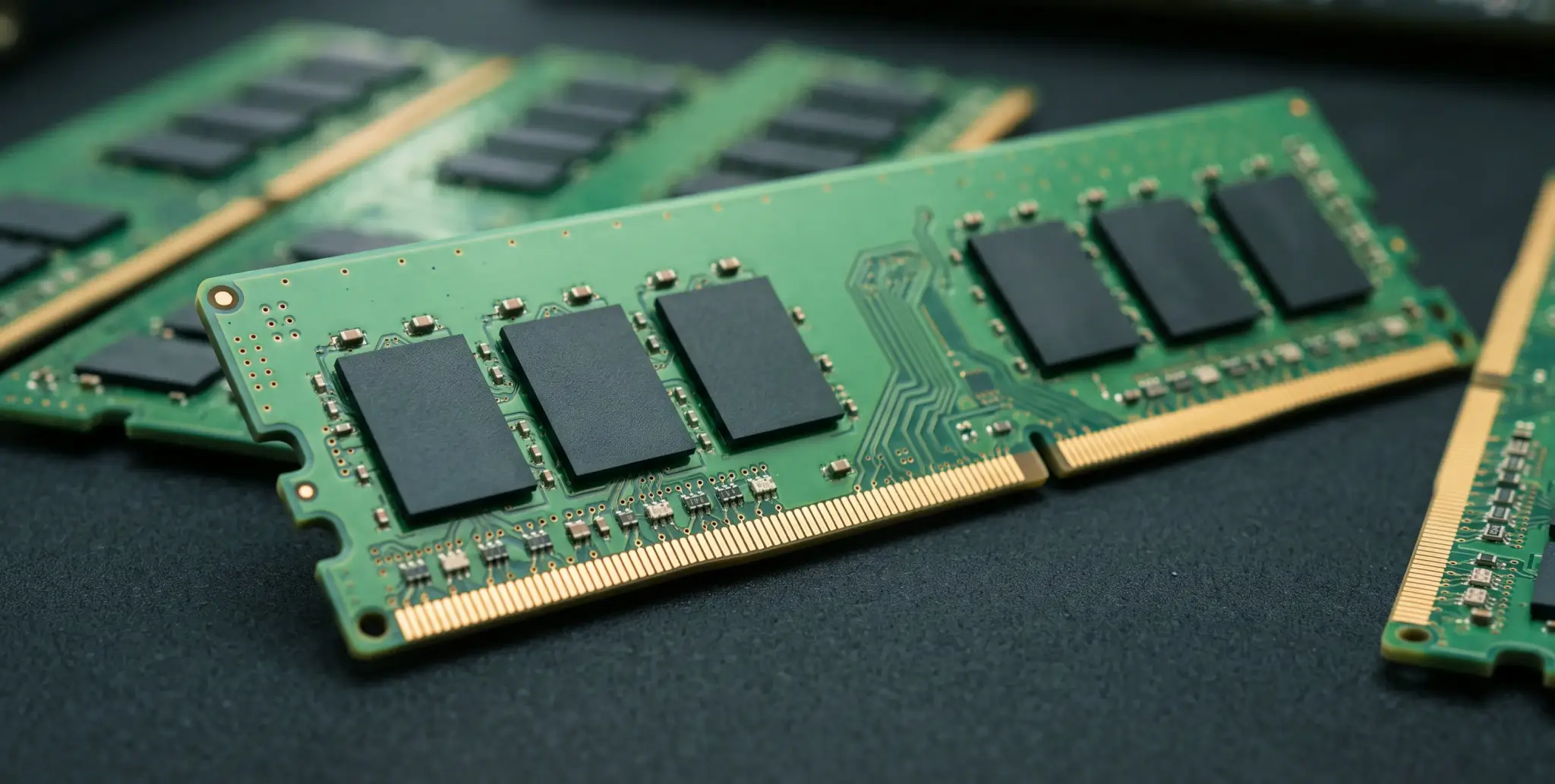
Memory chip stocks represent companies that manufacture and sell memory components or supply the fabrication equipment necessary to build them. Unlike logic processors that calculate data, these components fall into three main categories: DRAM serves as active working memory, NAND flash acts as permanent storage, and high-bandwidth memory (HBM) provides the massive data throughput required for AI accelerators. The global memory market is massive, with the top three players: Samsung, SK Hynix, and Micron, controlling almost 90% of total memory chip production. This guide maps out the key semiconductor stocks in the memory sector and explores different methods to gain market exposure without recommending specific investments.
Here are the key takeaways regarding the memory sector:
- DRAM, NAND flash, and HBM form the foundation of the memory market, serving different functions from active processing to permanent storage.
- A highly concentrated group of companies, including Samsung, SK Hynix, and Micron, dominates global memory production.
- The sector experiences severe cyclicality, where component prices directly drive company revenues and stock volatility.
- Investors can access the sector via individual shares, ETFs, or derivative instruments, each carrying distinct risk levels.
Which companies are the top memory chip manufacturers?
The memory market is highly concentrated, with a few companies - most notably Samsung, SK Hynix, and Micron - accounting for the vast majority of global DRAM production.
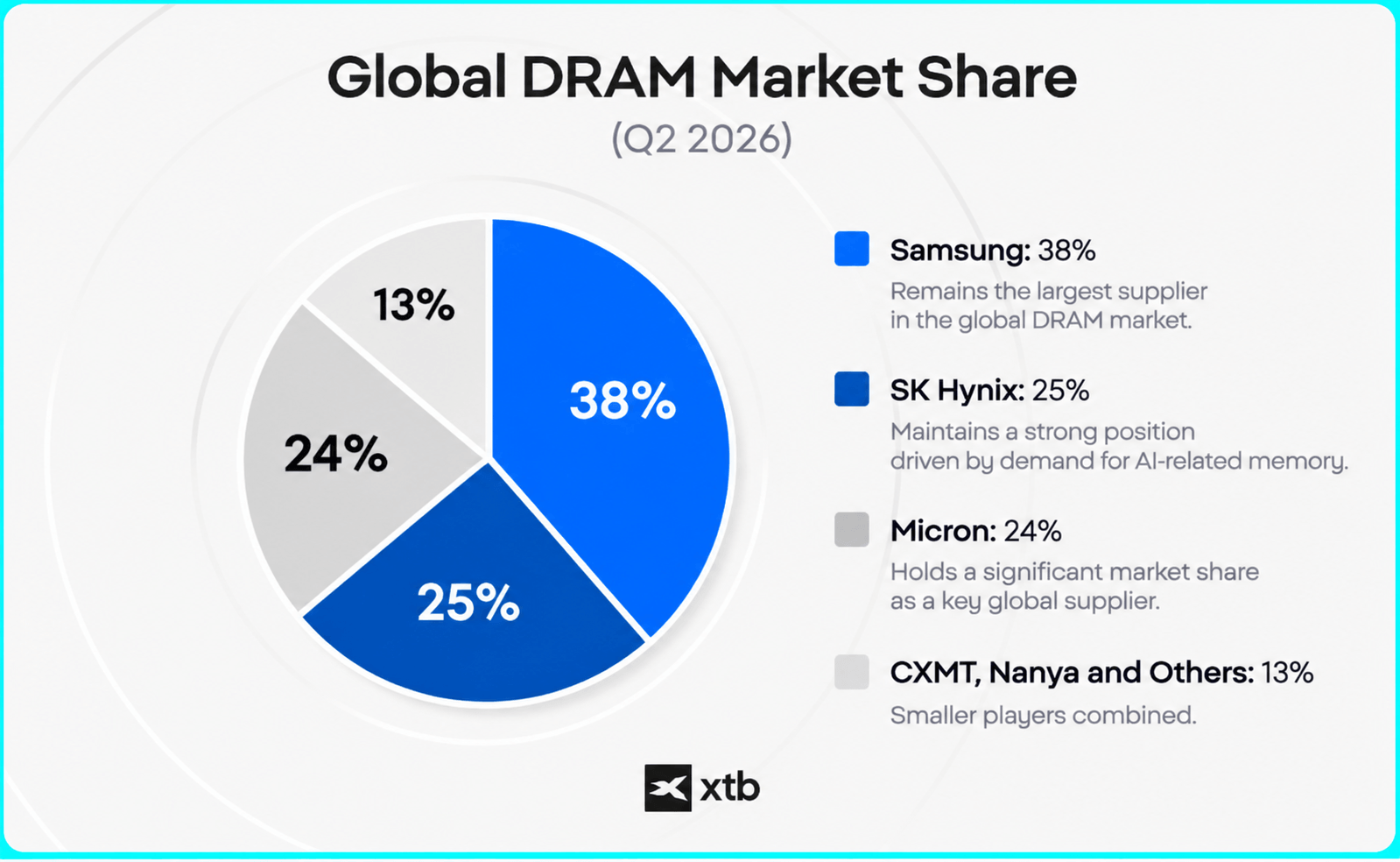
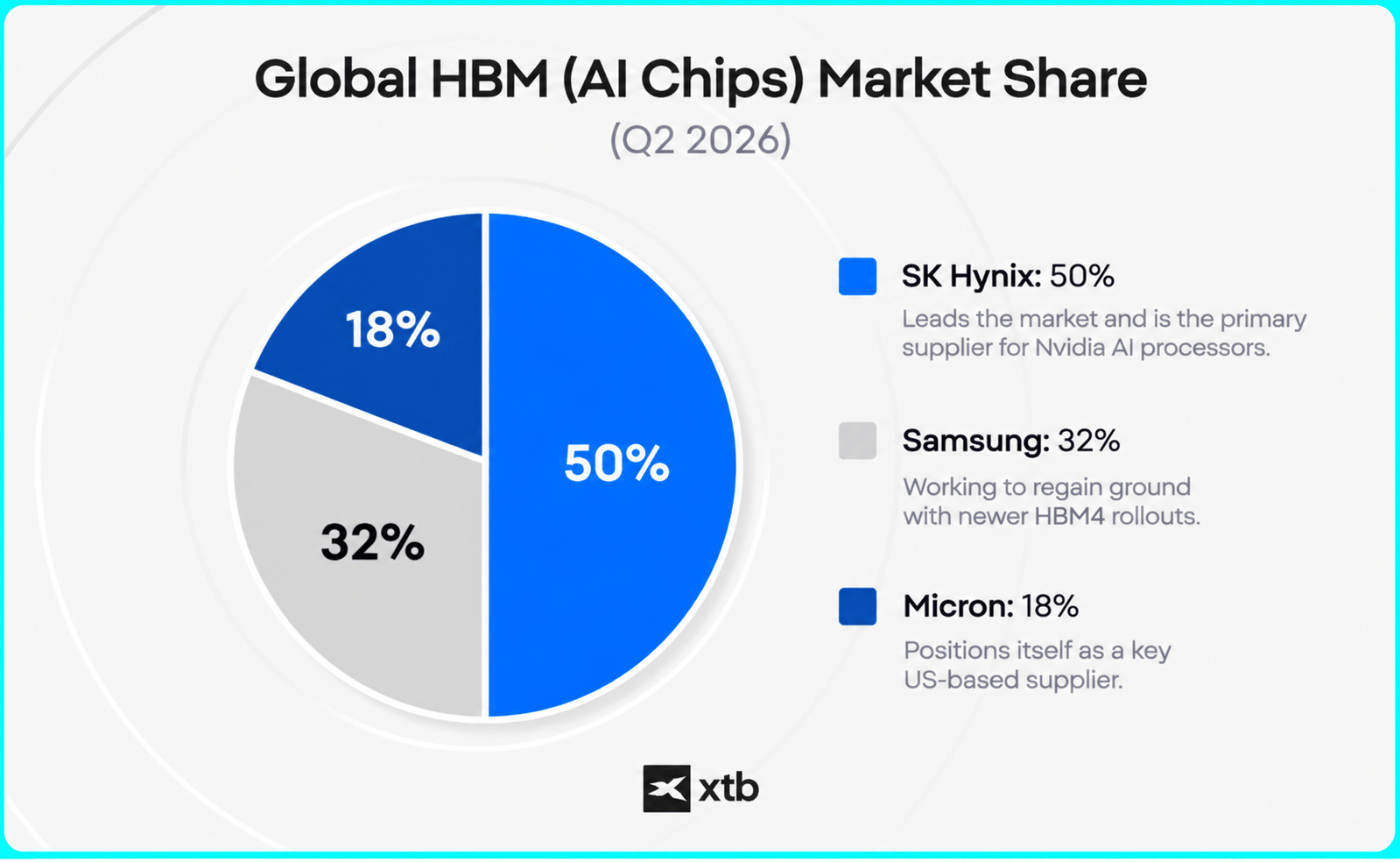
Source: Counterpoint Research DRAM and HBM Report as of Q2 2026
Data are estimations and may be not fully accurate, HBM and DRAM market share changes over time. SanDisk and Western Digital are not meaningful producers of those as companies specialize in NAND memory market.
Micron Technology (MU)
Micron Technology operates as a leading American manufacturer of both DRAM and NAND flash memory. It stands out as the only major pure-play memory chip company listed in the United States. By examining a recent Micron 10-K annual report, investors can clearly see how revenues are split strictly between active memory and storage components, unlike highly diversified conglomerates.
For investors, this relatively focused business model makes Micron particularly sensitive to changes in memory pricing, inventories, and the broader semiconductor cycle. The company also has growing exposure to high-bandwidth memory and data-centre products, which links its future earnings increasingly closely to AI infrastructure spending, server demand, and the pace of adoption of next-generation memory technologies.
Remember, past performance is not an indicator of future results.
SK Hynix
SK Hynix is a South Korean chipmaker that produces both DRAM and NAND flash memory. The company holds a critical position in the supply chain for high-bandwidth memory (HBM), making it a key supplier for AI infrastructure and data centres.
Its position in HBM has become especially important as AI accelerators require significantly more memory bandwidth than traditional computing systems. For investors, this means SK Hynix is not only exposed to the conventional DRAM cycle but also to the faster-growing AI memory segment, where production capacity, manufacturing yields, advanced packaging and customer qualification can have a major impact on margins and market share.
Remember, past performance is not an indicator of future results.
Samsung Electronics
Samsung Electronics ranks as the largest producer of memory chips globally. As of 2026, memory components represent the biggest segment of this massive conglomerate’s business, which also includes smartphones, consumer electronics, and logic foundries. Memory chips account for roughly 70% of total company revenues in mid-2026, while 25% was the historical norm.
Unlike more focused memory companies, Samsung offers exposure to several semiconductor and consumer technology markets at the same time. This diversification can reduce dependence on a single product category, but the growing contribution from memory also means that changes in DRAM, NAND, and HBM pricing have become increasingly important for group profitability. Its ability to compete in advanced HBM generations and maintain manufacturing scale remains central to the investment case.
Remember, past performance is not an indicator of future results.
SanDisk (SNDK)
SanDisk emerged as a spinoff from Western Digital to operate as a distinct player in the NAND flash memory space. This separation allows the company to focus entirely on solid-state flash memory technologies rather than traditional spinning disk storage.
The company therefore provides more direct exposure to NAND pricing, enterprise SSD demand, and the continued transition from HDD-based storage toward flash in many applications. Its earnings can still be highly cyclical, however, because NAND remains particularly vulnerable to oversupply, inventory corrections, and sharp movements in average selling prices. Data-centre storage demand and AI-related infrastructure investment may provide an additional long-term growth driver.
Remember, past performance is not an indicator of future results.
Western Digital (WDC) and Seagate (STX)
Western Digital and Seagate focus heavily on data storage and hard disk drives (HDDs) rather than pure memory chip manufacturing. They offer exposure to the broader demand for data storage across consumer and enterprise markets.
Their investment profile is therefore different from that of companies such as Micron or SK Hynix. Rather than depending primarily on DRAM or HBM pricing, Western Digital and Seagate are more closely linked to enterprise storage capacity, cloud infrastructure and hyperscale data growth. AI may still be an important demand driver because training and inference generate enormous volumes of data that must be stored economically, which continues to support the role of high-capacity HDDs alongside flash storage.
Remember, past performance is not an indicator of future results.
Remember, past performance is not an indicator of future results.
Equipment and IP providers
Companies like ASML, Applied Materials, and Rambus do not manufacture memory chips directly. Instead, they provide the complex lithography machines, fabrication equipment, and intellectual property (IP) licensing required by chipmakers, offering an indirect way to access the sector’s growth. These companies are generally more exposed to semiconductor capital expenditure than to day-to-day movements in memory prices.
When memory producers expand fabs, introduce new process nodes, or invest in HBM and advanced packaging capacity, equipment and technology suppliers can benefit even before the additional chips reach the market. At the same time, a downturn in the memory cycle can cause manufacturers to postpone investment, making capex plans an important indicator for this part of the supply chain.
Why are memory chip stocks in focus in 2026?
Demand for high-bandwidth memory (HBM) from data centres and AI applications has driven extreme attention toward memory chip stocks, but the sector remains strictly cyclical. The fundamental mechanism driving these companies involves a continuous boom-and-bust cycle. When data centres and electronics manufacturers demand more memory than factories can produce, prices for DRAM and NAND flash surge, directly increasing the revenues and share prices of memory chip stocks. Conversely, when production exceeds demand, the resulting oversupply or glut crashes component prices, forcing companies to sell at a loss. Historically, the market experienced a severe oversupply around 2023, followed by a sharp AI-driven rebound stretching into 2024 and 2026.
In 2026, the focus has shifted heavily to high-bandwidth memory due to some optimistic forecasts. For example, Bank of America predicts that the HBM market will reach $54.6 billion in 2026, representing a 58% year-over-year increase from 2025. Moving into 2027, projections align with a scaling trajectory toward the $75 billion mark.
The volatility is stark; for instance, certain players like SanDisk, as of August 2026, saw year-over-year stock growth reaching 3400%. However, this rapid growth comes with severe daily corrections, with major players routinely experiencing single-day drops of 8% to 10% - or even more.
Because of this volatility, timing market entries becomes a significant risk factor for those looking at AI stocks. Entering during the peak of an expansion cycle exposes investors to heavy losses during the inevitable correction. Investors must remember that past performance is not a reliable indicator of future results. The sector requires heavy capital expenditures for new fabrication plants and relies heavily on Asian manufacturing hubs, creating geographic and concentration risks.
What drives memory chip stock prices and earnings?
Memory chip stocks are primarily driven by changes in DRAM and NAND pricing, supply levels, inventories, and product mix. Because memory chips are relatively standardized products, even small shifts between supply and demand can cause large changes in average selling prices, gross margins, and manufacturer profits.
The cycle can become especially important when producers expand capacity at the same time. Strong demand and limited supply usually support pricing, while excess inventories and overproduction can quickly pressure earnings. For investors, the most useful signals to monitor include:
- DRAM and NAND average selling prices (ASPs)
- Inventory levels across manufacturers and customers
- Capital expenditure and new production capacity
- Product mix, particularly higher-value HBM and data-center memory
How is HBM changing the memory chip industry?
High-bandwidth memory is changing the economics of the memory industry by making advanced memory a critical component of AI infrastructure rather than simply a commodity used for storage or general computing. HBM stacks multiple DRAM dies vertically, allowing AI accelerators to access much larger amounts of data at significantly higher bandwidth.
For memory manufacturers, this creates an opportunity to move toward more specialized and technically demanding products. However, HBM also requires advanced packaging, strong manufacturing yields, and qualification with major AI-chip customers, which means execution remains important. Investors following the HBM market should pay particular attention to:
- HBM production capacity and manufacturing yields
- Customer qualification for new HBM generations
- Exposure to AI accelerators and data-center demand
- The impact of HBM growth on margins and overall product mix
What are the biggest risks for the global memory chip market?
The biggest risk is that today’s shortage eventually becomes tomorrow’s oversupply. Memory has always been a deeply cyclical business: when DRAM and NAND demand exceeds available production, prices rise fast, margins expand, and manufacturers respond by increasing capital expenditure. The problem comes later because new capacity often arrives just as demand starts to cool. Inventories build, average selling prices fall, and earnings can deteriorate very quickly. That basic mechanism has not disappeared just because AI is now the dominant investment theme.
AI may, however, make this cycle different. HBM is more complex than traditional commodity memory, requires advanced packaging, high manufacturing yields, and qualification with major AI-chip customers, which raises technological barriers and can support stronger margins. At the same time, server DRAM and HBM demand is increasingly linked to hyperscaler spending rather than only smartphones and PCs. This could make the current upcycle structurally stronger and potentially longer, but it does not remove the possibility that aggressive capacity expansion eventually catches up with demand.
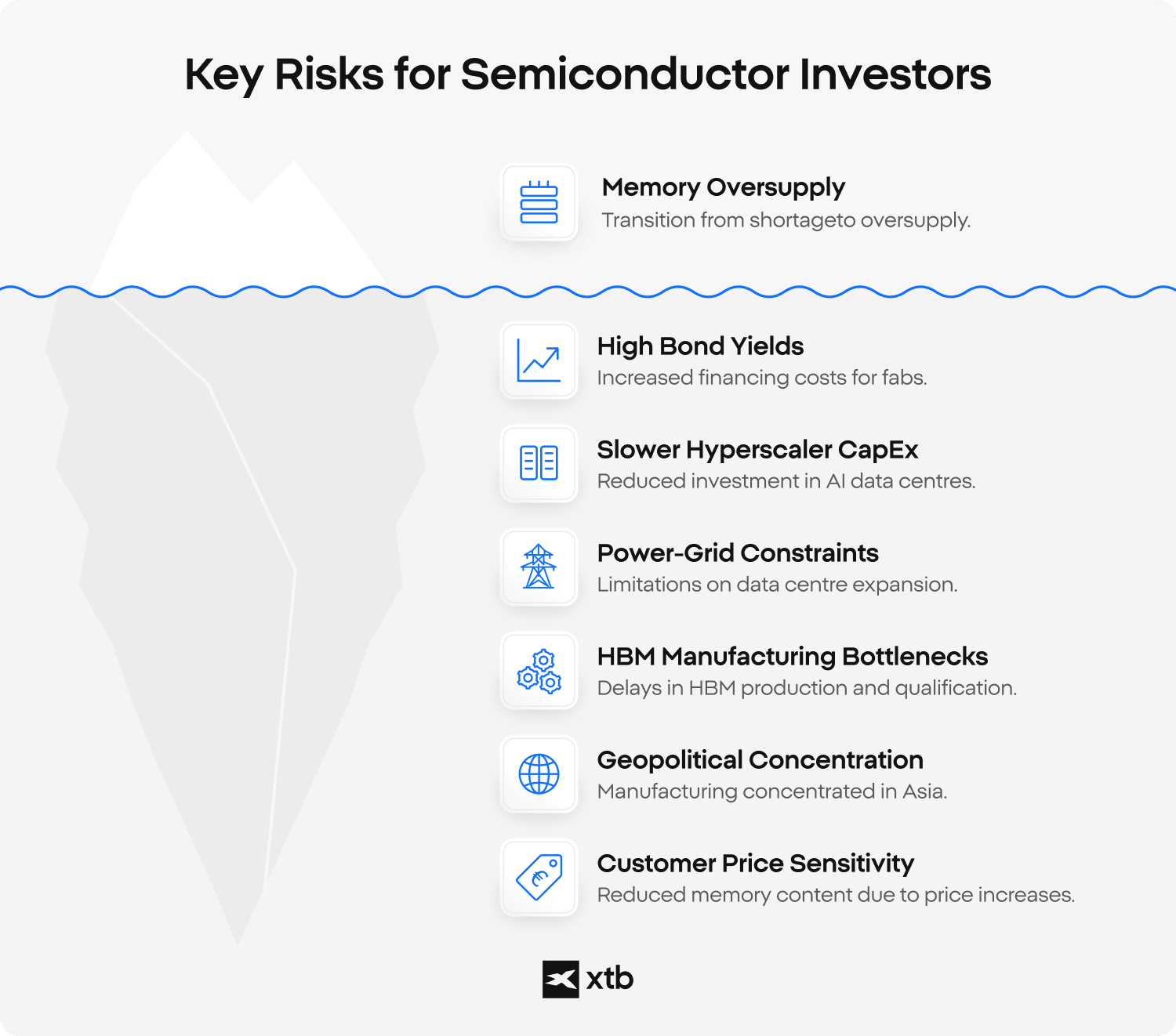
Higher yields, data-centre bottlenecks and the limits of AI spending
There is also a broader macro risk that is easy to underestimate. AI infrastructure is enormously capital-intensive, so persistently high global bond yields raise financing costs for data centres, power networks, semiconductor fabs and advanced packaging facilities. Higher yields can therefore hurt memory stocks twice: they increase the cost of building the infrastructure that creates future HBM demand, while putting pressure on equity valuation multiples.
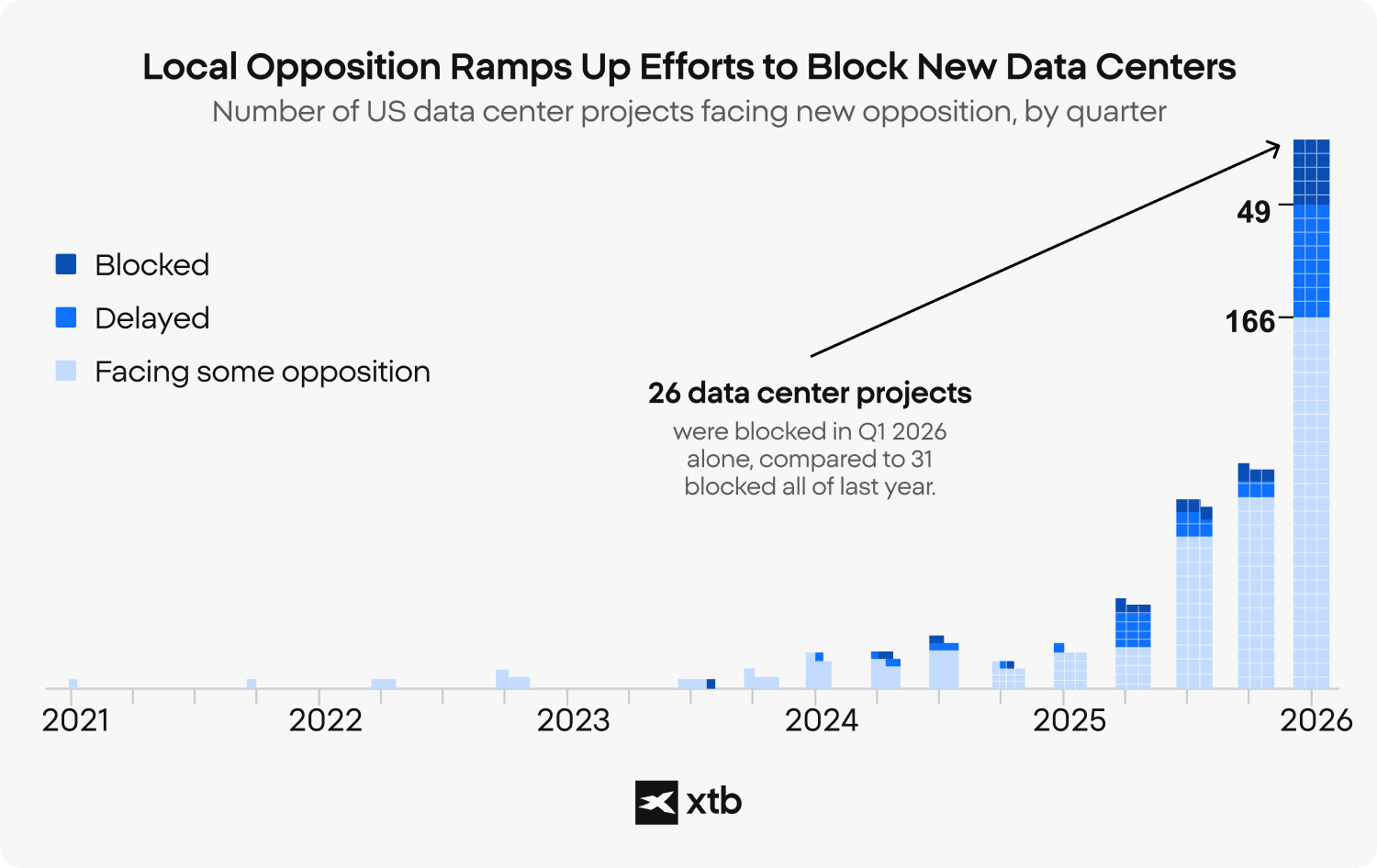
Physical infrastructure is becoming another constraint. In the US, opposition to new data centres has increased sharply because of concerns about electricity consumption, water usage, grid capacity and local costs. According to Data Center Watch, dozens of projects were blocked or delayed in early 2026, showing that AI deployment is increasingly limited not only by chip availability but also by power, permitting, and local politics. If data-centre construction slows, orders for GPUs, HBM, server DRAM and enterprise storage can be delayed as well.
For investors, this means the central question is no longer simply whether AI demand will grow. It almost certainly will. The harder question is whether hyperscaler spending, electricity infrastructure, data-centre construction and memory supply can all expand at roughly the same pace. If they cannot, the memory market could move from shortage to imbalance surprisingly quickly, which is exactly why ASPs, inventories, capex, HBM capacity, and data-centre investment remain the indicators worth watching closely.
How can you gain exposure to memory chip stocks?
You can gain exposure to memory chip stocks through individual shares, sector-specific semiconductor ETFs, or derivative instruments like CFDs, each carrying a different risk profile. For investors researching how to invest in stocks, purchasing shares of individual companies like Micron or SK Hynix offers direct, concentrated exposure to the memory cycle. This method captures the full upside of rising DRAM and NAND flash prices but also exposes the portfolio entirely to single-company risks, such as manufacturing defects or delays in developing next-generation memory nodes.
Those looking for diversification often turn to exchange-traded funds. Understanding what an ETF is crucial here; technology and semiconductor ETFs hold baskets of dozens of companies, spreading the risk. While memory chip stocks make up a portion of these funds, the presence of logic chip designers and equipment manufacturers dilutes both the upside and downside of the memory cycle.
Finally, those asking what a CFD is should note that Contracts for Difference offer a way to speculate on price movements in either direction. Regardless of the chosen path, mitigating the inherent cyclicality of memory chip manufacturers requires a clear understanding of your investment horizon. As always in financial markets, past performance does not guarantee future results.

FAQ
Memory chip stocks are shares of companies that manufacture memory semiconductors such as DRAM, NAND flash, and high-bandwidth memory, or supply the equipment and technologies used to produce them. The sector includes direct manufacturers such as Samsung, SK Hynix, and Micron, as well as semiconductor equipment and IP providers.
For investors, the key distinction is between direct memory producers and indirect suppliers. Direct manufacturers are more exposed to changes in memory pricing, while equipment and technology providers may benefit from broader semiconductor investment cycles.
Samsung Electronics, SK Hynix, and Micron Technology dominate the global memory industry, particularly in DRAM. These companies also have meaningful exposure to NAND and, increasingly, HBM, although their competitive positions and product mixes differ.
Their scale matters because memory manufacturing requires advanced fabrication technology, large capital expenditure, and efficient production. These barriers make it difficult for new competitors to enter the market quickly.
DRAM is temporary working memory used by processors, while NAND stores data permanently in products such as SSDs, smartphones, and data-center storage systems. HBM is a specialized form of DRAM designed to deliver much higher bandwidth by stacking memory dies vertically.
For investors, these markets should not be treated as identical. NAND tends to be highly sensitive to supply and pricing, while HBM is more closely linked to AI accelerators and advanced data-center demand.
Memory chip stocks are cyclical because supply and demand can move out of balance very quickly. When demand rises faster than production, memory prices increase and manufacturer margins can expand sharply. When too much supply enters the market, prices and profits can fall just as quickly.
The cycle is intensified by the industry’s high fixed costs. Memory manufacturers must continue investing in fabs and equipment, so changes in utilization, inventory, and pricing can have a major effect on earnings.
The most important cycle signals include:
DRAM and NAND average selling prices
inventory levels
manufacturing utilization
capital expenditure and new capacity
Memory chip stocks are heavily influenced by DRAM and NAND pricing, inventories, production capacity, margins, and product mix. Because memory products are relatively standardized, even modest changes in supply and demand can have a large effect on profitability.
Investors should therefore look beyond headline revenue growth. Improving pricing, lower inventories, stronger manufacturing yields, and a greater share of higher-value products such as HBM can all materially improve earnings.
HBM is changing the memory sector by making advanced memory a critical part of AI infrastructure. AI accelerators require enormous data throughput, and HBM helps deliver it by stacking multiple DRAM dies vertically and placing them close to the processor.
For memory manufacturers, HBM can improve product mix and create higher-value revenue opportunities. However, it also requires sophisticated packaging, strong manufacturing yields, and qualification with major AI-chip customers, making execution particularly important.
Companies with strong HBM and data-center memory businesses tend to have the most direct exposure to AI infrastructure demand. SK Hynix and Micron are closely associated with HBM growth, while Samsung also has broad exposure across advanced memory categories.
AI exposure goes beyond HBM alone. Server DRAM, enterprise SSDs, advanced packaging, and semiconductor equipment can also benefit from rising investment in data centers and accelerated computing.
The most useful metrics include average selling prices, gross margin, inventory levels, capital expenditure, free cash flow, and product mix. These indicators can help show whether the memory cycle is improving or weakening.
Investors should also watch how quickly manufacturers expand HBM capacity and whether new memory generations are successfully qualified by large customers.
Key metrics to follow include:
gross margin and free cash flow
DRAM and NAND ASPs
inventory days
capex, HBM capacity, and manufacturing yields
Memory companies can benefit from long-term AI growth because advanced accelerators require large amounts of fast memory. HBM in particular has become an increasingly important part of AI systems and data-center infrastructure.
However, memory remains a cyclical business. Even if AI demand grows structurally, periods of oversupply, falling prices, and heavy capital expenditure can still create significant volatility in earnings and share prices.
The main risks include oversupply, falling memory prices, weaker demand, high capital expenditure, manufacturing problems, and geopolitical concentration. The sector also depends heavily on advanced fabrication facilities and global semiconductor supply chains.
Technology transitions create another layer of risk. A company that falls behind in HBM, packaging, or next-generation DRAM can lose market share even during a strong industry cycle.
Investors can gain exposure through individual shares, semiconductor ETFs, or derivative products such as CFDs. Each method offers a different balance between concentration, diversification, and risk.
Direct shares provide the clearest exposure to individual memory companies, while ETFs spread risk across a broader group of semiconductor businesses. Derivatives add leverage and require additional caution because losses can be amplified.