
An educational overview of investment options, comparing their risks, returns, and suitability for different investors.
An educational overview of investment options, comparing their risks, returns, and suitability for different investors.


Stocks, ETFs, real estate, gold, and crypto are among the most common ways people invest money in 2027, but no single option suits everyone. The harder question isn't where you can invest, but which investment type matches your goals, time horizon, and tolerance for risk. Understanding those differences is often more important than trying to identify the next market winner. This guide explains the main investment options and how they differ in practice.
Key Takeaways
-
A good investment is not defined by the highest return, but by how well it aligns with an investor's goals, time horizon, and risk tolerance.
- Stocks, ETFs, bonds, real estate, precious metals and digital assets are types of investments that can behave very differently under the same market conditions.
- Long-term investment outcomes often depend more on diversification and consistency than on selecting a single high-performing asset.
- Semiconductors, AI infrastructure, gold, silver, energy markets, and rising oil prices are among the major 2027 themes, but they should be understood as market exposures - not automatic investment opportunities.
What Does "Good Return" Actually Mean in 2027?
A good investment return in 2027 is not simply about how much money a portfolio gains on paper. What matters is how much purchasing power remains after inflation is taken into account. This is the difference between a nominal return and a real return. Understanding it is important for any beginner investor. A nominal return shows how much an investment increased in percentage terms. A real return adjusts that gain for inflation. If an investment grows by 6% while inflation is 3%, the real return is closer to 3%.
The portfolio value increased, but part of that growth was offset by rising prices across the economy. This distinction also explains why keeping money in cash for long periods can reduce purchasing power even when the account balance continues to rise. Savings accounts can play an important role for emergency funds and short-term goals, but their interest rates do not always keep pace with inflation. Over time, this can result in a gradual decline in what the money can actually buy. Some of the most discussed market themes for this year include:
- S&P 500: Goldman Sachs expects the index to reach around 8,700 in Septermber 2027, while forecasting S&P 500 earnings per share of roughly $415 in 2027.
- Gold: Goldman Sachs targets $5,400/oz by the end of 2027, while J.P. Morgan sees gold reaching around $6,300/oz by the end of the year.
- Oil: J.P. Morgan expects Brent crude to average approximately $64/bbl in 2027, reflecting a softer supply-demand balance and reduced pressure on inventories. EIA, however, now forecasts Brent at about $84/bbl on average in 2027.
- Bitcoin: Bernstein expects BTC to reach around $150,000 by mid-2027, while Citi’s in September lifted its 12-month target to $113,000. Standard Chartered’s latest clearly confirmed target is $100,000 for the end of 2026, with no specific target for 2027.
- Ethereum: Standard Chartered’s confirmed near-term target is $4,000 for the end of 2026 while the bank trimmed the Ethereum goal for the end of 2027 to $10,000 from $18,000.
The broader lesson is that a "good return" is often less about achieving exceptionally high gains and more about preserving and gradually growing purchasing power over time. Consistently outperforming inflation by several percentage points can have a larger long-term impact than trying to achieve excessive returns, risking much more.
How Much Risk Are You Willing to Take?
Every return comes with a price, and that price is usually volatility. Investments that offer higher long-term return potential can also fall more sharply in the short term, so risk is not something separate from investing. The key is to distinguish normal price volatility from behavioural risk: volatility can be managed with time and diversification, while panic selling can turn a temporary decline into a permanent loss.
Time horizon is one of the main filters for risk. The longer the investment horizon, the more room there may be to hold growth assets such as stocks through market declines. The practical question is behavioural: would you still stay invested if your portfolio fell by 30% before recovering?
|
|
|
|
|
|
|
|
|
|
|
|
|
|
|
|
*These are simplified examples for educational purposes only and are not investment recommendations.
Are Stocks and ETFs Still Worth Investing In?
Stocks and ETFs remain among the most widely used ways to participate in long-term economic growth. While short-term performance can vary significantly, both asset types have historically benefited from the ability of businesses to grow revenues, earnings, and productivity over time. So the answer to the question “Where to invest money?” is straightforward: stocks and ETFs available on brokerage platforms remain the most accessible entry points, historically delivering average annual returns of around 8-10% before inflation over long periods.
A stock represents ownership in a single company, while an ETF (Exchange-Traded Fund) is a fund that can provide exposure to dozens, hundreds, or even thousands of investments through a single instrument. This broader exposure is one reason ETFs have become widely adopted: a single ETF can provide exposure to dozens, hundreds, or even thousands of underlying holdings, removing the need to select individual companies.
Historically, a broad US stock market index such as the S&P 500 as of October 2026 has generated real annualized total returns of approximately 7% on average since the launch in March 1957, after adjusting for inflation and assuming dividends are reinvested, and nominal return of 10.7%. Although results have varied across decades and market cycles. Remember that past performance does not guarantee future results.
These returns have not been achieved in a straight line. Market declines, corrections, and periods of uncertainty are a normal part of investing, even during long-term upward trends. However, investing in individual stocks is perceived as riskier than passive ETF strategies - because it requires research, knowledge and deep understanding of financial markets and balance sheets.
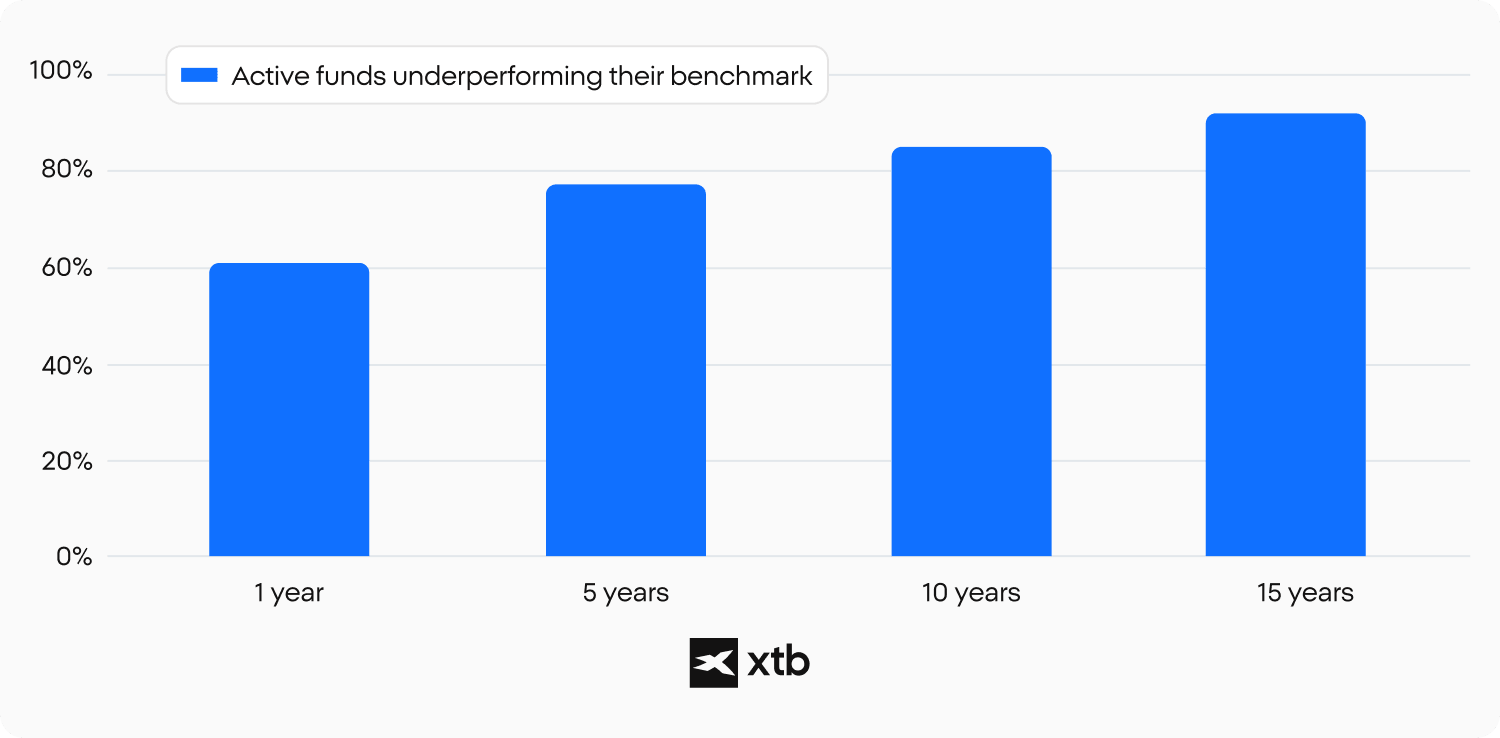
Source: S&P SPIVA Global Scorecard, Year-End 2024. Global average across US, Europe, Canada, Australia, MENA, Brazil, Chile, South Africa, India and Japan.
How Do Stocks and ETFs Differ in Practice?
Stocks and ETFs are often mentioned together, but they work differently. A stock represents ownership in one company, so its value depends on the performance of a
single business. An ETF is a fund traded on an exchange that can provide exposure to many companies, sectors, regions, or commodities through one instrument. The main difference is concentration: ETFs spread exposure across many holdings, while individual stocks depend on one company.
Historically, broad stock market indices have delivered average annual returns of around 8 to 10% before inflation over long periods, although results have varied across decades and market cycles. These returns have not come in a straight line. Corrections, bear markets, and periods of volatility are a normal part of equity investing, which is why time horizon matters. Knowing the trends is crucial because it allows one to know where to invest money to get potential returns.
Popular ETF exposures in 2027
ETFs are often used to access broader markets or themes without selecting individual companies. The exact exposure depends on the ETF’s structure, index, and underlying assets. The stocks and ETFs below are not the best investments right now. They are simply a list of popular assets in 2027, which is driven mostly by the AI infrastructure boom, largely focused on semiconductors. So, explore the main investment options in 2027.
- Nasdaq-100 ETFs – provide exposure to large technology and growth companies listed on Nasdaq, including many firms linked to artificial intelligence, cloud computing, and digital services.
- S&P 500 ETFs – track 500 of the largest publicly listed U.S. companies, offering diversified exposure to the U.S. equity market across technology, healthcare, financials, industrials, and consumer sectors.
- MSCI All Country World ETFs – offer broad exposure to companies from both developed and emerging markets, providing diversified global equity exposure.
- South Korea ETFs – focus on Korean companies operating in semiconductors (Samsung, SK Hynix), electronics, batteries, industrial technology, and consumer sectors.
- China ETFs – invest in Chinese companies listed in mainland China, Hong Kong, or international stock markets.
- Emerging Markets ETFs – provide access to companies from developing economies such as India, Brazil, Taiwan, South Korea, Saudi Arabia, and other emerging markets.
- Semiconductor ETFs – invest in companies involved in chip design, manufacturing equipment, memory, foundries, and semiconductor materials, providing targeted exposure to AI infrastructure and computing demand.
- Defence ETFs – provide exposure to companies operating in aerospace, defence, military technology, cybersecurity, and government defence contracting, benefiting from rising global defence spending.
- Nuclear Energy & Uranium ETFs – invest in uranium producers, nuclear fuel suppliers, reactor developers, and companies supporting nuclear power generation, reflecting growing interest in reliable low-carbon electricity for AI data centres and electrification.
- Oil ETFs – provide exposure to crude oil prices, energy-sector companies, or oil futures contracts, depending on the ETF's structure.
Popular stocks investors follow in 2027
Individual stocks provide direct exposure to one company’s business model, financial results, valuation, and competitive position. This can create more concentrated risk than an ETF.
- NVIDIA – designs AI chips, graphics processors, and data-centre computing systems that power artificial intelligence, cloud computing, and high-performance workloads.
- Micron Technology – produces memory and storage semiconductors used in servers, smartphones, personal computers, and AI infrastructure.
- ASML – manufactures advanced lithography machines that are essential for producing cutting-edge semiconductor chips.
- SK Hynix – develops memory chips and high-bandwidth memory (HBM) solutions widely used in AI systems and data centres.
- Amphenol – manufactures electronic connectors and components used across communications, aerospace, industrial technology, and data-centre infrastructure.
- HEICO – supplies aerospace, defence, and industrial components for commercial and government customers.
- Redwire – provides space infrastructure, engineering services, and technology solutions for commercial and government space programmes.
- SpaceX – develops and operates launch vehicles, spacecraft, and satellite systems to enable space transportation and connectivity.
- Alphabet – operates Google's search, cloud, YouTube, and AI platforms, and invests in emerging technologies through its innovation and R&D initiatives.
- Exxon Mobil – operates across oil and natural gas production, refining, chemicals, and energy-related infrastructure.
The main difference is concentration. ETFs usually spread exposure across many holdings, while individual stocks depend on the performance of a single company. Neither approach removes risk, and past performance does not guarantee future returns.
NVIDIA - Is It Still a Key AI Investment Theme in 2027?
NVIDIA has become one of the most closely watched companies in the artificial intelligence industry. Its graphics processing units (GPUs) are widely used to train and run AI models, making the company a central supplier to data centres and cloud-computing providers.
The stock returned roughly 1,160% over the five years to mid-2027 as demand for AI infrastructure accelerated, one of the strongest runs among large-cap technology
stocks in that period. However, future performance will continue to depend on factors such as competition, technological innovation, customer spending, and overall market valuations.
Remember, past performance is not an indicator of future results.
ASML - Why Do Investors Follow It?
ASML is a Dutch technology company that manufactures advanced lithography machines used to produce cutting-edge semiconductor chips. These systems are essential for companies such as TSMC, Samsung, and Intel.
Because only a small number of firms can produce the world's most advanced chips, ASML occupies a unique position within the global semiconductor supply chain - it is the sole supplier of EUV lithography machines used by TSMC, Samsung, and Intel. Its stock returned about 148% over the five years to mid-2027, with performance often linked to long-term trends in computing, artificial intelligence, and digital infrastructure.
Remember, past performance is not an indicator of future results.
Arista Networks - What Makes It Important for AI Infrastructure?
Arista Networks is important for AI infrastructure because it supplies the high-speed networking equipment that connects large-scale computing environments in data centres and cloud platforms. As AI models require increasing amounts of computing power, the need for fast and reliable data transfer between servers has grown, making Arista an indirect way to gain exposure to the AI buildout without owning chip makers.
Investors often view Arista as an indirect way to gain exposure to AI infrastructure. Rather than producing chips, the company focuses on the networking systems that connect large-scale computing environments.
RTX Corp - Why Is It Often Associated With Defence Spending?
RTX is associated with defence spending because missile systems and defence-related equipment make up a large share of its revenue, making government defence budgets a primary driver of investor interest. Formerly Raytheon Technologies, the company operates across aerospace and defence, including aviation technology, and its stock returned about 102% over the five years to mid-2027. Geopolitical developments and long-term demand for aerospace technology also shape investor sentiment toward the stock.
Investor interest in RTX is often influenced by government defence budgets, geopolitical developments, and long-term demand for aerospace technology. The company provides exposure to industries that differ significantly from the technology sector.
Remember, past performance is not an indicator of future results.
HEICO - What Makes It Different From Other Aerospace Stocks?
What sets HEICO apart is its focus on the aftermarket: unlike large aerospace manufacturers that build new aircraft, HEICO specialises in replacement parts, repair services, and aviation components for planes already in service. Its stock returned about 143% over the five years to mid-2027, supported by growth in global air travel and aircraft utilisation.
The company has historically benefited from growth in global air travel and aircraft utilisation. As a result, investors often follow HEICO as a unique participant in the broader aerospace industry.
Remember, past performance is not an indicator of future results.
TotalEnergies - Why Do Investors Watch It?
Investors watch TotalEnergies because its diversified business model gives exposure to both traditional and low-carbon energy in a single stock - it spans oil and gas production, refining, chemicals, and an expanding portfolio of renewable energy projects. As one of the world's largest integrated energy companies, its stock returned about 91% over the five years to mid-2027, with oil and natural gas prices remaining important drivers of financial performance.
Remember, past performance is not an indicator of future results.
Schneider Electric: How Does It Benefit From Electrification?
Schneider Electric develops products and software used in energy management, industrial automation, and electrical infrastructure. The company plays a role in trends such as electrification, energy efficiency, and data-centre expansion.
Growing demand for electricity infrastructure has increased investor interest in companies operating behind the scenes of digitalisation and industrial transformation. Schneider Electric is often viewed as one of the key players in this area.
FAQ
There is no investment that is completely risk-free. Assets generally considered lower risk, such as government bonds or cash savings, may still be exposed to inflation risk, meaning purchasing power can decline over time. The appropriate level of risk depends on an investor's goals, time horizon, and financial situation.
Many investment products can be accessed with relatively small amounts of capital. The minimum investment depends on the platform, asset type, and investment vehicle being used. In practice, the ability to invest regularly is often more important than the size of the initial investment.
Both approaches are commonly used. A lump-sum investment puts money to work immediately, while gradual investing spreads purchases over time and may reduce the impact of short-term market volatility. The choice often depends on personal circumstances rather than a universally superior strategy.
ETFs allow investors to gain exposure to a wide range of assets through a single instrument. Many ETFs track stock indices, sectors, commodities, or regions, making them a simple way to access diversified market exposure without selecting individual securities.
Yes. Diversification can reduce concentration risk, but it cannot eliminate market risk. A diversified portfolio may still decline in value during periods of economic uncertainty, market stress, or broad asset-price declines.
The answer depends on the ETF. A broad-market ETF typically spreads exposure across many companies, while an individual stock depends on the performance of a single business. However, some specialised ETFs can be as volatile as, or even more volatile than, individual stocks.
Financial markets are influenced by economic growth, interest rates, inflation, corporate earnings, investor sentiment, and geopolitical events. Because these factors change constantly, investment performance can differ significantly across years, sectors, and asset classes.
Unlike bonds or dividend-paying stocks, precious metals do not typically generate income on their own. Their value depends primarily on market demand, supply conditions, industrial usage, and investor sentiment.
Many people view cryptocurrencies as an investment asset, but they differ significantly from traditional investments such as stocks or bonds. Their prices can be highly volatile, and the factors influencing their value are often different from those affecting conventional financial markets.
Both decisions matter, but long-term outcomes are often influenced by consistency and discipline. Even well-chosen investments can produce disappointing results if they are bought or sold based solely on short-term market movements.