
The user wants to understand what the MetaTrader platform is and how MetaTrader 4 differs from MetaTrader 5, so they can judge what the platform is for - without tying it to any specific broker.
The user wants to understand what the MetaTrader platform is and how MetaTrader 4 differs from MetaTrader 5, so they can judge what the platform is for - without tying it to any specific broker.


MetaTrader is a trading platform built by MetaQuotes Software that enables you to trade various financial markets. The software exists in two main versions: MetaTrader 4, released in 2005, and MetaTrader 5 released in 2010, with deeper analytical tools. Investors use this tool to analyze price movements, deploy technical indicators, and execute trades. However, you cannot access the markets directly through the software maker; access requires an account with a broker who provides the platform.
Key takeaways:
-
Platform definition: MetaTrader is a software interface created by MetaQuotes for analyzing and trading financial markets.
- Version comparison: MetaTrader 5 serves as the functionally expanded successor to the older, predominantly forex-focused MetaTrader 4.
- Primary usage: The platform equips traders with interactive charts, order management tools, and automation capabilities.
- Access method: You secure access to the platform exclusively by opening an account with a participating broker.
What is the MetaTrader platform?
MetaTrader is a trading platform built by MetaQuotes Software, used to trade financial markets (forex and CFDs among others) and available on desktop, web browser, and mobile devices. MetaQuotes launched the original version on July 1, 2005. The software acts as an interactive terminal connecting your computer or mobile device to the global financial markets.
The platform primarily handles what is forex and CFD contracts, depending on the specific instruments your broker offers. You use MetaTrader to execute trades, conduct chart analysis, and apply various technical indicators to price action. It functions exclusively as the technological bridge between you and the broker's liquidity, rather than as a direct provider of financial assets.
MetaTrader 4 vs MetaTrader 5: What's the difference?
MetaTrader 5 is the newer and functionally broader platform (more asset classes, more timeframes and order types, a built-in economic calendar and depth of market), while MetaTrader 4 was built mainly for forex and is today the version being phased out. MetaQuotes actively develops MT5 as the definitive successor, gradually phasing out MT4 availability for new licences since 2026.
Despite the push for modernization, many traders maintained their legacy MT4 setups due to established habits and a large existing ecosystem of custom algorithms. However, a newer iteration does not automatically mean a universally better experience for every single user, as some prefer the streamlined nature of older software.
|
|
|
|
|
|
|
|
|
|
|
|
|
|
|
|
|
|
|
|
|
|
|
|
|
|
|
|
What is MetaTrader used for?
MetaTrader provides tools for technical analysis (charts, indicators), placing and managing orders, and — in its advanced form — automating trading. The core interface revolves around an interactive workspace where you monitor real-time quotes and historical price data on a specific chart and timeframe. The typical terminal layout features a main chart window surrounded by specialized panels like the Market Watch for asset pricing and the Navigator for accessing custom tools.
[IMAGE x]
|
|
|
|
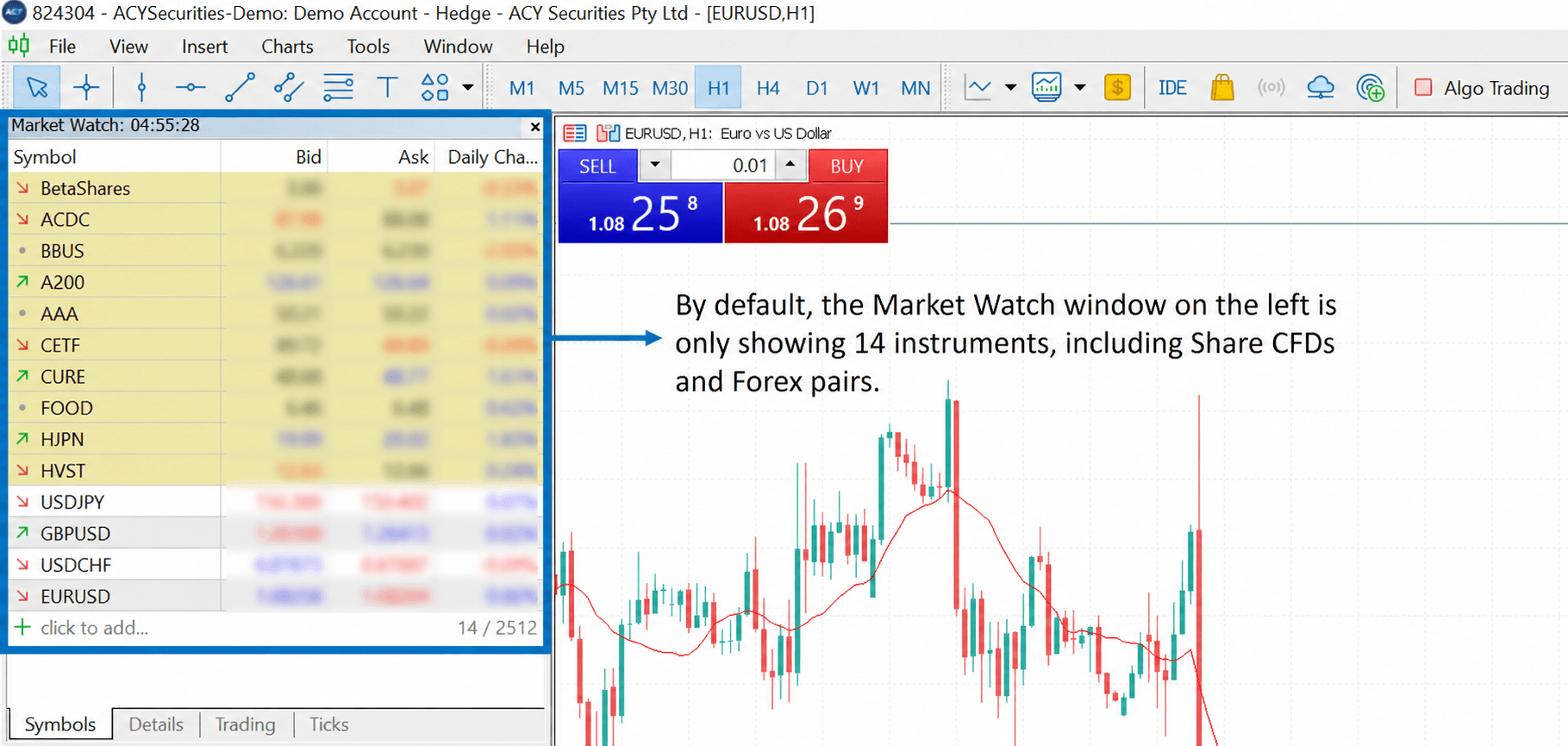
You can execute trades using diverse order types, including immediate market execution and various pending orders that trigger at specific price levels. Essential risk management functions, such as Stop Loss (SL) and Take Profit (TP), are seamlessly integrated into the order ticket interface.
For traders exploring algorithmic trading, the platform utilizes MQL4 or MQL5 languages to run automated scripts known as Expert Advisor (EA), and also supports a community marketplace for copy trading signals. While an EA can execute a complex strategy autonomously, remember that automation does not guarantee profits, and past performance does not predict future results.
Does MetaTrader provide real-time market data and prices?
MetaTrader can display real-time market prices, but the data is supplied through your broker rather than by MetaQuotes as one universal price feed. The platform connects to the broker's trading server, which determines the instruments, quotes and other market information displayed in your account.
As a result, MetaTrader users at different brokers may see differences in:
- available financial instruments;
- bid and ask prices;
- spreads and trading costs;
- market depth and other available data.
The same principle applies to trade execution and account conditions. MetaTrader provides the technological interface, while the broker determines the market offering and trading environment available to you.
How do you get access to the MetaTrader platform?
You do not buy MetaTrader directly from the vendor — the platform is provided by a broker, which offers it to its clients together with market access. MetaQuotes solely functions as the software developer, completely detached from holding client funds or routing market orders. Therefore, learning how to choose a broker remains a separate, critical step before utilizing the platform.
Once registered with a provider, you can access the interface through multiple channels, including a standalone desktop client, a web browser version, or dedicated mobile apps for iOS and Android. Beginners typically start by downloading the software to practice on a demo account before transitioning to a live environment with real capital.
Is MetaTrader safe and suitable for beginners?
MetaTrader is a legitimate trading platform developed by MetaQuotes, but the safety of your funds depends primarily on the broker you use. MetaTrader provides the software for market analysis and order execution, while the broker manages your trading account, holds client funds, and provides access to financial instruments. For this reason, the broker's regulatory status and applicable client protections should be assessed separately from the platform itself.
MetaTrader can also be used by beginners, although some features require time to learn. A demo account allows you to explore charts, indicators, and order types using simulated funds before considering live trading. However, demo results may differ from live trading conditions, and knowing how to operate the platform does not remove risks related to leverage, volatility, or financial losses.

FAQ
FAQ
MetaTrader is a trading platform developed by MetaQuotes for analyzing financial markets and placing trades through a connected broker. It combines charting, technical analysis, order management, and automated trading tools.
Its main features include:
interactive price charts and technical indicators;
market and pending orders;
automated trading with Expert Advisors (EAs);
account and position management.
MetaTrader itself does not provide brokerage services or hold client funds. Market access, instruments, prices, fees, and execution conditions are determined by the broker.
No. MetaTrader is trading software, not a broker. MetaQuotes develops the platform, while brokers provide trading accounts, market access, prices, and order execution.
This means spreads, commissions, available instruments, and other trading conditions depend on the broker you use.
MetaTrader 4 (MT4) was designed primarily for forex trading, while MetaTrader 5 (MT5) is a newer multi-asset platform with broader functionality.
Key differences include:
Markets: MT5 has broader support for stocks, futures, and other assets where offered by a broker.
Timeframes: MT5 has 21, compared with nine in MT4.
Tools: MT5 adds features such as Depth of Market and an economic calendar.
Programming: MT4 uses MQL4, while MT5 uses MQL5.
The instruments available on either platform ultimately depend on the broker.
Yes, you can trade stocks on MetaTrader 5 if your broker offers them. MT5 supports a wider range of financial instruments, but this does not mean every broker provides access to all of them.
Some brokers may offer only forex and CFDs, while others may provide stocks, ETFs, futures, or other instruments.
Yes. MetaTrader supports automated trading through programs called Expert Advisors (EAs). MT4 uses MQL4, while MT5 uses MQL5 to create EAs, custom indicators, and scripts.
Automated trading can execute predefined rules without manual intervention. However, it does not eliminate investment risk or guarantee profits, and past or backtested performance is not a reliable indicator of future results.
MetaTrader can be suitable for beginners, although some of its advanced features have a learning curve. Demo accounts allow users to explore the platform and practice without risking real money.
Beginners can use a demo account to learn how to:
read and customize price charts;
use technical indicators;
place and manage orders;
monitor positions and account information.
Understanding the platform does not replace learning about risk, leverage, margin, and financial markets.
Yes. MetaTrader is available on mobile devices, desktop computers, and through a web browser. Mobile apps for iOS and Android provide charting, market monitoring, and trade-management functions.
Desktop versions generally offer more extensive options for customization, analysis, and automated trading.
MetaTrader is generally free for retail traders to download and use. However, trading itself can involve costs determined by the broker.
These may include spreads, commissions, overnight financing charges, or other account- and instrument-specific fees.
Yes, MetaTrader can display real-time market data, but the data comes through your broker rather than from a universal MetaQuotes feed.
Prices, spreads, available instruments, and market depth can therefore differ between brokers and account types.
MetaTrader 5 is the newer platform with broader functionality, but MetaTrader 4 is still used by many traders and brokers. MT5 offers a multi-asset architecture and more advanced trading and analytical tools.
MT4 remains established particularly in forex trading, with a large ecosystem of indicators and Expert Advisors. The better choice depends on the markets, features, and broker support a trader needs.
You can install MetaTrader without a live brokerage account, but you need a connection to a trading server to access relevant market data and execute live trades.
A demo account can be used to explore the platform in a simulated environment. Real-money trading requires an appropriate account with a supporting broker.
No. MetaTrader does not guarantee successful or profitable trading. It provides analysis, order execution, and automation tools, but trading results depend on factors such as market conditions, strategy, execution, and risk management.
Technical indicators, Expert Advisors, and backtests cannot reliably predict future results. Past or simulated performance is not a reliable indicator of future performance, and trading involves the risk of loss.