



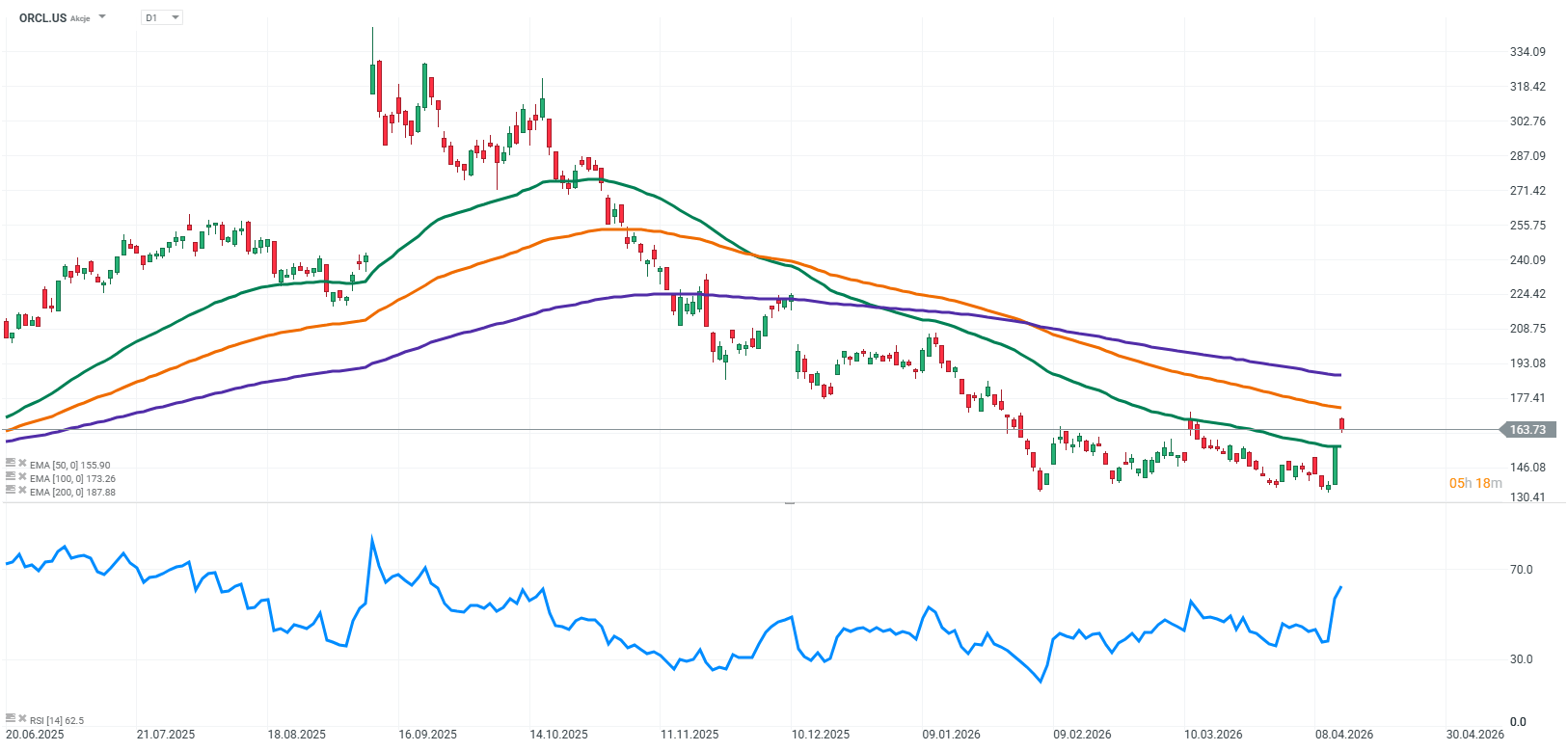
Today’s market developments point to a very clear trend. The growth of artificial intelligence is no longer just a story about new models or chips, but increasingly about whether all of this can actually be powered. Oracle has expanded its partnership with Bloom Energy and plans to use up to 2.8 GW of capacity for its AI data centers, with around 1.2 GW already secured and under deployment. The market reacted immediately, with both Oracle and Bloom Energy seeing notable gains.
Why this deal matters
What really stands out here is that Oracle is no longer just investing in AI technology, but securing something far more fundamental — energy. Until recently, the main bottlenecks were processors and computing power. Now, the limiting factor is increasingly basic electricity availability and the ability to quickly connect new data centers to the grid.
Bloom Energy offers a solution through localized power systems that can be deployed faster than traditional power plants or grid expansion. This allows Oracle to scale its AI infrastructure without waiting years for energy infrastructure to catch up.
Market reaction
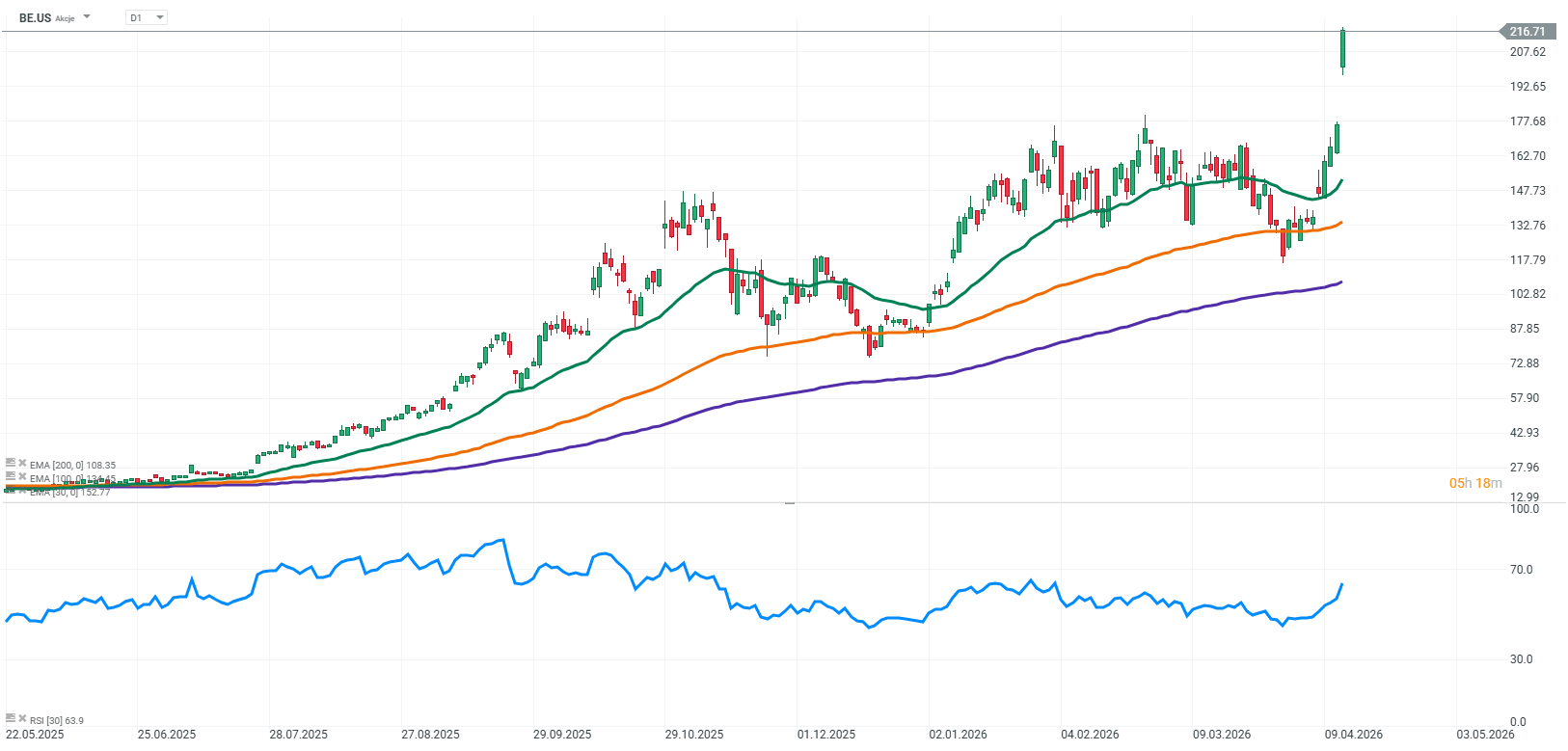
Investors responded very positively to the news.
Source: xStation5
Bloom Energy has emerged as one of the biggest beneficiaries of this story. Its shares are rising sharply as investors begin to see the company not as a traditional energy player, but as a provider of critical infrastructure for the AI boom. In practice, this suggests the potential for many more similar contracts with large technology companies.
Source: xStation5
What this says about the AI market
The most important shift visible here is a change in the center of gravity of the AI story. Not long ago, the key question was who had the best models and the most GPUs. Now it is becoming increasingly clear that the real constraint is physical infrastructure, including energy, cooling, and the ability to build massive data centers.
In this context, Bloom Energy is no longer viewed as a typical energy company, but rather as a provider of the essential “tools” that enable the entire AI ecosystem to function.
What this means for Oracle
For Oracle, this is a strategic move rather than just a business contract. The company is securing access to power, which could ultimately determine how quickly it can expand its data centers and serve cloud customers.
In practice, Oracle is trying to build an advantage not only in technology, but also in infrastructure. In today’s AI landscape, that is increasingly important, as the winners will be those who can deliver everything at once, including models, hardware, and energy.
Risks and the bigger picture
Despite the positive market reaction, there are also risks to consider. Bloom Energy will need to scale production and execute large infrastructure projects, which is neither simple nor cheap. At the same time, current valuations already assume continued strong growth in demand for AI-related energy.
In the short term, momentum remains strong and the market may continue to trade this narrative. Over the longer term, the key question is whether such contracts become the norm across the industry or remain isolated large-scale deals.
Key takeaways
This situation clearly shows that AI is entering a new phase. It is no longer just a technological race, but increasingly an infrastructure race. The biggest constraint is no longer ideas or algorithms, but very real factors such as electricity and the ability to deliver it where data centers are being built. Oracle is securing its future growth, while Bloom Energy is emerging as one of the quiet beneficiaries of the AI boom, because without companies like it, that growth simply would not be possible.


Market wrap: European indices rebound 🔼 Defence stocks on the rise


TSMC in Talks with Elon Musk Over Terafab


Daily summary 📈 Precious metals and stock indices rebound as Treasury yields fall


US Open: Nasdaq 100 extends losses 🚩 AI stocks under pressure, CoreWeave falls 8%