



Amazon has spent years convincing investors that it can simultaneously expand its e-commerce business, scale its advertising operations, and build one of the most profitable cloud businesses in the world. However, today’s earnings release may show that the market has started looking at the company through a completely different lens. The focus is no longer only on revenue growth rates or even profit levels. The increasingly important question is whether the hundreds of billions of dollars invested in data centers and AI infrastructure are beginning to generate measurable returns.
AWS remains Amazon’s main engine of growth and profitability. The consensus expects the segment’s revenue to increase by approximately 31% year over year, reaching $40.57 billion. This would represent growth significantly above the overall company level and provide further confirmation that cloud computing remains Amazon’s most important profitability pillar.
This time, however, strong growth alone may not be enough. Investors will compare AWS results with Microsoft Azure and Google Cloud performance while looking for answers as to whether rising AI infrastructure spending is translating into real demand and future revenue growth.
One more theme will dominate the entire report: massive capital expenditures. Amazon is significantly increasing spending on data centers, servers, and infrastructure required for AI development. The consensus expects approximately $52.5 billion in CapEx in the third quarter and more than $200 billion for the full year.
The scale of these investments is enormous. The market will therefore not only focus on how much Amazon plans to spend, but above all on whether these expenditures are translating into stronger demand, better utilization of data centers, and future revenue growth.
Today’s results will therefore test two things: the strength of AWS and Amazon’s ability to transform massive AI investments into real economic returns.
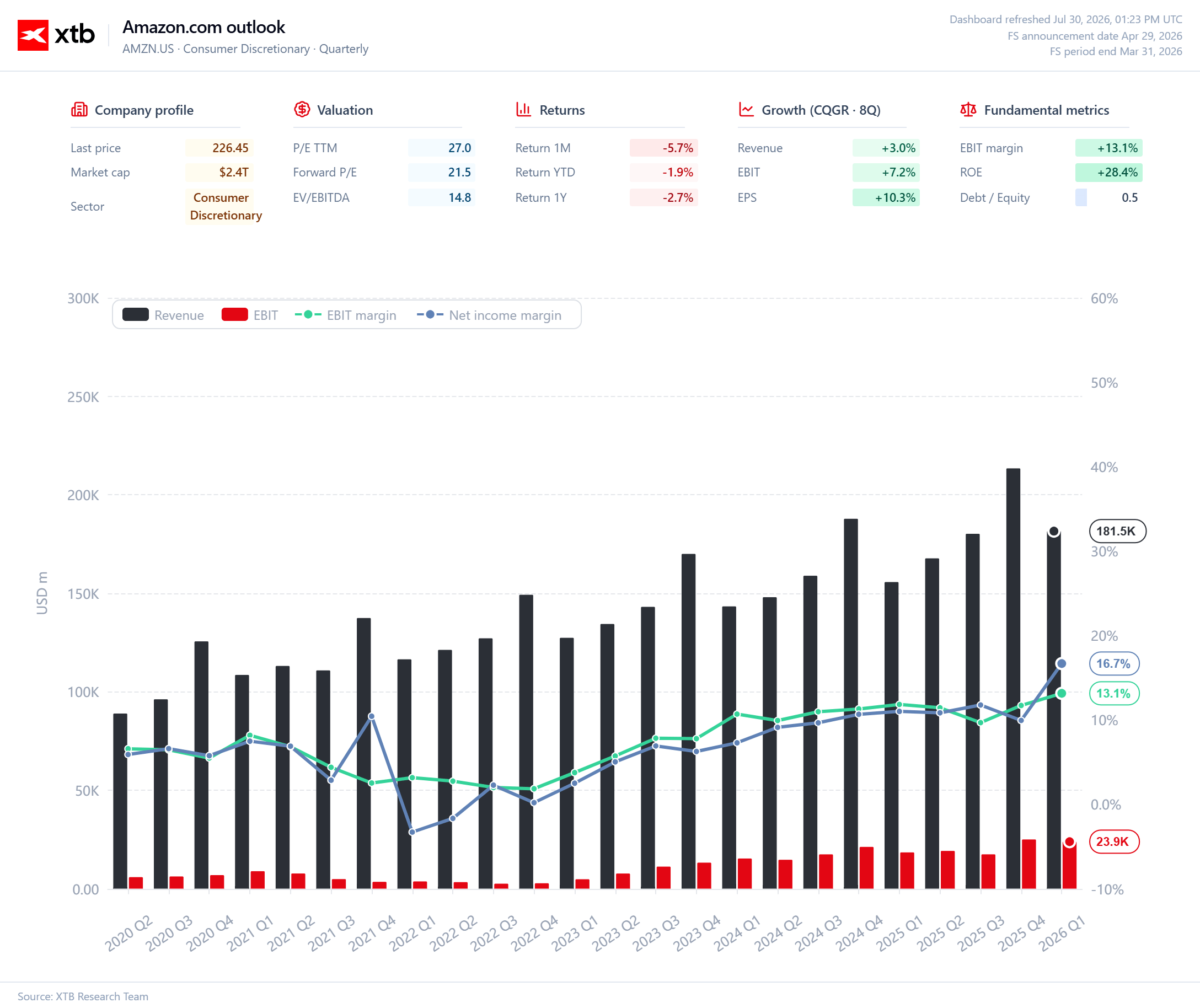
Key Financial Expectations
-
Total company revenue: $197.01 billion
-
Total company revenue growth: approximately 18% year over year
-
AWS revenue: $40.57 billion
-
AWS revenue growth: approximately 31.3% year over year
-
Online stores revenue: $69.92 billion
-
Physical stores revenue: $5.87 billion
-
Third-party seller services revenue: $46.15 billion
-
Advertising revenue: $19.32 billion
-
Subscription services revenue: $13.75 billion
-
North America revenue: $113.95 billion
-
International revenue: $42.71 billion
-
EPS: $1.83
-
Operating income: $23.61 billion
-
Operating margin: 12%
Forward Guidance
-
Expected third-quarter revenue: $203.93 billion
-
Expected third-quarter operating income: $25.07 billion
-
Estimated third-quarter CapEx: $52.46 billion
-
Estimated full-year CapEx: $200.53 billion
AWS Remains the Heart of Amazon’s Profits
Amazon today is much more than an e-commerce company. Online stores still generate the largest share of revenue, but AWS remains the key driver of profitability growth.
The consensus expects AWS revenue of $40.57 billion, representing approximately 31% year-over-year growth. This would be significantly higher than overall company growth and another confirmation that demand for cloud services remains very strong. AWS growth is particularly important because the cloud segment generates significantly higher margins than traditional e-commerce operations. Each additional dollar of AWS revenue can therefore have a greater impact on operating profit than additional sales generated by Amazon’s retail business.
For Amazon, AWS is simultaneously a growth engine, a source of profitability, and the foundation of its artificial intelligence strategy. Through AWS, the company provides customers with access to computing power, infrastructure, and services needed to build and deploy AI solutions.
If segment growth remains around 31%, Amazon will demonstrate that rising investments in data centers are responding to real demand. However, if growth turns out to be weaker, the market may begin questioning whether the scale of investment is moving ahead of Amazon’s ability to monetize it effectively.
AWS Will Be Compared With Microsoft and Alphabet
AWS results will not be analyzed in isolation from competitors. Microsoft and Alphabet are also increasing spending on data centers and AI infrastructure.
All three companies are competing for customers that require increasing amounts of computing power for model training, data processing, and deployment of artificial intelligence tools. Therefore, today’s report will also serve as a test of AWS’s position relative to Azure and Google Cloud. If AWS delivers growth in line with or above consensus expectations, the market may conclude that Amazon is still successfully benefiting from global cloud demand growth.
However, if competitors are growing faster, questions will emerge regarding customer acquisition pace, infrastructure availability, and AWS’s ability to maintain its competitive advantage. In the current investment cycle, the question is no longer simply who owns the largest data centers. Increasingly important is who can best utilize rising demand and transform infrastructure into durable revenue streams.
AWS has enormous scale, a broad customer base, and an extensive product offering. Today’s results will show whether these advantages translate into sufficient growth momentum to maintain its leadership position.
AI Is More Important Than CapEx Scale
Amazon no longer needs to convince the market that it intends to invest enormous amounts of capital. The consensus expects approximately $52.5 billion in capital expenditures in the third quarter and more than $200 billion for the full year. These are levels that would have seemed almost impossible to imagine just a few years ago.
Today, however, the announcement of high CapEx spending alone is no longer the biggest surprise.
Investors understand the scale of the race for AI infrastructure. They know that data centers, servers, and advanced computing systems require massive investment. The most important question is therefore not how much Amazon will spend.
The much more important question is whether these investments are beginning to generate returns.
The market will be looking for information regarding:
-
Growth in demand for AI services within AWS
-
Utilization of newly built data centers
-
Availability of computing capacity
-
The pace of customer acquisition
-
Development of Amazon’s own chips
-
The impact of AI on future revenue growth and margins
If management shows that new capacity is being quickly adopted by customers, high investment levels may be viewed as a strategic investment in future growth.
However, if spending continues to rise without a clear acceleration in revenue growth, the market may begin focusing on pressure on free cash flow.
Custom Chips Could Improve AWS Economics
One of the areas investors will be watching closely is the development of Amazon’s own chips.
Internally developed processors and AI-focused chips could allow Amazon to reduce dependence on external suppliers, better customize infrastructure for customer needs, and lower the cost of providing cloud services.
Over the long term, proprietary chips could also improve AWS margins. If Amazon can provide competitive computing power at a lower cost, it may be able to increase margins or offer customers more attractive pricing. However, the market will need concrete evidence regarding the adoption of these solutions. The mere presence of proprietary chips in AWS’s offering will not be enough.
The key question will be whether customers are actually increasing their usage of Amazon’s own chips and whether the company can use them to build a competitive advantage against rivals.
E-commerce Still Generates the Largest Revenue
Although AWS attracts the most attention from investors, Amazon’s core retail business remains the company’s largest source of revenue.
The consensus expects approximately $69.9 billion in online store sales and $46.2 billion in revenue from services provided to third-party sellers.
The second segment is particularly important for the quality of Amazon’s results.
Third-party seller services include commissions, logistics, and other solutions offered to businesses using Amazon’s marketplace. Growing participation from third-party sellers allows Amazon to expand its business without having to finance the entire inventory itself.
The consensus expects third-party sellers to account for approximately 60.2% of unit sales. This demonstrates how much Amazon has transformed from a traditional retailer into a broad-based services platform.
Advertising remains another important pillar.
Expected revenue of approximately $19.3 billion shows that Amazon is becoming increasingly effective at monetizing the traffic generated by its platform.
In this way, Amazon’s e-commerce ecosystem is no longer only about selling products. It is also creating higher-margin revenue streams connected with advertising, logistics, and seller services.
Guidance May Matter More Than the Q2 Results
The consensus expects Amazon’s second-quarter revenue to increase by approximately 18% year over year, reaching $197.01 billion.
This represents very strong growth, but the market expects the company’s overall growth rate to moderate in the current quarter.
Third-quarter revenue expectations stand at approximately $203.93 billion, meaning investors will pay particular attention to management’s outlook.
The second-quarter results will show what happened over the past few months. Guidance will show how Amazon views demand, sales trends, and growth momentum in the coming months.
If the outlook is strong, the market may conclude that the slowdown is smaller than currently expected.
However, if management provides cautious guidance, investor attention may quickly shift from very strong AWS results toward concerns about weaker overall growth.
Margins Remain Strong, but Cash Flow Could Come Under Pressure
The consensus expects operating income of approximately $23.6 billion and an operating margin of 12%.
In the third quarter, operating income is expected to increase to approximately $25.1 billion. Operational fundamentals therefore remain very strong.
Amazon has improved profitability across many segments, and the growth of AWS, advertising, and seller services is increasing the share of higher-margin businesses within the company’s results.
The challenge is that strong operating income does not automatically translate into equally strong free cash flow.
With annual CapEx exceeding $200 billion, a significant portion of generated cash may be reinvested into data centers and AI infrastructure.
Therefore, today’s report will also be a test of the quality of Amazon’s growth.
Amazon may show strong revenue growth and rising profits, but investors will want to know how much cash remains after financing record levels of investment.
AWS Growth and AI Demand Will Determine the Market Reaction
If AWS continues to grow rapidly and demand for AI services accelerates significantly, the market may accept pressure on free cash flow caused by elevated investment levels.
However, if CapEx remains extremely high without a corresponding increase in revenue growth, investors may conclude that the return on investment is still too far away.
The key issue is not whether Amazon can afford to invest at this scale. The company has the financial strength, market position, and operational capabilities to continue expanding its infrastructure.
The key issue is whether these investments are creating a foundation for future earnings growth.
The current AI investment cycle is different from previous technology spending cycles. Companies are not simply investing in additional capacity. They are building infrastructure that could become the backbone of future digital services, enterprise applications, and artificial intelligence platforms.
For Amazon, AWS is at the center of this transformation. The company must demonstrate that its infrastructure investments are not only increasing available computing capacity but are also generating higher customer demand, stronger revenue growth, and improved profitability.
Three Possible Scenarios
Positive Scenario
The positive scenario assumes a clear beat on consensus expectations, AWS growth above forecasts, and strong guidance for the third quarter. Additional catalysts would include information confirming increasing demand for AI services, high utilization rates of data centers, and progress in developing Amazon’s proprietary chips. In this scenario, even extremely high CapEx spending could be viewed positively. The market would conclude that Amazon is investing in response to real demand and building infrastructure capable of generating future revenue growth. Investors would likely focus on the long-term opportunity rather than short-term pressure on free cash flow.
Neutral Scenario
The neutral scenario assumes results broadly in line with consensus expectations, solid AWS growth, and no major new information regarding returns on AI investments. Such a report would confirm strong fundamentals but may not be enough to trigger a clearly positive market reaction, especially given the extremely high expectations surrounding CapEx spending. The company would demonstrate stability and continued execution, but investors may still wait for clearer evidence that AI investments are producing measurable economic benefits.
Negative Scenario
The negative scenario includes weaker AWS growth, cautious third-quarter guidance, and continued increases in spending without clear evidence of monetization. In this case, the market could focus on the risk of slower growth and increasing pressure on free cash flow. Investors may begin questioning whether Amazon is investing too aggressively ahead of actual customer demand.
Amazon Faces a Test of AI Monetization
Amazon has a very strong fundamental position.
AWS is growing faster than the overall company and remains the primary source of earnings growth. Advertising and third-party seller services are increasing the share of more profitable businesses, while operating margins remain strong.
Today’s report will provide answers to several key questions:
-
Can AWS maintain growth of around 31%?
-
How does AWS growth compare with Azure and Google Cloud?
-
Is demand for AI services accelerating?
-
How quickly are new data centers being utilized?
-
Are Amazon’s proprietary chips increasing customer interest?
-
Will Amazon increase its investment spending forecasts?
-
How will high CapEx affect free cash flow?
-
Will Prime Day confirm consumer resilience?
-
Will third-quarter guidance exceed expectations?
Amazon may deliver very strong results today. However, to convince the market, AWS will need to prove that expanding AI infrastructure is responding to real demand and that massive CapEx spending is beginning to create the foundation for future revenue growth
Source: xStation5



Three markets to watch next week (23.10.2026)



Daily Summary: Oil at five-month highs, indices under pressure (23.10.2026)

US Open: Further declines on Wall Street, Brent above 111 USD, AI correction continues (14.10.2026)



Morning Wrap: AI profitability concerns spark market Sell-Off