



Oil prices have reacted with a sudden, sharp rise to Trump’s statement on the reinstatement of the ‘Iranian blockade’ and the US’s new role as a paid ‘guardian’ of the Strait of Hormuz – the market has immediately priced in the geopolitical risk, even though the flow of goods itself is formally to be maintained.
What Trump said
The US President announced on Truth Social that the Strait of Hormuz “is and will remain open, with or without Iran”, whilst reinstating a blockade targeting solely Iranian ships and customers. The new development concerns the funding model – the US is now to be the formal “Guardian of the Strait of Hormuz” and will levy a 20 per cent fee on the value of all cargo transported through the strait in exchange for protection.
The oil market’s reaction
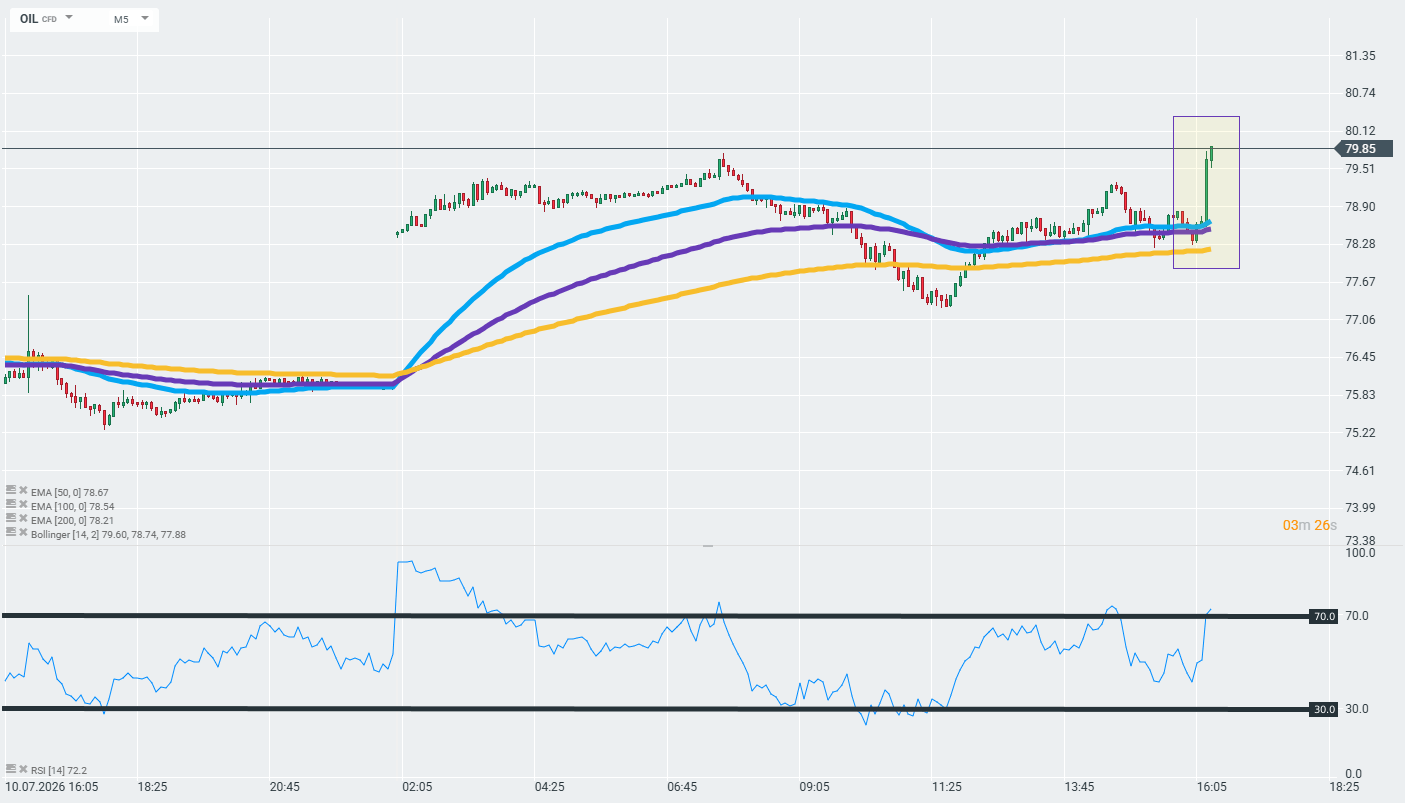
The OIL CFD chart on the M5 timeframe shows a classic ‘news spike’ – the candlestick shoots sharply upwards from around USD 78.3 to USD 79.85, breaking through all three EMAs (50/100/200) almost in a single move. The RSI (14) jumped to 72.2, entering overbought territory, which confirms that the move was very rapid and emotional – typical of a reaction to geopolitical news.
It is worth bearing in mind the context of recent months – the market has already reacted in a similar way on numerous occasions to Trump’s statements regarding the Strait of Hormuz; for example, in April, WTI crude jumped by 8% to over $104 following the announcement of a blockade of Iranian ports, and in July, Brent tested the $80 mark after the truce with Iran was broken. History shows that such movements tend to be short-lived if the actual flow of oil through the strait is not genuinely disrupted.
Why is this important for the market?
-
The Strait of Hormuz accounts for around 20 per cent of global oil trade, so even a hypothetical risk to its throughput pushes up the uncertainty premium in the price.
-
This new measure – a 20 per cent ‘toll’ on cargo – sets a precedent that could increase logistics costs and freight rates; the market is partly pricing this in as a rise in the cost of transporting oil, not just as a risk to supplies.
-
The key question for the next steps: will Iran accept the role of an ‘excluded’ player without a military response, or will it view this as a further escalation and take retaliatory action in the region?


Daily Summary: Oil at five-month highs, indices under pressure (23.10.2026)


US Open: Further declines on Wall Street, Brent above 111 USD, AI correction continues (14.10.2026)


Chart of the Day: Is USDJPY running out of road? Inflation forces the BoJ to act, but the Fed could spoil the Yen’s rally



Macro Calendar: Preliminary PMI Readings and Earnings Ahead