



US Challenger Layoffs: 71.321k (Previous 153.074k). The USDIDX continue to slide today, but gains slightly after the Challenger report.
The November Challenger report paints a mixed picture of the U.S. labor market: moderating layoffs on the surface, but historically elevated levels beneath the headline. Despite a sharp 53% month-over-month decline, job cuts remain far above long-term norms and signal that corporate America is still bracing for economic and structural adjustments.
Job Cuts Declined in November — But Stay Historically High
-
November layoffs fell by 53% from October’s unusually high 153,074 cuts.
-
Even after the drop, November still marked the highest November total since 2022 and the 8th month this year in which layoffs exceeded year-ago levels.
-
Historically, layoffs in November rarely surpass 70,000 — this has happened only twice since 2008.
The decline is encouraging, but the broader trend remains elevated, reflecting lingering economic uncertainty and cyclical softening across key industries.
Year-to-Date Cuts Reach the Highest Since the Pandemic
-
Employers have announced 1.17 million job cuts through November — up 54% YoY.
-
This is the highest YTD tally since 2020, and only the 6th time since 1993 that cuts have surpassed 1.1 million by November.
-
Historically comparable periods occurred during recession years: 2001, 2002, 2009, and 2020.
Although the U.S. economy has avoided recession so far, the scale of layoffs resembles early recessionary dynamics, with companies acting pre-emptively to protect margins.
Industries Leading the Layoff Wave
Several sectors are undergoing significant restructuring:
• Telecommunications: +268% YoY
-
15,139 cuts in November, largely from Verizon — the worst month since early 2020.
-
YTD total: 38,035 cuts.
• Technology Remains the Top Private-Sector Job Cutter
-
12,377 cuts in November; YTD: 153,536 (+17% YoY).
-
Reflects continued cost discipline, redundancy elimination, and AI-driven restructuring.
• Retail: +139% YoY
-
Workforce reductions driven by softening consumer demand, tariff uncertainty, and shifts in shopping behavior.
• Non-profits: +409% YoY
-
Severely impacted by federal funding cuts and reduced charitable giving.
• Food Sector (Beef Processors): +26% YoY
-
Continues to adjust capacity amid changing agricultural and consumer trends.
Restructuring pressures are broad-based, impacting both cyclical industries (retail, food) and structural ones (tech, telecom, nonprofits).
Why Are Companies Cutting Jobs?
The top drivers of layoffs reveal both cyclical and structural pressures:
-
Restructuring: 20,217 cuts in November; YTD: 128,255.
-
Closings (stores, units, departments): 17,140 in November; YTD: 178,531.
-
Market/Economic Conditions: 15,755 in November; YTD: 245,086.
-
Artificial Intelligence:
-
6,280 cuts in November.
-
54,694 cuts YTD attributed directly to AI automation — a trend accelerating since 2023.
-
-
DOGE (Department of Government Efficiency):
-
293,753 cuts YTD — the single largest reason overall.
-
Additional 20,976 cuts from indirect funding losses (“Downstream Impact”).
-
A notable share of layoffs is being driven by policy-driven and technology-driven factors rather than pure economic weakness, suggesting deeper shifts in workforce composition.
Hiring Plans Hit the Lowest Level in Over a Decade
-
Companies announced 497,151 planned hires through November, down 35% YoY.
-
This is the weakest hiring outlook since 2010.
-
Seasonal hiring also fell to the lowest level since tracking began in 2012, with no new November seasonal hiring announcements.
Companies are not only reducing headcount — they are slowing future hiring as well. This combination often precedes broader labor-market softening.
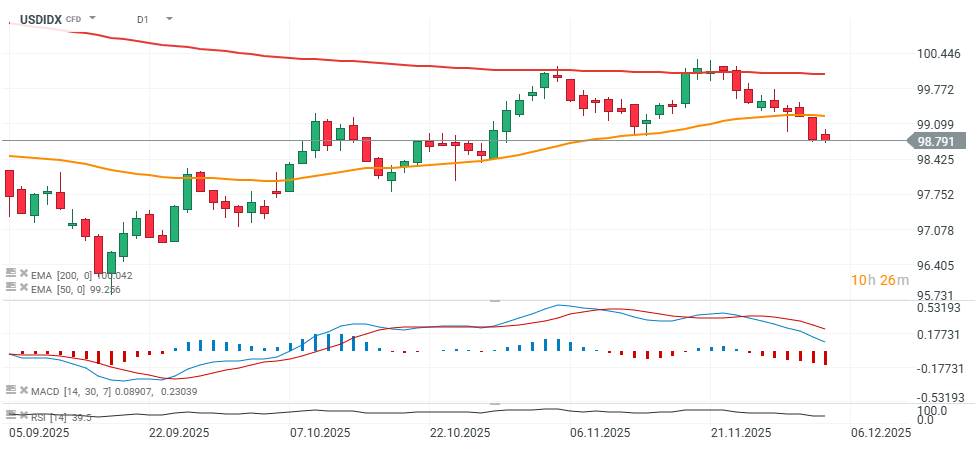
Source: xStation5



US CPI above expectations!🔥📈


Dollar in Limbo Ahead of CPI 🚨

Morning wrap 🗽 Wall Street looks to rebound ahead of US CPI as ASML results weigh on sentiment (14.10.2026)



Economic Calendar - Start of Wall Street Earnings Season, Hawkish RBA, and Middle East Tensions (13.10.2026)