



The USD/JPY market is currently in a transitional phase between the end of the previous zero interest rate regime and the early phase of normalization. After the sharp volatility episodes of 2024, triggered by the Bank of Japan's shock exit from ultra-dovish policy and partial unwinding of carry trade, the market in 2025 has shifted to a mode of selective risk acceptance. The exchange rate is no longer moving on impulses but within a structural trend, where investors cautiously test the limits of Japanese policymakers' tolerance for yen weakness.
Recent weeks have seen an increase in volatility, with relatively small price movement ranges. This is a classic symptom of a market that has stopped reacting linearly to interest rate differentials alone and has started pricing in related risks such as Japan's fiscal policy, the credibility of the BOJ's normalization process, or potential currency intervention risks. Investors no longer question the fact of being on the path of monetary policy normalization in Japan, but increasingly assume that it will be bumpy due to Japan's structural problems.
USD/JPY remains high, but the upward trend has lost momentum. Every attempt to break upwards is met with caution due to political and intervention risks, while declines are shallow because the carry trade structure has not been fully dismantled.
Technically, the exchange rate remains above the EMA50, 100, and 200, confirming the medium-term upward trend. At the same time, the slope of these averages is beginning to flatten, signaling a loss of momentum. Bollinger Bands are narrowing after previous expansion, indicating a phase of volatility compression before the next directional move. RSI oscillates near the neutral level, without overbought signals. MACD remains positive, but the histogram is weakening, which confirms conclusions from the EMA structure.
USDJPY (D1)
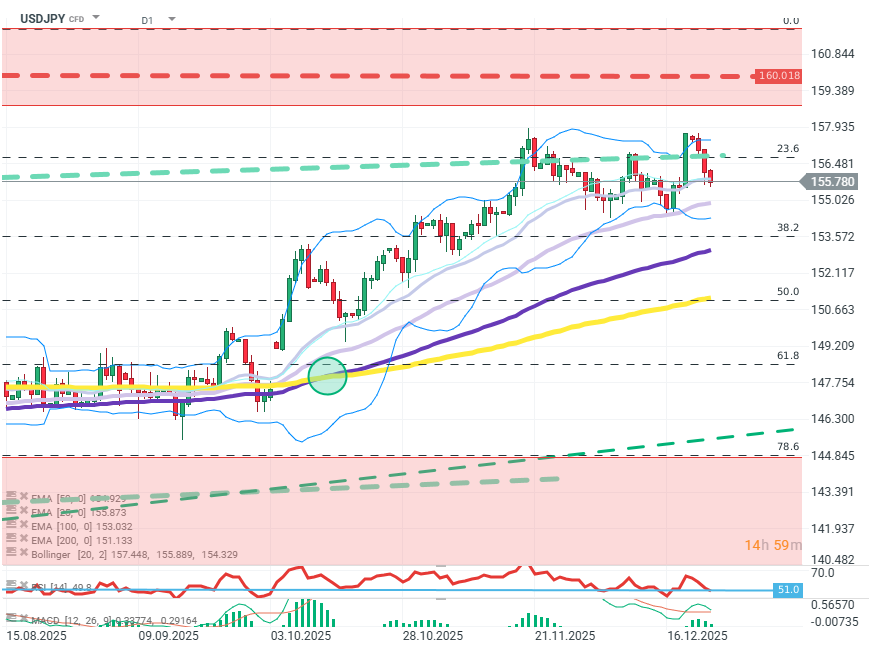
Source: xStation5



Daily Summary: New Records on Wall Street. Markets Await the New Earnings Season


US Open: Wall Street Pushes Back Expectations of Another Fed Hike



Oil falls below $100🚨

Daily Summary: Yields at their highest since 2002, yet Wall Street is still rising🚨