



- CME reported record volumes average daily volume (ADV) in March reached 41.1 million contracts (+33% YoY), while the full first quarter averaged 36.2 million (+22% YoY), confirming strong demand for risk-hedging instruments.
- Activity increased across all major segments, including interest rate, commodities, and U.S. Treasury contracts, where open interest reached record levels.
- UBS raised its Q1 2026 EPS forecast to $3.38 (vs. $3.29 previously and $3.16 consensus), pointing to higher transaction revenues driven by rising volumes.
- At the same time, UBS maintains a Neutral rating and a $310 price target (around current levels), suggesting limited upside at current valuations.
- The bank notes that although volumes remain high, pricing pressure (including discount structures and product mix) is partly limiting revenue growth.
- UBS believes the current environment is supportive for results, but peak activity may already be behind us, implying tougher comparisons in the coming quarters.
- As a result, UBS prefers companies less dependent on volume-driven dynamics, which underpins its cautious stance on CME.
- Despite this, CME remains a strong momentum stock - shares are up approximately 14% YTD, despite the S&P 500 falling over 10% and nearly 20% in the past six months.
- Meanwhile, Raymond James maintains a more positive stance (Outperform), citing weakness in the competing FMX platform as a supportive factor for CME.
- Operational incidents remain a negative factor, including the temporary suspension of trading in metals and gas markets, which the company is still analyzing.
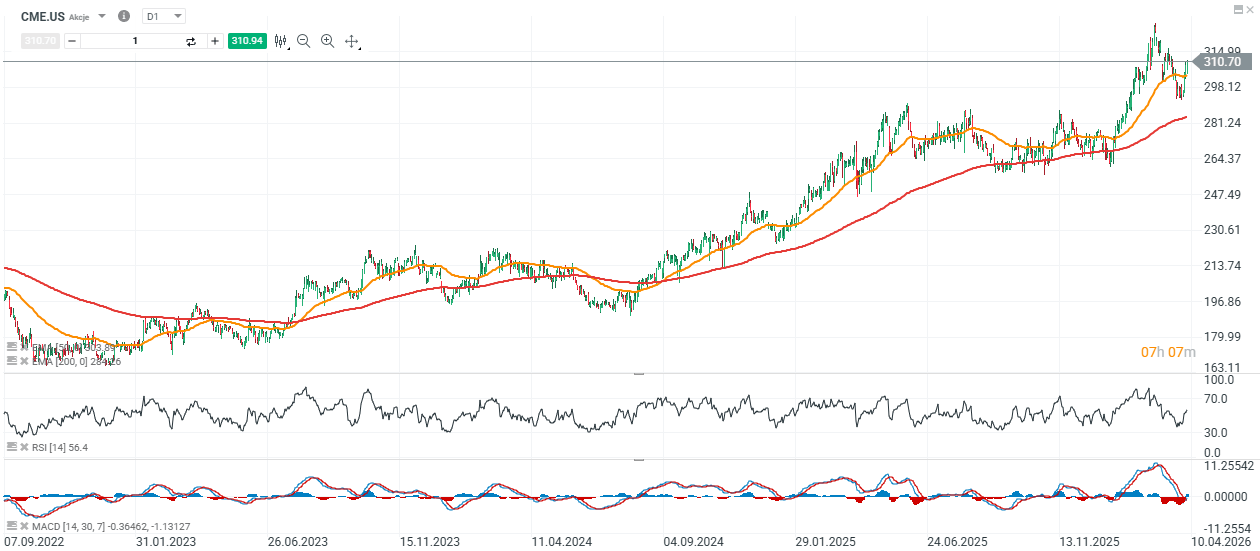
CME Group shares (CME.US, D1 interval)
CME Group remains a high-quality beneficiary of market volatility, although according to UBS, further upside potential is limited as favorable operating conditions have largely been priced in. The company benefits from record trading volumes in U.S. Treasuries, aggressive hedging activity in the S&P 500, and business diversification, while maintaining a near-monopolistic position across several large markets. Investors view it as a defensive stock with a high-quality business, strong management, and a strategy that effectively capitalizes on market uncertainty. From a technical perspective, the uptrend appears intact, although the stock may face short-term resistance — particularly around the $315–320 range. Key support currently stands near $280, where the 200-day EMA (red line) is located.
Source: xStation5



US Open: Further declines on Wall Street, Brent above 111 USD, AI correction continues (14.10.2026)



Morning Wrap: AI profitability concerns spark market Sell-Off



Daily Summary: Valuations Under Pressure, Capital Moves Away From Technology

US OPEN: Earnings misses and rising oil push indexes lower