



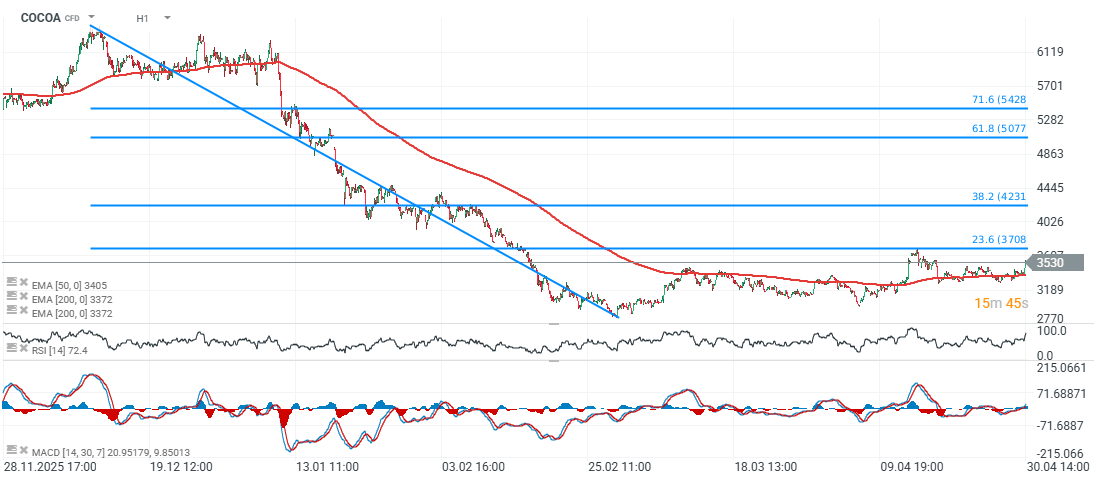
Cocoa futures on ICE (COCOA) are surging more than 4% today, rebounding from the local lows. Recent World Bank headlines suggesting a 50% collapse in cocoa prices in 2026 have sparked understandable concern across producing countries and among market participants. However, from a commodities market perspective, this interpretation reflects a misreading of base effects rather than a forward-looking signal of further downside. A closer look at price dynamics, positioning, and fundamentals suggests that the bulk of the correction is already behind us, and current levels are closer to a cyclical floor than the start of a new leg lower.
The correction has already played out
The cocoa market has undergone one of the most aggressive mean-reversion phases in recent commodity history.
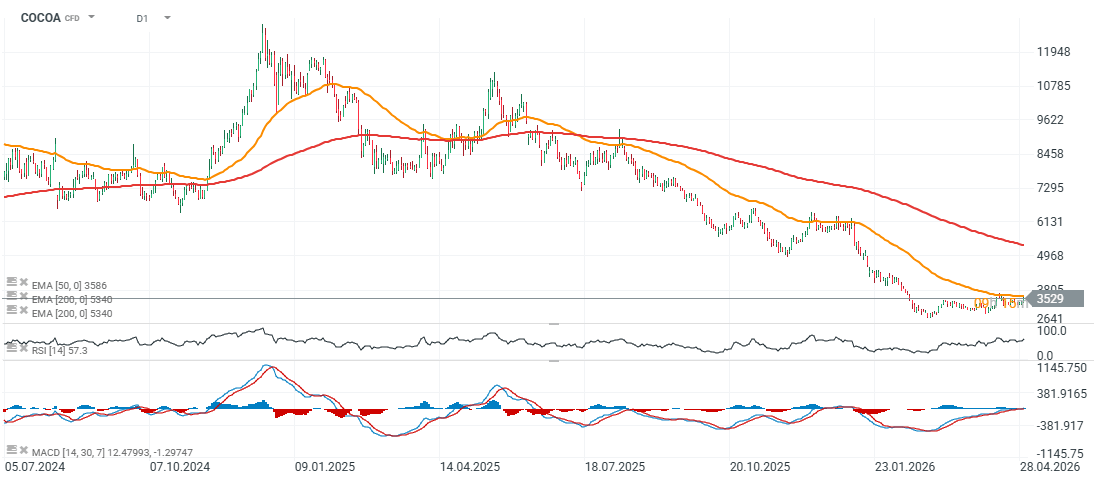
- ICE cocoa futures have declined roughly 70 - 75% from the December 2024 peak (~$12,900/t)
- Prices are currently trading in the $3,000 - $3,500 range
- Year-to-date (2026), the market is down around 40 - 45%
Against this backdrop, the World Bank’s 2026 average forecast of ~$3,800/t is not a bearish call in spot terms. It reflects a year-on-year comparison to an inflated 2025 average rather than a projection of further structural downside from current levels. The forecast describes normalization, not collapse.
Is there a floor? Evidence points to yes
From a physical market standpoint, several factors suggest that the $3,000 region is increasingly acting as a support zone. Certified exchange stocks have recently peaked and are now starting to draw down, while European grinder inventories are tightening as destocking cycles mature. Commercial positioning also indicates reduced panic hedging compared to the 2024–2025 extremes. In other words, the supply overhang that followed the price spike is being absorbed, not expanding. However, it's not guaranteed and any weather change can change the market.
Weather risk: the underestimated variable
One of the most underappreciated elements in current pricing is weather asymmetry. The World Bank itself assigns a ~60% probability of El Niño conditions in H2 2026, which has historically:
- reduced rainfall across the West African cocoa belt
- disrupted yields during critical pod development phases
This directly challenges the baseline assumptions of a +34% production recovery in Ghana and +5% in Côte d’Ivoire. Market implication: if El Niño materializes, the current surplus narrative could quickly flip into supply tightening, forcing a repricing of risk.
Demand: destruction likely near its limits
The demand side has been under pressure, but the adjustment process appears mature. Over the past 12–18 months, chocolate manufacturers have reformulated products, reduced cocoa content, and adjusted packaging and portion sizes. However, elasticity has limits. Q1 grindings in Europe and North America were weak, but incremental demand destruction is slowing. As lower prices filter through, hedging cycles reset and forward cover is rebuilt, with grindings likely to stabilize into mid-2026 and gradually recover thereafter.
The World Bank vs market consensus
It is important to contextualize the World Bank forecast within the broader analyst spectrum. The Bank sits at the bearish end of institutional estimates. Other benchmarks include J.P. Morgan’s ~$6,000/t medium-term anchor and ING’s ~$4,400–$4,600/t equivalent for 2026. Rabobank and Citigroup have revised surplus estimates downward, pointing to a tighter supply picture than the Bank’s baseline suggests. Consensus view:
- 2026 likely closes just below $4,000/t
- with upside risk into 2027 as demand normalizes and weather risks are priced in
From a commodities strategy perspective, four pillars currently define the cocoa market: weather risk (El Niño probability), inventory normalization (stocks drawing down), demand stabilization (post-reformulation plateau), and supply.
COCOA (H1, D1)
Source: xStation5
Source: xStation5



Daily Summary: Valuations Under Pressure, Capital Moves Away From Technology


US OPEN: Earnings misses and rising oil push indexes lower

Market Wrap: "Decent" results are not enough – tech stocks fall further; oil highest since May (22.10.2026)


US100 drops 1.8% 🚨